

Audio By Carbonatix
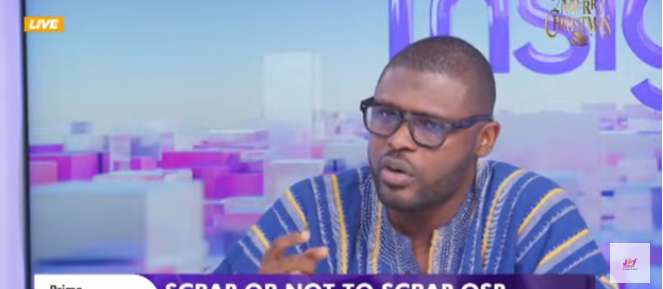
Private legal practitioner, Noah Ephraem Tetteh Adamtey, has said his challenge to the Office of the Special Prosecutor (OSP) is not about the person holding the position but about how the office was created under Ghana’s Constitution.
According to him, “My issue is with the constitution, not the individual. I have no issue with the office specifically. My interest is the constitution and what the constitution says.”
Speaking on Prime Insight on Joy Prime, Mr Adamtey explained that his writ challenging the OSP had attracted strong public reactions, even though he did not expect it to gain much attention.
“The writ I filed, which I honestly thought would just go under covers until the courts came into the public… There are quite a number of strong sentiments about it,” he said.
He said that his position is not new and has nothing to do with opposition to an independent prosecutorial body. According to him, he has held the same view for years.
“I think for me it’s a fundamental issue I’ve had since somewhere in 2016. I’ve written extensively on it on my blog and on my Facebook page on why I disagree with the procedure that was adopted to set up the OSP. A lot of people think I do not want an independent prosecutorial body, which is not really the case.”
He said his concern is rooted in Article 88 of the Constitution, which deals with prosecutorial authority in Ghana.
“When I read Article 88, my view is simply that Article 88 creates an Attorney-General. It does not create even the office of the Attorney-General,” he said, citing Supreme Court decisions such as the Martin Amidu case, where the court held that “the Attorney-General is the individual who is appointed, not the office.”
Adamtey explained that under the Constitution, the Attorney-General is a minister of state and part of the executive arm of government.
“Prosecution in this country is a purely executive function,” he said. “The constitution tells us that it is this Attorney-General who has the exclusive mandate to prosecute all crimes in the country.”
While Article 88 allows the Attorney-General to authorise another person to prosecute, Adamtey argued that the Constitution gives that power to the Attorney-General alone, not to Parliament.
“That provision allows the Attorney-General and not any other person to appoint some other person to prosecute,” he said. “So the question is, how would the Attorney-General authorise the person?”
He said the OSP Act attempts to deal with this by stating that the Special Prosecutor is authorised by the Attorney-General, but at the same time promotes independence from the Attorney-General, which he believes creates a contradiction.
“We have heard the OSP himself and his officers always say that they are independent of the Attorney-General,” Adamtey said. “They tell you clearly that they are not in any way attached to the Attorney-General… and that is where the problem is.”
He questioned whether the decision of one Attorney-General to authorise another prosecutor can bind future Attorneys-General.
“Must the current Attorney-General be bound by that discretion of a previous Attorney-General? That raised an issue with how Parliament created the Office of the Special Prosecutor.”
Mr Adamtey also pointed to the seven-year tenure of the Special Prosecutor, which extends beyond the four-year term of a president and Attorney-General.
“We have created this permanent institution; it clearly tells you that the understanding of Parliament was not to create a temporary office, but an enduring institution that even goes beyond the Attorney-General.”
“This is not directed at this OSP. No, I have no issue with the office specifically,” he added.
He proposed a constitutional amendment as the proper solution, drawing examples from other countries.
“South Africa and Kenya faced the same situation we face,” he said. “What they did was through their new constitutions.”
According to him, Ghana should amend Article 88 to properly establish the OSP within the Constitution.
“My position is that we have to constitute it properly by amending Article 88 to create the office within the constitution,” he said.
He noted that concerns about the OSP’s constitutional basis are not limited to one political party.
“The NDC is not the only party that has issues with the Office of the Special Prosecutor. The NPP has also raised legitimate concerns.”
He added that the current Attorney-General himself raised constitutional concerns about the OSP while he was in Parliament.
“This is bipartisan. Both the NDC and the NPP believe that there is some constitutional issue that needs to be addressed.”
He warned that failing to resolve the matter would continue to cast doubt over the OSP’s work.
“If the issue is not addressed today, it will hang over the OSP for as long as the OSP will be prosecuting,” he said.
Latest Stories
-
Photos: Mahama commissions 85-bed Police Hospital ward, donates two ambulances
9 minutes -
GTEC directs Ghana’s public universities to reopen by October 16 and begin lectures on October 19
10 minutes -
Star Oil donates GH¢1million towards construction of new CID facility
14 minutes -
Court hands Adjetey Sowah, two others lifetime bans after Amputee Football legal dispute
23 minutes -
NDC appoints Julius Kwame Anthony as a Deputy Communications Director
24 minutes -
Ghana repatriates 120 Nigerians rescued from suspected cybercrime centres
28 minutes -
NPP rejects Emelia Agbenyo’s appointment as Deputy EC Chair, demands withdrawal
33 minutes -
EOCO grants Suame MP John Darko enquiry bail in GH¢27m SIC investigation
36 minutes -
NPP cannot question EC appointment after appointing own people to Commission – Kwakye Ofosu
42 minutes -
BoG deepens public trust with regional stakeholder forum in Techiman
51 minutes -
‘We have turned the tide’ – Ato Forson says Ghana is ready to take off
56 minutes -
Police arrest man captured in viral video assaulting wife in Agona Nkwanta
58 minutes -
KATH Mother and Baby Unit construction stalled for 14 months over unpaid contractor arrears
1 hour -
Government wanted to ‘tilt the balance’ with new EC appointments – Kwakye Ofosu
1 hour -
Angry Tema Community 25 residents threaten to sleep at GWL over water shortage
2 hours