

Audio By Carbonatix
Israeli air strikes killed the newly appointed commander of Hamas's military wing, Mohammed Odeh, in Gaza City on Tuesday. The high-profile assassination comes just days after his predecessor died in a similar targeted attack.
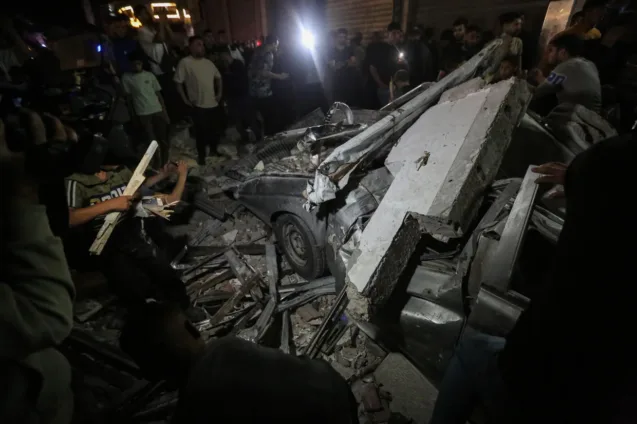
The multi-missile operation hit a residential building in one of the busiest market areas of Gaza City. Local medics and witnesses reported that at least three Palestinians were killed and dozens more were injured in the major attack.
According to the Israeli military and the Shin Bet security service, forces targeted buildings that served as a hideout for Odeh. Intelligence teams had tracked his movements for several months leading up to the operation. Hamas did not offer an immediate comment, though the group later confirmed that its top commander had been killed.
The operation marks the latest deadly Israeli strikes on Gaza despite a ceasefire with Hamas that began in October.
Market District Struck Ahead of Holiday
The strike targeted the upper three floors of the al-Kayali building in the centre of Gaza City. The surrounding streets were heavily congested with shoppers ahead of the Muslim holiday of Eid al-Adha.
Witnesses said at least five missiles struck the building almost simultaneously from different directions. One resident reported hearing the sound of a helicopter hovering overhead immediately before the attack.
Rescue teams rushed to the scene but struggled to reach the upper floors. The scale of the structural damage and severe crowd congestion in the market area hampered initial recovery efforts. Video footage from the scene showed civilian defence crews and ambulances searching through the rubble as large crowds gathered.
Intelligence Surveillance Preceded the Strike
The Israel Defence Forces and Shin Bet tracked the Hamas commander for months before launching the missiles.
"As part of the joint operation by the IDF and Shin Bet to eliminate the terrorist Mohammed Odeh, several buildings in the heart of Gaza City that served as a hideout for him were attacked, after months of intelligence surveillance in order to track his movements and the movements of his assistants in the organisation," a joint statement from the IDF and Shin Bet said.
The military noted that the operation extended beyond the primary target to hit his broader network.
The statement added that they had also struck "a nearby apartment belonging to a Hamas terrorist who raided on October 7 and was part of Odeh's circle of assistants."
"As part of the operation to eliminate Odeh, the IDF struck terrorist infrastructure sites in Gaza City that were used by Odeh and additional Hamas operatives," the IDF said in a statement. "Simultaneously, the IDF struck a nearby hideout apartment belonging to a Hamas terrorist who infiltrated Israel during the October 7th massacre and operated within Odeh’s network."
Israel Identifies Target as October 7 Architect
The Israeli government tied Odeh directly to the planning of the cross-border incursions into southern Israel.
Israeli Prime Minister Benjamin Netanyahu's office said on Tuesday that Odeh was "one of the architects of the October 7 massacre".
"Odeh was responsible for the murder, abduction, and wounding of many Israeli citizens and IDF soldiers," the statement continued.
Odeh had previously overseen the intelligence headquarters for Hamas. He reportedly took over the leadership of the military wing following the death of the previous leader, Izz ad-Din al-Haddad, earlier this month. Al-Haddad was killed in another Israeli air strike in May that also hit a residential building and killed at least three people.
In his statement, Netanyahu made it clear that Israel would continue its targeted killing campaign. He said Israel would "continue to pursue anyone who took part in the October 7 massacre", adding: "Sooner or later, Israel will reach them all."
Ceasefire Strained Under Regular Strikes
The assassination highlights the fragility of the active truce between the two sides. Israel has conducted regular strikes across Gaza since the ceasefire began on 10 October.
Hamas has repeatedly accused Israel of breaching the terms of the ceasefire and attacking civilians. The Hamas-run health ministry has reported the killing of more than 900 people in Israeli strikes during the ceasefire period.
The Israeli government maintains it has a licence to target Hamas members. It has, in turn, accused Hamas of breaching the ceasefire agreement by failing to disarm.
The political gridlock coincides with broader regional conflict. Progress on the latter phases of a US-led peace plan for Gaza has stalled since the US and Israel started a war with Iran in February.
The US announced the start of the second phase of the peace plan in January. The plan called for a transitional, technocratic administration to assume governance of Gaza alongside the demilitarisation and reconstruction of the territory. However, talks on disarmament remain deadlocked. Hamas has since reactivated its police force and appears to be reasserting its authority on the ground.
Regional Toll Elevates as Conflicts Concur
The strike on Odeh occurs against the backdrop of an immense human toll accumulated since the war began. About 1,200 people were killed in the initial Hamas-led attack on Israel, and 251 others were taken hostage.
Israel responded by launching a massive military campaign in Gaza. The bombardment reduced much of the Palestinian territory to ruins and left many of its 2.1 million residents displaced.
Israeli forces have killed more than 72,800 people in Gaza, according to its health ministry. The United Nations considers these figures reliable.
The security situation is fracturing on multiple fronts simultaneously. The latest Israeli attack on Gaza comes after 31 people were killed by Israeli strikes in Lebanon, where Netanyahu has vowed to step up military action against the armed group Hezbollah. Israel's military said its attacks in Lebanon targeted Hezbollah infrastructure and fighters.
Diplomatic Paths to Political Survival
The recurring violence underscores the deep divide over the future of Gaza’s governance and security framework. While Israel continues its military campaign to eliminate Hamas's armed leadership, international mediators maintain that a political resolution remains possible if the group alters its core strategy. According to a peace envoy tracking the negotiations, Hamas can survive politically by giving up weapons and armed conflict. However, with the assassination of successive military commanders and ongoing gridlock over the US-led demilitarisation plan, the prospects for transitioning from armed conflict to political diplomacy remain highly uncertain.
Latest Stories
-
Banks are responding to improved monetary policy conditions – John Awuah
18 minutes -
Judges’ conference forces further adjournment of Salomey Baffoe case
29 minutes -
GRA assures Tullow of collaboration to settle $393m tax liability without disrupting its petroleum operations
59 minutes -
South Korea demands apology from Pyongyang for landmine blasts that injured three
1 hour -
Carlos Queiroz not the sort of coach Black Stars need – Nii Lante Vanderpuye
2 hours -
AFCON 2027Q: ‘Our Black Stars team is gone’ – Former Sports Minister
2 hours -
Prof. Prempeh calls for public review of draft constitutional reform bills
2 hours -
AFCON 2027Q: ‘I have never seen a poor performance from Black Stars like against Gambia’ – Nii Lante Vanderpuye
2 hours -
Bawumia backs insurance sector reforms after engagement with IBAG
2 hours -
Nigeria set to launch National Digital Address System 9 years after Ghana showed the way
3 hours -
Policy rate decision takes time to reflect in lower lending rates – BoG
3 hours -
Western Regional Minister applauds Karpowership’s role in Ghana’s power sector
3 hours -
Playback: Road safety crises: Where are we getting it wrong?
3 hours -
Enterprise Life celebrates 25 years of protecting families and building trust
3 hours -
ICC London rules in favor of Ghana against Tullow over $400m tax charge
3 hours