

Audio By Carbonatix
False claims about Nigeria's electoral commission sparked concern as voters cast their ballots on Saturday.
Videos containing old and misleading footage filmed in previous polls were also circulating.
While Nigerians await the official election results we have looked into some of these claims.
Social media in Nigeria, especially Twitter, has played a huge role in the dissemination of credible election-related news but at the same time, it has been a major source of disinformation and misinformation.
One disinformation trend we monitored was the sharing of videos purporting to show ballot-stuffing during the elections.
In Nigeria, people vote by putting their thumbprint beside the logo of the party of their choice.
Using reverse-image search tools, the BBC traced some of the videos of people thumb-printing ballots to elections in 2021 and 2019.
They are cooking results in the North what a joke of an election @inecnigeria @MBuhari you promised us a free and fair election what the hell is this #shareINECresult #TakeBackNigeria we want all these states nullified this is rigging shame on you #NigeriaDecides2023 pic.twitter.com/znt78NFcJV
— Keisha🇿🇼🇳🇬🌟⭐ (@Keisha_Lakish) February 26, 2023
Another viral clip showed people being coached on the best way to print their thumb on ballot papers while voting for a particular party.
Both sets of videos had strong regional and religious undertones and were widely shared on WhatsApp groups and Twitter.
A popular politician in Nigeria was one of the people who shared the video of people being coached on how to thumb print.
How the votes went in some South Eastern units. pic.twitter.com/IR6K7qd0nM
— Adamu Garba II (@adamugarba) February 25, 2023
The video appears to be voter sensitisation projects carried out by the opposition Labour Party in parts of Nigeria. The BBC has contacted the party for comment but they are yet to respond. The BBC could not establish where the videos were recorded.
But we know that the ballots shown in at least one of these viral videos were not real.
They are clearly marked "specimen" and bear little resemblance to the standard electoral commission ballot papers, seen below on the left.
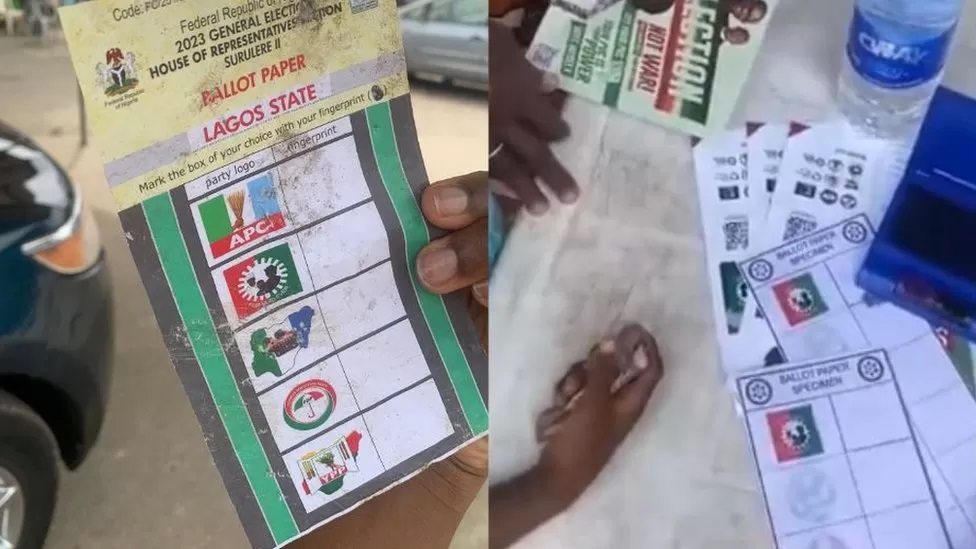
The false ballot used in the viral video, on the right, is marked "ballot paper specimen"
Alleged rigging by electoral body
A bold claim that has gained traction, pushed largely by influencers on social media, alleges that Nigeria's Independent National Electoral Commission (Inec) is rigging the election count to favour the governing All Progressives Congress (APC) party.
Videos shared by accounts with large followings also suggested that Inec's server had been breached and unknown people were inputting fabricated election results.
RIGGING ALERT:
— Rinu Oduala 🔥🔫 (@SavvyRinu) February 25, 2023
Unauthorized people are currently logged into INEC server, uploading results different from what was voted at polling booths across the country today.
INEC may be compromised right now. #WatchSR #NigeriaDecides2023 #SOSREX pic.twitter.com/SzuKk2cXCN
Checks showed that the alleged website was not that of the electoral commission and was, in fact, a fake website that replicated the interface of Inec's election results viewing portal.
The web address has inconsistencies typical of a phishing website, such as having numbers instead of an actual website name.
Inec released a statement saying that although its server was "slow and unsteady" due to the amount of activity going on, it was not compromised.
There were also claims that Inec used the Bimodal Voter Accreditation (BVAS) machine to add votes to the tally of a particular candidate. Inec denies this.
It is one thing to rig an election when your original losing margin was 40:60.
— David Hundeyin (@DavidHundeyin) February 25, 2023
It is entirely another thing to do so when the margin is 10:90.
If INEC really helps APC to carry out this abomination, it's not angry tweets that you'll have to worry about.
I promise.
In 2021 Nigeria's electoral commission introduced the BVA machine to simplify the verification and accreditation of voters on election day. But it was also to be used in uploading results on the commission's result viewing portal.
Some social media users claimed without evidence that machine failures had happened because Inec was deliberately sabotaging the electoral process.
But Inec, in a statement it released to counter the viral allegation, said some machines failed to accredit voters or upload election results in some areas because of technical problems or the absence of an internet connection.
Some political parties, including those of the three leading opposition contenders, have called for the polls to be cancelled because of the issues relating to the BVAS, among other complaints.
Sharing fake election results
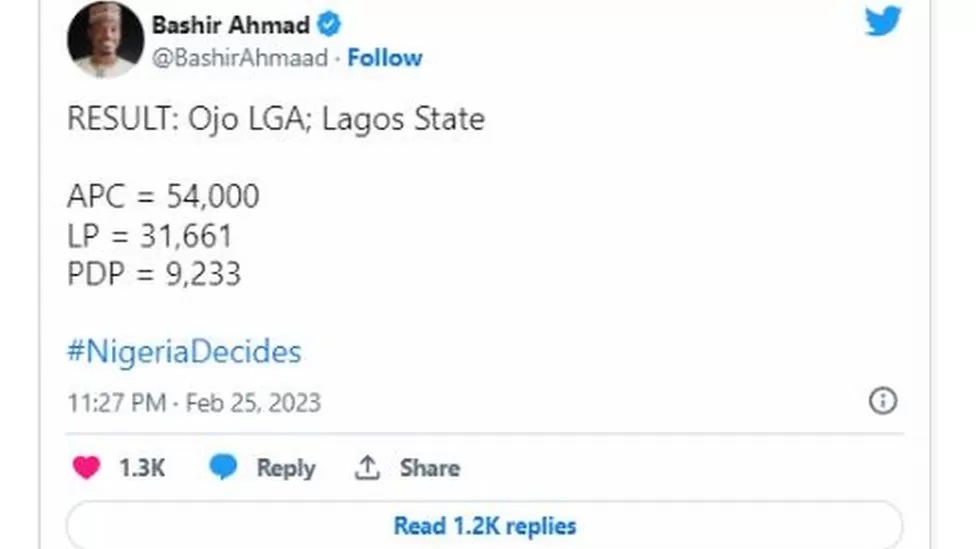
Social media influencers and politicians with hundred of thousands of followers shared fake and misleading results. This has contributed to the questioning of the official results released by Inec.
Bashir Ahmad, a spokesman for President Muhammadu Buhari, was one of those who shared results later confirmed to be fake when Inec released the official results. Mr Ahmad has since deleted his tweet.
Obasanjo the 'hero'
One person who featured prominently in disinformation messages shared online was former Nigerian President Olusegun Obasanjo, who was a member of the Peoples Democratic Party (PDP) but has since thrown his support behind Peter Obi of the Labour Party.
In the lead up to the election, allegations of Mr Obasanjo intervening to stop a lorry load of Chadians who were allegedly coming to vote in the election was shared widely using WhatsApp.
The message said a junior immigration officer alerted the former president of 1.5 million Chadians with Nigerian voter cards travelling to Kaduna in north-west Nigeria in 100 trucks, but that Mr Obasanjo had instructed his personal security to block all roads and capture the foreigners.
Checks in Nigeria show no reports of arrests of Chadians trying to enter the country. As a former president, Mr Obasanjo does not have the power to block roads or instruct security agencies to intercept people or goods coming into the country.
Moreover, a reverse image search confirms that one of the pictures used to spread the story was in fact from the News Agency of Nigeria in May 2021 - when it reported that the Nigeria Security and Civil Defence Corps stopped Fulani herders from entering Kwara state. Another picture was from 2021, when the security network, Amotekun, detained another set of Fulani herders.
Popular musician and activist Charles Oputa, also known as Charly Boy, shared this false story to his Instagram handle. He has since deleted it.
Another false claim trending on social media and messaging apps such as WhatsApp is that Mr Obasanjo had "stormed" the Inec collation centre in Abuja with the "real results" of the elections, which he had supposedly gotten from the servers.
But there is no credible possibility that Mr Obasanjo could have intercepted results that were yet to be uploaded to Inec's server. BBC reporters at the collation centre did not see any evidence of such an event happening.
Latest Stories
-
I leave with respect, gratitude and pride – Carlos Queiroz
12 minutes -
Stop turning investigation into punishment – OccupyGhana tells EOCO, BNI
12 minutes -
GPL 2026/27: Medeama go top after win over Port City
24 minutes -
Manhyia South MP Baffour Awuah reports himself to EOCO after arrest warrant
34 minutes -
Ghana records 11 cocaine cases in 28 drug busts since March 2025; biggest hauls seized abroad
36 minutes -
The numbers behind Carlos Queiroz’s tenure as Black Stars boss
45 minutes -
The man who saw tomorrow: How Dr Bawumia built for Ghana what America and Nigeria are building today
1 hour -
Kumasi drivers demand price controls for goods, brand some traders as real ‘Kalabule’
1 hour -
Consumer Protection Agency commends FDA for destroying illegal bales of diapers
1 hour -
GNFS rescues stranded persons after flooding in Hohoe
2 hours -
Baffour Awuah deliberately refused to honour EOCO invitation – Deputy AG, Srem-Sai
2 hours -
‘Believe in these players’ – Carlos Queiroz tells Ghanaians after leaving Black Stars job
2 hours -
Gideon Boako: GoldBod books must be stretched to establish true nature of reserves support
2 hours -
ECG announces planned maintenance outage in parts of Accra on Friday
2 hours -
Carlos Queiroz sacked as Black Stars head coach
2 hours