

Audio By Carbonatix
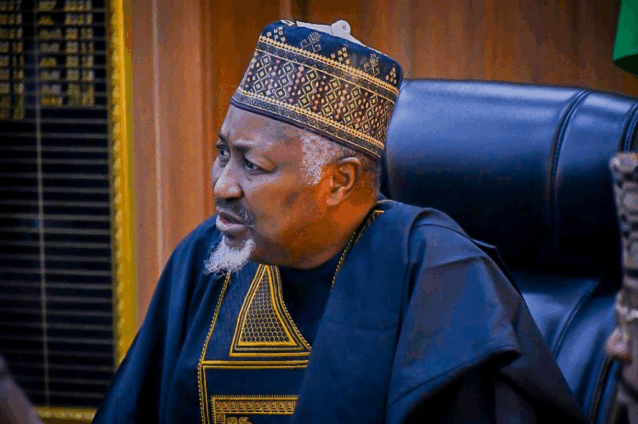
Nigeria's Defence Minister, Mohammed Badaru Abubakar, has resigned, the presidency said on Monday, with immediate effect.
Presidential spokesperson Mayo Onanuga said in a statement that Abubakar was quitting on health grounds.
"His resignation comes amid President [Bola] Tinubu's declaration of a national security emergency, with plans to elaborate on its scope in due course," the spokesperson said.
Nigeria's armed banditry is a security crisis
Nigeria has long been plagued by mass kidnappings, but the past weeks have seen a surge in attacks and abductions by armed bandits.
Most recently, gunmen attacked a church in Kogi state in central Nigeria, abducting the pastor along with nearly a dozen worshipers during a Sunday morning service.
On Saturday, some 30 women, including a bride and visiting wedding guests, were kidnapped in Sakoko in northwestern Nigeria.
In all, some 490 people have been abducted across multiple states in the past two weeks, according to Nigeria's Punch newspaper.
A large number of these were from the St. Mary's private Catholic boarding school in Papiri, Niger State, where 315 people, mostly children, were abducted in late November. Around 50 children managed to escape.
Armed bandits, often operating in Nigeria's northwest and north-central regions, frequently carry out kidnappings for ransom.
As well as banditry, Nigeria is also battling a deadly Islamist insurgency in its northwestern regions.
But the Nigerian government has long been criticised for failing to stem the security crisis and protect schools in particular.
Security forces stretched thin
In the wake of the kidnappings, President Tinubu declared a security emergency and ordered mass recruitment of police and military personnel.
But the military and police are already low paid, lacking in equipment and in need of training.
"In remote villages and towns, state security agents are virtually non-existent and surveillance remains very poor," finds Oluwole Ojewale, Regional Coordinator for the Institute for Security Studies, an African think tank, in an analysis.
Nigeria has only approximately 370,000 officers to protect its 220 million citizens, according to a UK government assessment, and significant numbers of these are seconded to protect wealthy individuals.
Corruption and bribery are commonplace, while police response to crimes is often slow, the assessment finds.
Latest Stories
-
Ghana wins $393m Tullow tax arbitration as tribunal upholds GRA assessment
3 minutes -
Gender Minister assures women’s group of action on Affirmative Action, Development Bank
47 minutes -
Over 2,000 teachers in Dormaa comply with strike – GNAT Secretary
57 minutes -
Food Buffer Stock seeks stronger liquidity buffer despite record profit
1 hour -
LPG investments key to achieving 50% access target by 2030 – Energy Minister
1 hour -
Jinapor: New LPG terminal strengthens Ghana’s energy security
1 hour -
Agbodza directs road agencies to fast-track design approvals to prevent project delays
1 hour -
Housing Minister urges stakeholders to prioritise quality education in Banda District
1 hour -
Government redeems pledge to complete abandoned projects – Kofi Buah
1 hour -
Sam George calls for Black Stars disbandment, GFA dissolution after Gambia defeat
1 hour -
Bunkpurugu MP urges action to curb network disruptions in Northern Ghana
1 hour -
Education Minister calls for evidence-based response to learning crisis in West Africa
2 hours -
NPA reaffirms regulatory support as Puma Energy deepens investment in LPG and CRM
2 hours -
Ketu South NDC clears 73 aspirants for constituency elections
2 hours -
We are with all flood victims – Hohoe MP
2 hours