

Audio By Carbonatix
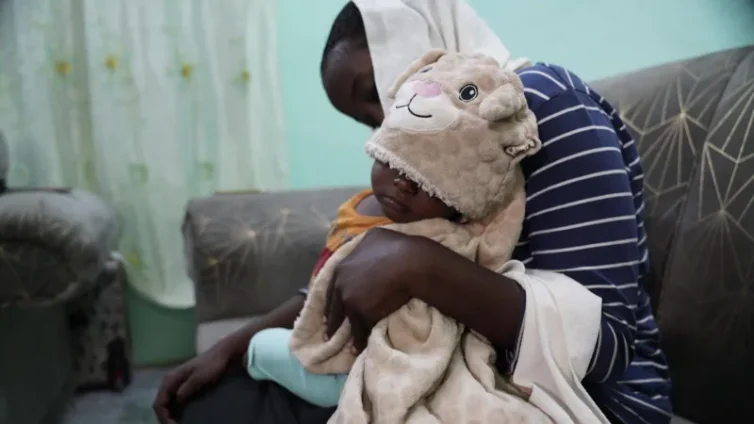
Armed men are raping and sexually assaulting children as young as one during Sudan's civil war, says the UN children's agency, Unicef.
Mass sexual violence has been widely documented as a weapon of war in the country's nearly two-year conflict.
But Unicef's report is the first detailed account about the impact of rape on young children in Sudan.
A third of the victims were boys, who typically face "unique challenges" in reporting such crimes and seeking the help they need.
Unicef says that, although 221 rape cases against children have been officially reported since the start of 2024, the true number is likely to be much higher.
Sudan is a socially conservative country where huge societal stigma stops survivors and their families from speaking out about rape, as does the fear of retribution from armed groups.
The Unicef report provides an appalling window into the abuse of children in the country's civil war.
Perhaps its most shocking revelation is that 16 of the victims were under the age of five years, including four infants.
Unicef does not say who is responsible, but other UN investigations have blamed the majority of rapes on the paramilitary Rapid Support Forces (RSF), saying RSF fighters had a pattern of using sexual violence to terrorise civilians and suppress opposition to their advances.
The RSF, which is fighting this war against its former allies, the Sudanese Armed Forces, has denied any wrongdoing.
"The sheer scale of sexual violence we have documented in Sudan is staggering," said Mohamed Chande Othman, chair of the UN's fact-finding mission when its previous report was published in October.
According to evidence presented by international human rights groups, victims in the RSF's stronghold of Darfur were often targeted because they were black African rather than Arab, apparently with the aim of driving them out of Sudan.
The UN humanitarian response for Sudan is already underfunded. Recent cuts in US aid are expected to reduce programmes to help the victims even further.
Harrowing details in Unicef's report underscore the dire situation.
"After nine at night, someone opens the door, carrying a whip, selects one of the girls, and takes her to another room. I could hear the little girl crying and screaming. They were raping her," recalls Omnia (not her real name), an adult female survivor who was held by armed men in a room with other women and girls.
"Every time they raped her, this girl would come back covered in blood. She is still just a young child. They only release these girls at dawn, and they return almost unconscious. Each of them cries and speaks incoherently. During the 19 days I spent there, I reached a point where I wanted to end my life."
As a fractured nation at war, Sudan is one of the most challenging places on earth to access services and frontline workers.
The vast number of people displaced by the war has made women and children more vulnerable to attack – three out of four school-age girls are out of school, the UN says.
Trump government cuts end vital help
The devastating outcome of these crimes is aggravated by the fact that victims have few places to turn to for medical help, because many medical facilities have been destroyed, looted or occupied by the warring parties.
Recent US aid cuts may be endangering even the limited services available to protect children.
Unicef has been providing safe spaces for children through a network of local activists who have set up what are known as Emergency Response Rooms to deal with the crises in their communities.
The activists relied quite heavily on US aid, and most have been forced to shut down, according to a Sudanese coordinating committee that monitors them.
More broadly, the UN organization dedicated to protecting women's rights says local organisations led by women are vital in delivering support to survivors of sexual violence. But they receive less than 2% of the total funding of the UN's Sudan Humanitarian Fund.
The BBC learned that at least one of these local groups, known as "She Leads", was forced to close when US funding was stopped.
It was not a big expense, measured in the tens of thousands of dollars, but enabled case workers to reach around 35 survivors a month, said Sulaima Elkhalifa, a Sudanese human rights defender who runs a government unit on combatting violence against woman and helped organize the private initiative.
Those who have been raped by armed men "don't have the luxury of being depressed," she told the BBC.
The demands of war – finding food, needing to flee – leave no space to deal with trauma, she added.
Latest Stories
-
TGMA controversy hasn’t affected my relationship with Diana Hamilton – Piesie Esther
47 seconds -
Cliff Cheqona to take TP Masterclass to Lagos and Abuja in 2027
4 minutes -
Bond market: Turnover rises 77% to GH¢2.76bn
4 minutes -
Be lovers of the environment – Archbishop Kwofie calls for stronger fight against environmental injustice
8 minutes -
BoG declares FX compliance “non-negotiable” as it moves to tighten rules
11 minutes -
Government to prioritise creation of decent jobs – Finance Minister
17 minutes -
Ghana’s ocean is not land under water: Why the Fisheries Commission is right to demand a proper assessment of offshore gold exploration
23 minutes -
Teacher unions maintain strike as FWSC, GES negotiations yield no deal
25 minutes -
Photos: Mahama Ayariga engages World Bank on sustainable cities development
31 minutes -
Foreign Affairs Minister warns embassies over long queues, ‘inhumane’ conditions for visa applicants
33 minutes -
Photos: AMA steps up enforcement to clear traders from BRT shelters
33 minutes -
Shortage of health information officers threatens quality of healthcare data – GHIMA
34 minutes -
Ghana’s National Chess Team, The Golden Knights return from Samarkand with gold and seven new international titles
36 minutes -
Northern Births and Deaths Director to face PAC over GH¢71k withdrawals
44 minutes -
Djokovic claims 102nd title of career with China Open win
48 minutes