

Audio By Carbonatix
Only 27% of Ghana’s 94,200-kilometre road network is paved, while more than half of the country’s roads are in fair-to-poor condition, the World Bank has disclosed.
The Bank says the state of the road network remains a major constraint to Ghana’s economic growth, competitiveness and job creation, particularly in rural areas where feeder roads connect communities and agricultural producers to markets.
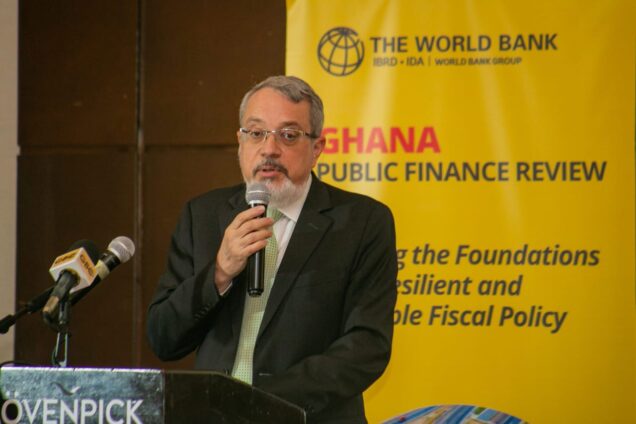
World Bank Division Director for Ghana, Liberia and Sierra Leone, Robert R. Taliercio, disclosed this at the launch of the World Bank’s Tenth Ghana Economic Update in Accra.
He said the challenges facing Ghana’s transport infrastructure require urgent reforms alongside increased investment.
“This is not just an infrastructure story. It’s a growth story, competitiveness story, and a job story,” Mr Taliercio said.
According to him, the poor state of the road network is compounded by weaknesses in maintenance financing and fragmented institutional responsibilities within the transport sector.
The World Bank has therefore identified the operationalisation of the Road Maintenance Trust Fund as one of six priority areas for transforming Ghana’s transport sector.
It has also called for the development of a unified national transport sector strategy, the revitalisation of freight-led rail services along the western and eastern corridors, and stronger measures to address road safety.
The Bank further wants Ghana to adopt climate-resilient infrastructure standards and extend the Digital Single Window to Takoradi and inland terminals.
Mr Taliercio said the World Bank was supporting Ghana’s efforts through the $500 million Ghana Market Access and Connectivity Project, which will finance the rehabilitation of about 1,050 kilometres of feeder roads.
The project is expected to focus on areas where poor road connectivity is restricting agricultural productivity, market access and rural livelihoods.
The World Bank, however, cautioned that increased investment in roads must be accompanied by effective maintenance and stronger institutional coordination.
“Building roads without maintaining them simply accelerates the cycle of degradation that we are all trying to break,” Mr Taliercio said.
The assessment places renewed focus on the need for Ghana to not only expand its road network but also develop sustainable systems for maintaining existing infrastructure and ensuring that roads support broader economic transformation.
Latest Stories
-
Fire destroys mattress showroom at Sokoban in Kumasi
12 minutes -
ECOM-SMS Ghana launches ‘Agriculture Our Future Clubs’ to address threat of ageing farmer population
15 minutes -
Nicholas Atsu Kumi
16 minutes -
Cherif Sarr: Economic participation needs more pathways, not one prescribed route
17 minutes -
Cyber Security Authority: Ghana led Operation Blackout, not FBI
22 minutes -
GH¢800,000 goods destroyed as fire engulfs Kia Rhino truck on Apedwa-Kibi Road
53 minutes -
Chief Justice calls for supportive workplaces to address mental health stigma
54 minutes -
NVI CEO defends GH¢13m spending on training, workshops and conferences
55 minutes -
Ghana targets first locally manufactured vaccine by 2027
58 minutes -
Teachers suspend strike after reaching agreement with government
1 hour -
Council of State describes talks with striking teachers as fruitful
1 hour -
Adjaye Associates opens new Accra studio with public space for cultural exchange
2 hours -
BoG to issue new Credit Risk Directive as NPL ratio in the Savings and Loans sector deteriorates
2 hours -
You can preach in a stationary vehicle, but not when it’s moving – Mahama clarifies
2 hours -
Alhaji Iddrisu Mustapha: The educated professional seeking to bring experience to NDC Western Region leadership
2 hours