

Audio By Carbonatix
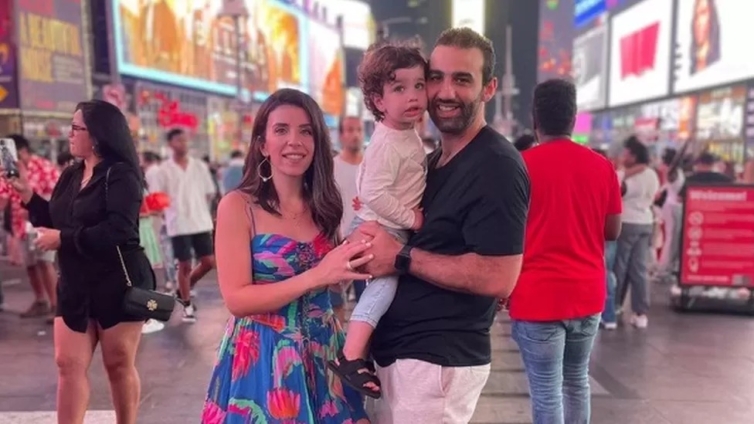
A Palestinian-American family has managed to flee Gaza after nearly a month trapped in the war-torn enclave.
Abood Okal, Wafaa Abuzayda and their one-year-old son, Yousef, crossed safely into Egypt through the Rafah crossing on Thursday morning, a family friend told the BBC.
The trio were among a list of 400 US citizens and 100 others approved by border authorities to leave Gaza.
But several hundred more foreign nationals remain inside the enclave.
For the Okals, who reside in the quiet Boston suburb of Medway, Massachusetts, the war shattered a joyful reunion with the grandparents Yousef had never met.
After flying into Tel Aviv last month, they took in the sights of Jerusalem, journeyed through the West Bank, went to the beach, shared meals and rode horses together.
Then, six days before they were to catch a flight back to Boston, Hamas launched its attack on Israel, which responded by bombarding Gaza.
Heeding Israel's warnings to flee south, the Okals left Ms Abuzayda's parents' home in Jabalia, in northern Gaza. They do not know if the house - which is in the vicinity of a refugee camp that was bombed on Tuesday - remains intact.
By the following weekend, they had made their way to Rafah and holed up in a house about five minutes from the border crossing into Egypt.
"The general understanding was that, if there was going to be any opportunity for American citizens to get out, it was going to be through Egypt," Sammy Nabulsi, a family friend, said.
According to Mr Nabulsi, over the past three weeks Mr Okal attempted to make daily contact with the US state department and the American embassies in Cairo and Jerusalem.
On four separate occasions, they were advised to go to the Rafah crossing, waiting in line for up to eight hours but never receiving permission to cross.
Mr Nabulsi, who told the BBC he spoke with the family nearly every day of their ordeal.
A real estate lawyer by trade, he said he contacted White House and state department officials, as well as several members of the US Congress, on the Okals' behalf.
But, he told the BBC, officials offered vague and shifting explanations for why his friends were unable to get out.
It was an experience that left him concerned the government was not prioritising rescuing its citizens from Gaza, and left the Okals feeling "completely hopeless and abandoned".
All the while, the family's circumstances were growing more dire with each passing day.
The house in Rafah where they were staying was a single-family unit, but they shared it with 40 others.
With no running water or fuel, the residents were limiting how often they flushed the toilets and drinking saltwater from the well to stay hydrated.
With no cooking oil on hand, the family was largely living off canned tuna and fava beans, according to Mr Nabulsi.
Their last visit to the bakery lasted six hours and their last water run yielded only a few litres for the whole house to share.
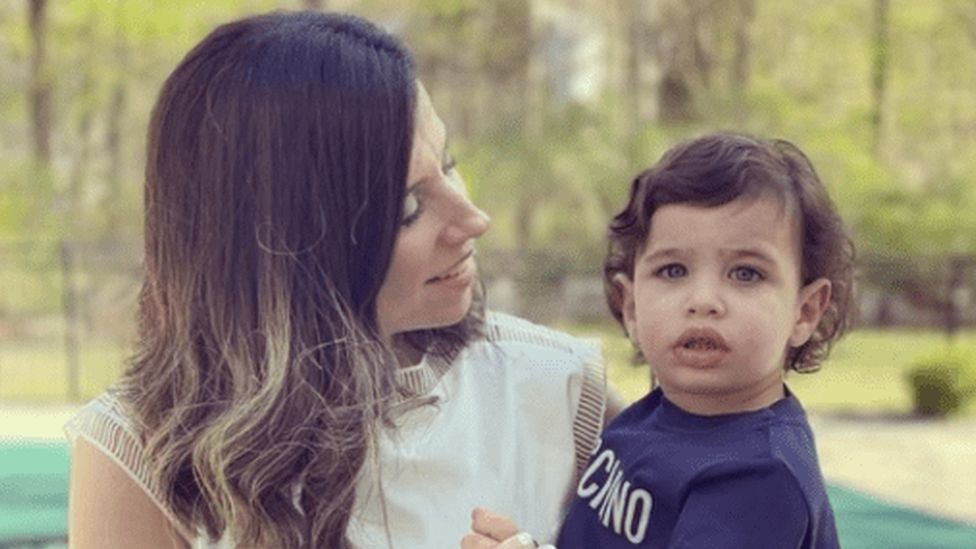
But the hardest part for Mr Okal and Ms Abuzayda was watching how the conditions were affecting their son, said Mr Nabulsi.
When the war broke out, Yousef had occasionally woken up startled by the sound of airstrikes.
But more recently, he had begun to wake up screaming, apparently from night terrors, even when it was quiet outside. Oftentimes, he was inconsolable and would not go back to sleep.
"In the early days, every time there was an airstrike, [his mum] would try to smile and clap to convince him it was just fireworks," Mr Nabulsi said.
A few days ago, he added, they had run out of milk and were unable to find any more.
Mr Nabulsi says Mr Okal is a research director at the Bristol Myers Squibb pharmaceutical company, and that Ms Abuzayda worked at a Boston non-profit for young adults.
On Thursday, the family's names appeared on a list published by Gaza's border authority with permission to enter Egypt.
Mr Nabulsi confirmed to the BBC the trio crossed into Egypt shortly after 11:30 local time (09:30 GMT) and was being transported to Cairo by US consular affairs officials.
"The Okal family is overwhelmed with the love and support they have received from home and abroad, but they are also exhausted, physically and emotionally drained, and have a long journey ahead of them back to the United States," he said in a statement.
The family, he added, is asking for privacy and the safe departure of all remaining Americans, as well as "compassion and prayers for the innocent civilians in Gaza, who gave them shelter, who helped them find food and water, but who continue to be without their own supply of food, water, fuel, or medicine to live".
Latest Stories
-
Government’s dismissal of my cocaine intelligence emboldens traffickers – Ntim Fordjour
4 minutes -
Video: Immunity should be exercised without creating classism – Inusah Fuseini on cocaine bust
18 minutes -
Ghana Air Force passes out 293 recruits after six months of intensive training
26 minutes -
EOCO vrs Baffour Awuah: EOCO should have secured warrant before arrest attempt at court – Inusah Fuseini
30 minutes -
Triple fibre cuts disrupt telecom services across Northern, Oti regions – Sam George
33 minutes -
Politicisation could undermine parliamentary probe into cocaine seizures – Dr Osae-Kwapong
40 minutes -
EOCO chases MP: Can Section 41 cure lacuna in EOCO Act? – Inusah Fuseini asks
43 minutes -
GNFS, GWL inspect fire hydrants in Ministries enclave; 23 found faulty
48 minutes -
Gov’t directs release of 50,000 bags of grain to ECOWAS
50 minutes -
Ghana, Germany deepen cooperation on railways, labour mobility
55 minutes -
Huge crowds greet Pope in Paris for open-air Mass
1 hour -
‘I never said I’ll declare a state of emergency’ – President Mahama on galamsey
2 hours -
Bobby Banson condemns EOCO’s attempted arrest of Nana Agyei Baffour Awuah
2 hours -
When Kumasi begins to look like somebody is in charge
2 hours -
Parliamentary probe into cocaine seizure would be a waste of time – Inusah Fuseini
2 hours