


Audio By Carbonatix
Associate Professor and Head of the Law, Humanities, and Social Sciences Department at Ashesi University, Dr. Maame Mensa-Bonsu, has advised Parliament to comply with the Supreme Court's ruling on the stay of execution regarding the four vacant parliamentary seats.
Speaking on JoyNews' Newsfile on October 19, she explained the importance of respecting the judiciary's authority and recommended that the Minority seek legal redress if they disagree with the decision.
Dr. Mensa-Bonsu stressed that Parliament must abide by the Supreme Court’s directive, even if it disagrees with the outcome. Compliance, she argued, preserves the rule of law and avoids institutional conflicts.
“When a person who has a duty exercises their duty and you disagree with it, I think you go for a supervisory order, you apply for a certiorari.
“Again, the fact that the order is until the matter is determined as opposed to the 10 days that the ex parte applications are supposed to get, perhaps, Minority would like to have the quest to review that order and be in compliance with the C.I 47.”
This follows the Supreme Court's recent order for the Speaker of Parliament to stay the execution of his ruling to oust four MPs who declared their intention to run as independent candidates in the upcoming election.
This application was made by Majority Leader, Alexander Afenyo-Markin.
Dr. Mensa-Bonsu highlighted the need for adherence to the principle of institutional settlement, which is central to the doctrine of separation of powers. She warned that if institutions such as Parliament disregard court rulings, it would lead to chaos.
“The point in the judicial system is to create some finality to actions... If everyone takes their interpretation as correct and disregards the courts, we will be back in a state of chaos.”
“One of the key reasons why separation of powers has been proposed as a useful way to run a country is the principle of institutional settlement.
"So what I argue is that it is not really that this is the institution that will get the answer right all the time or even that this particular is right. It is that this particular answer is final and we can respond to that, so we have a methodology for speaking to our courts when we think our court is wrong."
Meanwhile, Physician and political activist, Dr. Arthur Kennedy, is worried over the trajectory of the current Supreme Court, stating that its recent decisions leave much to be desired.
According to him, there have been too many instances that raise questions about the neutrality of the apex court.
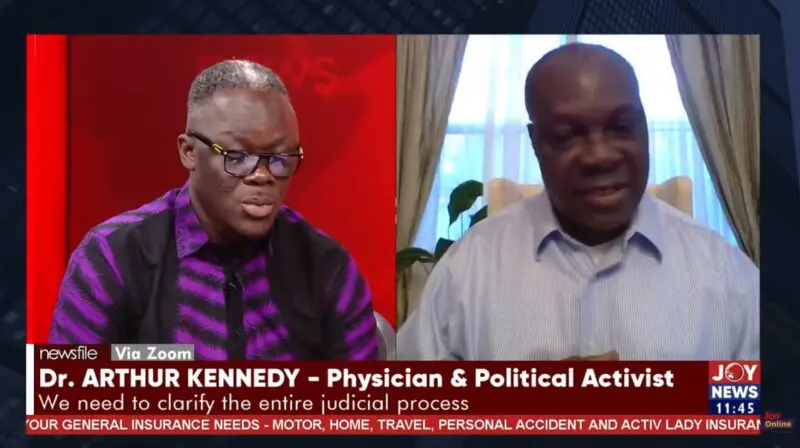
Based on these developments, Dr Kennedy fears that "on too many occasions, like the Domelevo case, the LGBT case, and in this current case our Supreme Court appears now to be doing more politics than law."
Latest Stories
-
NPP had more permanent fuel relief measures than current GH¢2 diesel cut – Amin Adam
17 minutes -
Photos from the 3rd Republic Bank-JoyNews Habitat Fair Clinic
19 minutes -
Ethiopia’s army promises restraint amid fears of new civil war
29 minutes -
Amin Adam calls for review of fuel taxes as diesel prices remain above GH¢18
1 hour -
World Vision Ghana, Ahafo districts sign MoU for universal WASH coverage
2 hours -
When the gold engine stutters: What Ghana’s Cedi and reserves are telling us about the new economic architecture
2 hours -
Two reportedly die after being trapped in mining pit at Juaboso
2 hours -
Petrosol cleans up Wa Municipal Hospital, to donate medical equipment
2 hours -
‘If NPP was ‘insensitive’ over fuel prices, NDC must accept same description now’ — Amin Adam
2 hours -
KiDi brings the hits to London in sold-out UK headline concert
2 hours -
The last goodbye of Ghanaian shot dead in the US
3 hours -
MCC opens door to Ghana again as MiDA revives development partnership
3 hours -
CSIR moves to turn scientific research into jobs, national growth
3 hours -
More patrons troop in as 3rd Republic Bank-JoyNews Habitat Fair clinic enters final day stretch
3 hours -
German, Russian foreign ministers hold rare talks amid rising tensions
3 hours