

Audio By Carbonatix
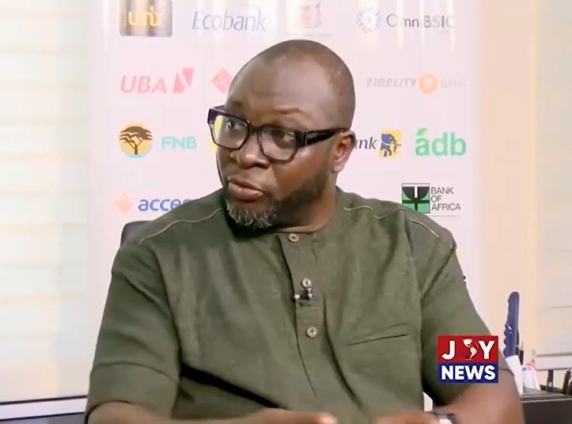
The CEO of Ghana Association of Banks, John Awuah, has revealed that a significant portion of the cedi’s past depreciation was driven not by real economic fundamentals but by calculated profiteering.
Speaking on Joy News’ PM Express Business Edition on Thursday, May 29, Awuah described a worrying trend of currency manipulation that he said accounted for as much as 30 per cent of the cedi’s past falls.
“I once stated with no proper research behind it that I could clearly read that the extent of speculation in the currency movement was between 20 and 30%,” he said.
“So if there was a depreciation, about 20 to 30% of that depreciation is not backed by any effective transaction, but people who are just playing on the currency for temporary price adjustments to profit from the currency movement.”
According to Mr Awuah, these speculative players were not responding to trade imbalances or macroeconomic shocks. They were simply gaming the market for short-term gains.
“If currency is able to hold its own, what you are doing is making that trade unattractive,” he said.
“Now, the cedi is more attractive. So the people who are holding cedi, they are looking for cedi investments, because the currency is not depreciating as aggressively as we are used to in the past.”
He was quick to caution, however, that appreciation should not be mistaken for stability. For businesses, what matters is not necessarily a stronger cedi, but a stable and predictable one.
“We should not be too excited about significant appreciation,” he warned. “That is not exactly what the business community is looking for.”
He explained that wild swings in the currency’s value—whether positive or negative—make it impossible for businesses to plan effectively.
“The business community is looking at predictability. Not that the currency has depreciated to ¢5 to the dollar, and tomorrow it is ¢10. Another time it is ¢9.”
Inconsistent currency movements hurt forecasting, banking, and investment decisions, he said.
“You need to plan effectively. You need some variables to hold their own and not be oscillating significantly beyond levels that you are unable to predict and have a proper forecast,” Mr Awuah explained.
“Even if you are talking to your banks, your ability to project your revenue generation is hampered if a component of your revenue is foreign currency-based.”
While Awuah expressed some confidence in the current performance of the cedi, he avoided making bold projections.
“I don’t want to say a wait and see, because I don’t have any reason to doubt the ability of the currency to hold its own. Coming down to single digits, I am not sure,” he said.
Latest Stories
-
Nana B passport claims a diversionary tactic — Abu Jinapor
10 minutes -
Pope Leo diagnosed with cancer as doctors remove lobe of lung, Vatican says
10 minutes -
Legal Aid Commission takes free legal services to Techiman main lorry terminal
15 minutes -
Nana B denies seeking passport favour, accuses Ablakwa of failing to account for GH¢16.4m
20 minutes -
Young girls demand climate action, stronger protection against child marriage
32 minutes -
Ex-gang boss sentenced to 40 years for orchestrating Tupac Shakur’s murder
32 minutes -
From near-deferral to three awards: UMaT graduate’s academic journey
34 minutes -
Atta Akyea denies seeking presidential pardon for Wontumi in galamsey case
1 hour -
Photos: Mahama commissions 85-bed Police Hospital ward, donates two ambulances
1 hour -
GTEC directs Ghana’s public universities to reopen by October 16 and begin lectures on October 19
1 hour -
Star Oil donates GH¢1million towards construction of new CID facility
1 hour -
Court hands Adjetey Sowah, two others lifetime bans after Amputee Football legal dispute
2 hours -
NDC appoints Julius Kwame Anthony as a Deputy Communications Director
2 hours -
Ghana repatriates 120 Nigerians rescued from suspected cybercrime centres
2 hours -
NPP rejects Emelia Agbenyo’s appointment as Deputy EC Chair, demands withdrawal
2 hours