

Audio By Carbonatix
President Nana Addo Dankwa Akufo-Addo is confident that the second phase of the Planting for Food and Jobs programme, with its focus on an input credit system that accommodates all value chain participants will continue the progressive transformation of Ghana's agricultural landscape.
With a strong emphasis on commercial agriculture, and a cascading effect on all stakeholders, from production to processing, distribution, and marketing, President Akufo-Addo believes, “This comprehensive approach will stimulate economic activities within the sector, generate employment, support industrialisation, boost exports, increase incomes, foster rural development, and propel overall economic growth.”

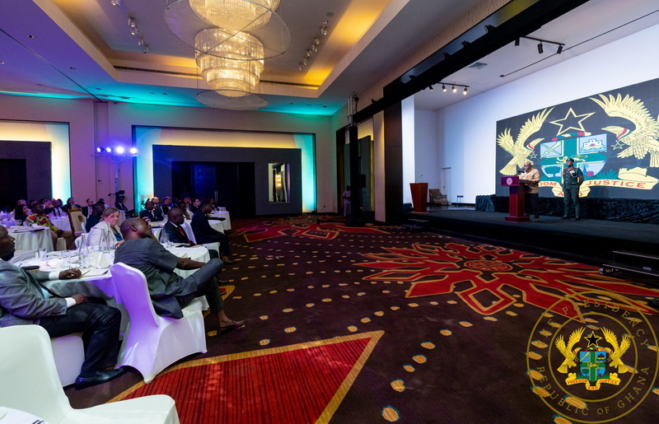
The President was speaking at a meeting of international development partners, on the second phase of the programme for Planting for Food and Jobs, at the Alisa Hotel, Accra, on Thursday, 26th October, 2023.
It will be recalled that on Monday, 28th August, 2023 in Tamale, capital of the Northern Region, President Akufo-Addo, launched the second phase of the Programme for Planting for Food and Jobs, which is a five-year strategic initiative, designed to accelerate the growth of the agriculture sector, in response to the exacerbated challenges it has faced, primarily due to the combined impact of recent adversities like the COVID-19 pandemic and the Russian invasion of Ukraine.
Anticipated to enhance food security and establish a strong comparative advantage in the production of diverse cash and food crops and poultry products by the end of the five-year implementation period, the President noted that, the new “comprehensive approach will stimulate economic activities within the sector, generate employment, support industrialisation, boost exports, increase incomes, foster rural development, and propel overall economic growth”, as well as, “leverage competitively the opportunities presented by the Africa Continental Free Trade Agreement (AfCFTA).”

However, in spite of the productive collaboration that has taken place between the Government and friends of Ghana over the years, he expressed concern about the cases of misalignment of priorities between the policies of certain international development agencies and national policies and strategies.
“Government is concerned by this, because projects designed by foreign governments to support Ghana's agriculture should, naturally, align with Government's priorities. Any deviation from this can amount to misdirected investments in the country. This platform, thus, provides an opportunity for all of us to identify the factors causing this disconnect, and take corrective measures,” he explained.
He further touched on the “unwelcome situation where Government, through its agencies such as the Ministry of Finance and the Ministry of Food and Agriculture, has no foreknowledge of some funds being employed in the country by international development agencies” as he acknowledged the multifaceted challenges facing Ghana's agriculture, especially in relation to available funding resources.”
Towards achieving optimal results for effective alignment and minimising the risk of duplication, and eliminating the lack of knowledge by the Government of projects by international development agencies, in favour of a coherent approach that promotes collaboration, he said, “dialogues, like the one we are having today, are essential, and should be a regular occurrence, providing avenues to discuss challenges, successes, and ensure increased collaboration in the execution of current and future agricultural development plans in Ghana.”

President Akufo-Addo also touched on the urgency of complementing governments efforts on the programme through resource mobilization and funding mechanisms, such as loans, grants, technical assistance, and other agricultural support initiatives, by collaborating with research institutions, farmer organisations, and private sector entities, to ensure increased capacity building, technology transfer, and knowledge sharing.
He also touched on monitoring and evaluation towards “ensuring the accuracy of data collection and analysis, thereby helping to address identified weaknesses that affect design, planning, implementation and project outcomes as well as ensure accountability and facilitate evidence-based decision-making.”
While acknowledging the government’s responsibility to create a conducive environment through regulatory measures and other incentives, he was confident that, the second phase of the Programme “will raise awareness about the potential of Ghana's agriculture, and draw in the necessary investments, facilitated by your invaluable support, so that we can achieve food security in Ghana.”
Latest Stories
-
Church of Pentecost supports over 2,000 BECE candidates in Obuasi with career guidance seminar
57 minutes -
Brandon Asante and Coventry all but promoted to Premier League despite Sheffield Wednesday draw
1 hour -
GPL 2025/26: Late Kwartemaa strike downs Hearts in Tema
1 hour -
Ghana Faces Sierra Leone Moment as Prosecutorial Powers come under strain
2 hours -
Don’t consume fish or seafood from Tema Shipyard until further notice – FDA warns
2 hours -
Why volunteering might be Africa’s most underrated career accelerator
2 hours -
ActionAid Ghana raises concern over gender gaps in Feed Ghana Programme
2 hours -
Windstorm wreaks havoc in Gushegu, displacing nearly 2,000 residents and damaging schools
2 hours -
Friends of Bridget Bonnie Marks her 35th birthday with donation to Kasseh Model Health Centre
3 hours -
From Ekumfi Kokodo to the Pulpit Stage: Essi Donkor’s gospel journey takes shape
3 hours -
Landfilling waste management creates no value, it’s an economic waste
3 hours -
Photos: Speaker Bagbin Commissions MPs constituency office under parliamentary decentralisation programme
3 hours -
Black Stars technical advisor Winfried Schäfer sacked as GFA shakes up backroom staff
3 hours -
Wenchi water project almost complete, critical to gov’t agenda – GWL MD
4 hours -
Anti-LGBTQ+ bill not part of government’s legislative agenda – Inusah Fuseini
4 hours