

Audio By Carbonatix
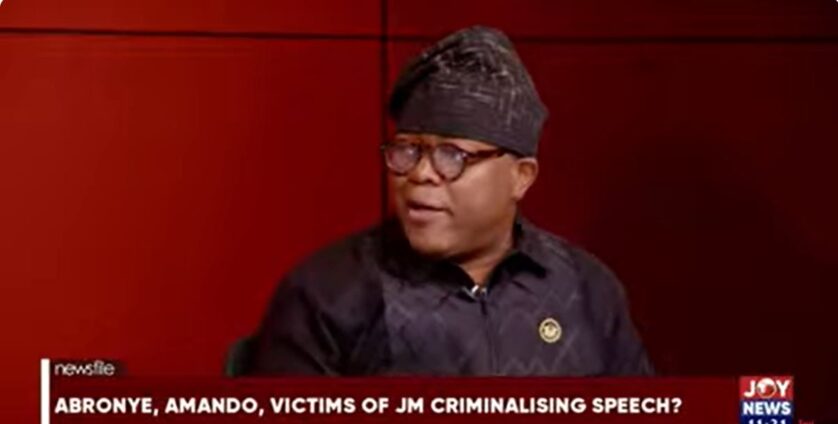
Managing Partner of Lord & Lords Legal Practice and Member of the National Democratic Congress Legal and Communication Committee, Victor Kwadjoga Adawudu Esq., has raised concerns about what he describes as a growing culture within Ghana’s political space that rewards abusive and reckless public commentary.
His comments follow the arrest of the New Patriotic Party’s Sunyani East Communications Officer, Abubakar Yakubu, popularly known as Baba Amando, in connection with ongoing investigations into allegations of offensive conduct, false publication, and the dissemination of statements considered likely to cause fear and panic.
Speaking on JoyNews’ Newsfile, Mr Adawudu suggested that some individuals have come to view abusive or misguided public statements as a form of notoriety, expecting that political actors will eventually intervene on their behalf if they face arrest.
He said this perception has contributed to a cycle where accountability is weakened, noting that some politicians and lawyers often rush to defend individuals who engage in such conduct.
“A culture is developing within our politics where some people believe that when they are abusive or make reckless and misguided statements, it becomes a form of fame because they assume they will eventually be arrested and others will intervene for them,” he said.
“There was a time when a police officer even called me and asked whether some of us in politics are not part of the problem, because we rush to defend people who engage in such conduct,” he added.
He explained that in some instances, individuals are arrested for making insulting or inflammatory remarks, only for political actors to move to secure bail or intervene at police stations quickly.
According to him, he has adopted a stricter personal position of refusing to intervene in such matters, arguing that accountability must be enforced consistently.
“I told people clearly that I would not come to the police station for them,” he said.
Mr. Adawudu added that the change in approach appeared to influence behaviour, as some individuals became more cautious once they realised there would be no automatic protection.
He maintained that political actors themselves play a role in shaping public conduct and accountability systems, stressing the need for restraint in their response to such cases.
“Ultimately, some of us in politics also contribute to this problem by the way we respond and intervene in such cases,” he said.
Latest Stories
-
EOCO had tactical team ready to arrest Baffour Awuah – Felix Kwakye Ofosu
16 minutes -
Afoko can unite NPP’s factions, says Charles Owusu Juanah
29 minutes -
Guardiola backing Man City after guilty verdicts
36 minutes -
Annoh-Dompreh questions EOCO’s claim that Manhyia South MP was unavailable for questioning
36 minutes -
Djokovic wins first match since Wimbledon at China Open
48 minutes -
KAIPTC, National Peace Council move to bridge civilian-security trust deficit to counter violent extremism
55 minutes -
Infantino should have no place in future of football – Pinto
58 minutes -
A decade of duty: First Commander recounts the unexpected birth of Ministries Fire Station
1 hour -
Mfantsipim must cultivate more business leaders, entrepreneurs – Nana Awuah
1 hour -
MOBA must reduce reliance on donations to protect Mfantsipim’s future – Patrick Kittoe
1 hour -
GCB extends Customer Service Week into month-long customer engagement
1 hour -
Africa risks widening inequality if it fails to build AI expertise – Kweku Awotwi
1 hour -
Women’s Voices Matter Movement petitions Gender Ministry over women’s rights and development
1 hour -
Ronaldo leaves Portugal camp after coach denies rift
1 hour -
Huel ad banned for suggesting its products could replace all meals
1 hour