

Audio By Carbonatix
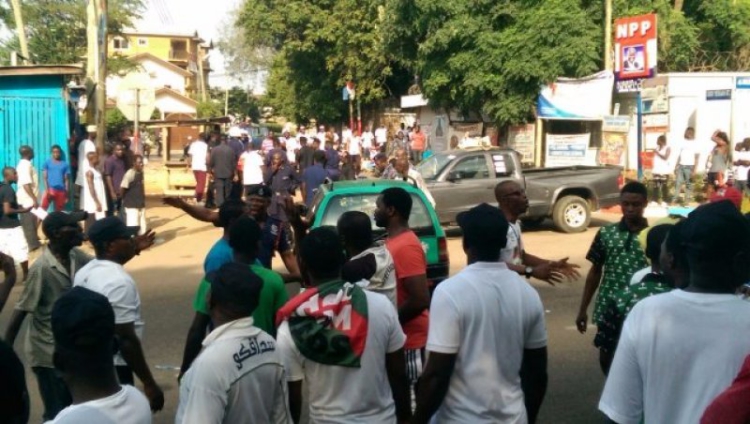
High unemployment and breakdown in family ties are causes of election violence in the Bono and Ahafo Regions, a study has revealed.
The survey also identified weak or inadequate electoral management body structures, including weak democratic institutions, dysfunctional judicial systems and polarized security agencies as major threats to the nation’s multi-party democracy, freedom of speech and rule of law.
The study recommended the need for successive governments to address these critical national challenges to foster unity and social cohesion in the nation’s political space.
It was conducted by Global Media Foundation (GLOMeF), Tim Africa Aid Ghana, and West Africa AIDS Foundation, all NGOs as part of a-15 month Election 2020 project being implemented by the NGOs with support from Star Ghana Foundation.
The project aimed at discouraging and reducing election-related violence in the constituencies through community dialogue and conflict resolution.
It is also to increase women, young people as well as People with Disabilities (PWDs) participation in politics and governance.
It further aimed at increasing the capacities of the electorate and election stakeholders, mostly in hard to reach communities, to influence political party manifesto to promote issue-based electioneering.
Titled “managing election 2020 related violence for democratic stability in Ghana”, the study was conducted in the Asunafo North and Asunafo South constituencies of the Ahafo and Banda and Tain constituencies of the Bono Region.
Police in the two regions have identified these areas as volatile and major election hotspots constituencies with a long history of political violence that threaten national peace and stability.
Societal challenges such as inequality and poverty, ethnicity and gender inequality remained electoral challenges of greater concern, Mr Raphael Godlove Ahenu, the Chief Executive Officer of the GLOMeF who released the outcome of the study indicated.
Speaking at a day’s election reporting training workshop for journalists, held in Sunyani, Mr Ahenu explained the concept of the study was drawn from data collected from Ghana’s 2012 Round five Afro barometers and the pre-election survey conducted by the Center for Democratic Governance (CDD-Ghana).
The three NGOs, implementing the Star Ghana Foundation project, organised the training workshop, which was attended by about 30 selected Journalists from the project implementing regions.
Other electoral challenges the survey mentioned included selfish leadership and weakened civil society activities, Mr Ahenu indicated saying until these challenges were addressed, it would be difficult for the nation to control political and election violence in the country.
Latest Stories
-
APL says GoldBod terminated US$1bn Goldstream deal over failure to meet obligations
3 minutes -
Daily Insight for CEOs: Making better decisions under pressure
4 minutes -
Weta rice farmers seek urgent support after floods destroy crops
5 minutes -
Mahama commits GH¢200m in 2027 Budget to complete Police Hospital expansion
8 minutes -
Standard Chartered Bank delivers strong returns and sustainable shareholder value
19 minutes -
Akufo-Addo’s role in the artificial cedi stability is indisputable — Facts do not bend to political convenience
22 minutes -
Breaking Bad actor RJ Mitte dies aged 34
29 minutes -
Wontumi pleads not guilty in GH¢30m Exim Bank loan case
34 minutes -
Beyond the Flyer: Awareness without screening is not enough
40 minutes -
Bekwai MP donates GH¢100,000 to hospital for specialist equipment
48 minutes -
Van Vicker sues Lil Win for defamation, demands GH¢10m
53 minutes -
FIFA/ FIBA agency Pep Sports moves to admit Ghana’s 7-Foot Basketball talent to its Ultra-Modern Sports campus after MyJoyOnline report
55 minutes -
GAUA strike disrupts academic plans at University of Ghana as students, parents express frustration
60 minutes -
Dad’s Army/African Polistas crowned champions of 2026 Accra Polo Club Trustees’ Cup
1 hour -
Mahama approves Integrated Basic Education Model, with funding expected in 2027 under GETFund formula
1 hour