

Audio By Carbonatix
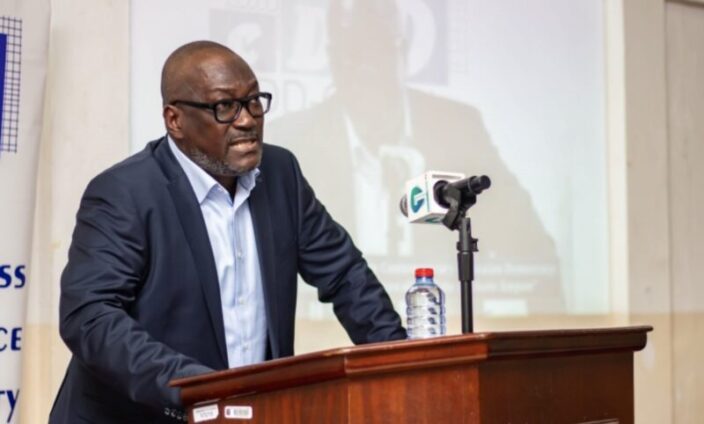
Professor Henry Kwasi Prempeh, Executive Director, Ghana Center for Democratic Development (CDD-Ghana), has eulogised the late Anthony Akoto Ampaw, a private legal practitioner for his selfless service to Mother Ghana.
He said the late Akoto Ampaw championed the voice of the people during challenging times in the history of Ghana through leading several street protest marches.
He also eulogised Akoto Ampaw for being a strong free speech advocate and a friend of the media.
Prof Prempeh gave the commendation in his keynote address during the Friends of Akoto Ampaw First Anniversary Public Lecture held at the Kwame Nkrumah Institute of African Studies, University of Ghana, Legon, Accra.
The event on the theme “The Crisis of Civic Citizenship in Contemporary Ghanaian Democracy Lessons from the Life and Times of the Late Akoto Ampaw,” was organised by the Friends of Akoto Ampaw in collaboration with the CCD-Ghana, the Kwame Nkrumah Institute of African Studies, University of Ghana, and Channel One TV.
Mr Akoto Ampaw, aka Sheey Sheey, passed away on October 20, 2023, at the age of 73.
It would be recalled that in late 1989, prompted by Mr Kwesi Pratt Jnr, and Mr John Ndebugre, Mr Akoto Ampaw and Prof Kwame Karikari, joined Mr Johnny Hansen, Mr Kweku Baako and others to form the Movement from Freedom and Justice (MFJ) with Prof Adu Boahen as its leader.
The MFJ had one other objective: To return the country to constitutional rule.
Two times in 1986 and 1987, Rawlings’ Provisional National Defence Council (PNDC) placed Mr Akoto Ampaw placed in long months of political detention.
First, in 1986, in the Tamale prison for six months and, in 1987, in the James Fort prison, Accra, for another 22 months.
Akoto Ampaw would often consider this experience a logic of the dictatorship.
Prof Prempeh noted that what citizens do in a democracy directly affected the quality of democracy they were likely to enjoy.
Quoting Mr Kofi Annan, a former United Nations Secretary-General, Prof Prempeh said, “if there is enough noise, enough pressure, enough organisation, the leaders will follow the people”.
The Executive Director said: “If the people are pathetic, they don’t vote, they are leaving the field wide open to the politicians to do what they want. So then, what is to be done? What have we been doing or not doing right?”
He said records showed that Ghanaians vote in extremely high numbers, above average global, and certainly on the continent.
“So, what is it that has been lacking? What are the choices, options, opportunities, and tools available to us as citizens that we might use to change the narrative I just presented? The most obvious form of civic engagement is, of course, voting. And God knows that Ghanaians love to vote.”
He said record had it that since 2008, around 75 plus percent of Ghanaians said they voted in the last election.
“So, there’s a very high level of public participation when it comes to voting. Not so many other forms of participation, especially when asked, when did you last participate in a demonstration or protest?”
Prof Prempeh said research shows that those who said they had participated in a demonstration, or protests was five per cent in 2022, from four per cent in 2012, and that the peak was around 15 per cent 2019.
He said citizens would use voting or voice protest to make their concerns known to government and policy makers; adding that few people had explored and deployed at full a range of voice options in their lives as citizens as Akoto Ampaw did in his life.
“So voting is also voice. So of course, I never went into the pooling booth with Akoto Ampaw, but I knew that he was a very civic-minded person, and he would vote. When I encountered him the first time, it was interesting,” he stated.
He said all firms in Ghana were commercial law firms, that was how they make their bread and butter but even in his law firm, and to many Ghanaians who encountered him in his capacity as a lawyer, Akoto Ampaw was very much a public interest at heart.
Professor Kwame Karikari, a former Executive Director of the Media Foundation for West Africa (MFWA), criticised the nation’s two major political parties for failing to address the illegal mining menace (galamsey) for fear of losing votes in mining areas.
Latest Stories
-
President Mahama ends Resetting Ghana tour of Ahafo Region
17 minutes -
African negotiators seek delivery of climate commitments at COP31
18 minutes -
BoG develops AI rules for financial sector
21 minutes -
‘Big Push’: Government assures contractors of prompt payments
25 minutes -
Court fines miner for breaking into gold buying shop
35 minutes -
Tarkwa court jails labourer for three years over GH¢123,000 theft
2 hours -
GAEC must retain nuclear scientists for Ghana’s nuclear ambitions – Minister
2 hours -
Man reportedly mistaken for game and shot by hunter dead in forest
2 hours -
19-year-old mason jailed 15 years for defiling seven-year-old pupil
2 hours -
Ghana’s banking sector assets rise 20.47% to GH¢500.2bn – BoG Governor
2 hours -
22 injured as Sprinter bus overturns at Sege after tyre burst
2 hours -
UN housing expert urges Ghana to strengthen Rent Control Department amid housing affordability concerns
2 hours -
Delta-BCI partnership reaches 166,000 people with breast cancer education
3 hours -
Power restoration fault suspected in Kumasi Central Market fire
8 hours -
The 7-foot giant of Ngleshie Amanfro: Seven-foot Ghanaian Ephraim Saawa dreams of joining the national basketball team
8 hours