

Audio By Carbonatix
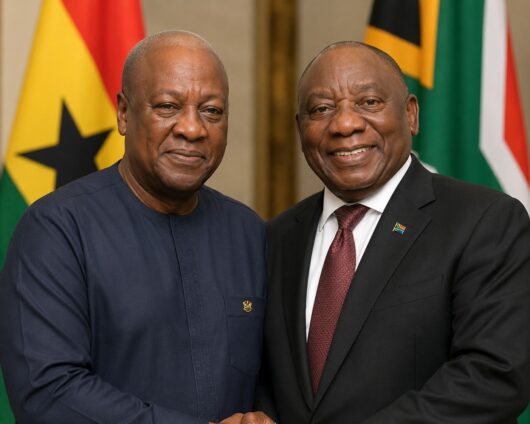
The Minister for Government Communications, Felix Kwakye Ofosu, has clarified that South African President Cyril Ramaphosa’s planned state visit to Ghana was arranged long before the recent outbreak of xenophobic attacks in South Africa.
According to him, the decision to postpone the visit was not a rejection of South Africa’s diplomatic overtures but a mutual recognition that the current tensions could overshadow the important issues both countries intended to discuss.
Speaking on Joy FM’s Midday News on Tuesday, Mr Kwakye Ofosu explained that the visit, initially scheduled for early August 2026, had been in the pipeline before the latest attacks targeting foreign nationals in South Africa.
“Let me indicate that this is a visit that had been planned well in advance of the outbreak of the recent xenophobic attacks. Indeed, it was slated to take place in early August 2026, but given the outbreak of these attacks and all the issues that have arisen therefrom, we sent a diplomatic communication to the South African government that we believe it is best to defer the visit until such a time when these matters have been resolved, and there is relative calm,” he said.
His comments follow reports that Ghana had declined President Ramaphosa’s proposed visit amid concerns over renewed xenophobic violence and its implications for the safety of Ghanaian nationals living in South Africa.
Mr Kwakye Ofosu stressed that Ghana attaches great importance to its longstanding relationship with South Africa, adding that both countries share strong historical, political, economic and social ties.
“Because we value the relationship we have with South Africa, a relationship that stems from shared values and cuts across several sectors — from economic and political relations to social cooperation — any such visit should focus on these important matters that have direct benefits for the people of both countries,” he stated.
He explained that allowing the visit to proceed under the current circumstances could shift attention away from key bilateral discussions and place greater focus on the recent attacks.
“Given the nature of the recent attacks, there is a likelihood that they will overshadow the very important issues that would have to be discussed during such a visit. So we believe that when matters settle, and the issue of xenophobic attacks no longer hangs over such discussions, it will then be appropriate to have the visit,” he added.
READ ALSO: Ghana rejects Ramaphosa state visit request over xenophobic attacks, concerns about his safety
The proposed state visit was expected to strengthen cooperation between Ghana and South Africa, with discussions focusing on deepening bilateral relations and exploring opportunities in areas of mutual interest.
Latest Stories
-
UK tries to stop Trump’s diesel export ban
3 hours -
Late Olise goal gives France win over Belgium
3 hours -
Mancini enjoys first win since return as Italy boss
3 hours -
Interest payments to average a high 20% of government revenue over next 4 years
3 hours -
Anthropic warns AI may pose ‘existential risks to humanity’ in IPO filing
3 hours -
Joe Hart trusts Man City chair Al Mubarak over ruling
4 hours -
Strategy of accumulating foreign reserves, gold carries high fiscal cost – S&P Global
4 hours -
Weak institutional arrangements, high debt servicing constrain Ghana’s rating – S&P
4 hours -
Man City CEO defiant over Premier League charges
4 hours -
Infantino makes bigger cash pledge to Fifa members
4 hours -
Bond market: Turnover declined by 28% to GH¢1.56bn
4 hours -
Volta Region National Public Speaking contest advances drug prevention conversation
4 hours -
New health training facility at Ampoma-Jema to address admission shortfalls, but Minister flags missing amenities
5 hours -
Black Challenge unveiled with sights set on Amputee World Cup glory
5 hours -
Pay striking teachers before expressway spending, Dr Kingsley Agyemang tells government
6 hours