

Audio By Carbonatix
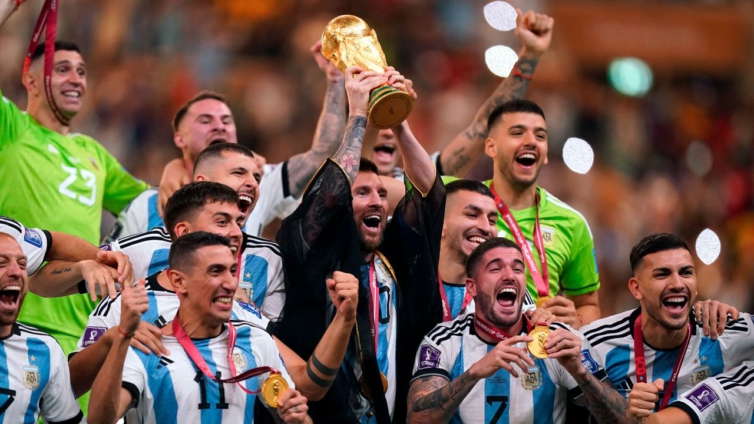
After 28 days, 64 games and 172 goals at Qatar 2022, Lionel Messi walked up on the podium at Lusail Stadium to finally get his hands on the World Cup trophy that had eluded him throughout his career.
Before joining his teammates, who were waiting for their captain in a hive of excitement on a nearby stage, Messi first shook hands with FIFA President Gianni Infantino and Qatar’s Emir Sheikh Tamim bin Hamad Al Thani.
Tamim then placed a black and gold bisht – a traditional item of clothing worn in the region for special events and celebrations – on the Argentina captain before the 35-year-old was handed the trophy.
In his new attire, which covered his national pale blue and white jersey, Messi danced towards his teammates before lifting the trophy above his head.
It was, for some, the perfect ending to a tournament that has been viewed by many as the best World Cup ever.
However, for others, it ruined the moment.
“Seems a shame in a way that they’ve covered up Messi in his Argentina shirt,” said former England international and presenter Gary Lineker on BBC’s live coverage of the final.
To others, it was one last attempt for Qatar to stamp its mark on the tournament – a criticism of the “sportswashing” (where critics accused Qatar of using the occasion to paper over its human rights record) that has underpinned much of the coverage of the tournament.
“Something a little strange about Messi being dressed in Bisht, that black cloak that the emir of Qatar dressed him in before lifting the World Cup,” New York Times journalist Tariq Panja tweeted.
“Qatar wants this to be its moment as much as it is Messi’s and Argentina’s.”
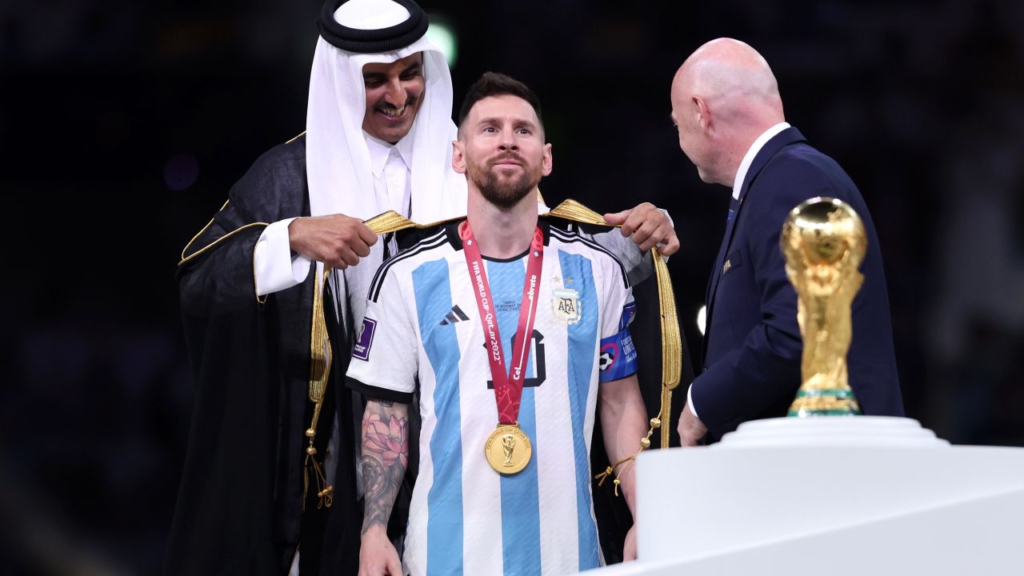
There was more criticism from other media, with British newspaper The Telegraph originally writing the headline “The bizarre act that ruined the greatest moment in World Cup history” in reference to Messi wearing the bisht.
It later changed the headline of the story to “Lionel Messi made to wear traditional Arab bisht for World Cup trophy lift.”
Messi didn’t wear the item of clothing for long, taking it off shortly after the trophy presentation and celebrating with his teammates in Argentina’s distinctive jersey.
Amid the criticism, Hassan Al Thawadi, Secretary General of the Qatar’s Supreme Committee for Delivery & Legacy (SC), an organization charged with organizing the World Cup, tried to explain the reasons behind the bisht.
“It is a dress for an official occasion and worn for celebrations. This was a celebration of Messi,” Al Thawadi told BBC Sport.
“The World Cup had the opportunity to showcase to the world our Arab and Muslim culture. This was not about Qatar, it was a regional celebration.
“People from different walks of life were able to come, experience what was happening here and get to understand that we may not see eye to eye on everything, but we can still celebrate together.”
‘Preconceived notions’
Others on social media were outraged by the criticism of the bisht, saying it was steeped in ignorance and misunderstanding of Qatar’s culture.
It was another example, they said, of the constant criticism the country has received since winning the right to host the tournament.
“Some are mad because Messi wore a bisht (it was gifted to him; a symbol of appreciation and respect in the Arab culture),” writer and columnist Reem Al-Harmi tweeted.
“However, I didn’t see the same level of anger and outrage when racism, Islamophobia, and orientalism was constantly used against the World Cup in Qatar.
“Instead of preconceived notions & judgmental views, turning this beautiful and meaningful photo into something that is not, read about the Arab bisht; its importance, and why/when it’s worn.
“Gifting someone a bisht, shows how significant/respectful they are, that’s Messi today.”
CNN reached out to FIFA for comment regarding the decision to use the bisht in the presentation ceremony.
Messi has not publicly commented on the bisht.
Latest Stories
-
Nearly 2,000 displaced, schools damaged as windstorm wreaks havoc in Gushegu
7 minutes -
Ghana’s Derrick Kohn to work under Marie-Louise Eta as she becomes first woman to coach men’s Bundesliga team
12 minutes -
Accra Open Championships conclude with strong performances ahead of African Championships
19 minutes -
Ghana to begin camping with 12 athletes after Accra Open Championships – Bawa Fuseni
40 minutes -
Anthony Joshua declines showdown with Tyson Fury but admits they ‘probably’ clash next
53 minutes -
Tyson Fury dominates Makhmudov, calls out Joshua next
1 hour -
I have supported highway authority financially to fix roads in my constituency – A Plus
2 hours -
US, Iran fail to reach peace agreement after marathon talks in Pakistan
3 hours -
ECG kicks off Phase Two of transformer upgrades at Lashibi; brief outages expected
3 hours -
Port crises loom as 11,000 drivers threaten four-day strike
4 hours -
A source of excellence across generations – Vice President Opoku-Agyemang lauds Mfantsipim
5 hours -
(Photos) Mfantsipim School launches historic 150th anniversary
5 hours -
Knights and Ladies of Marshall group backs Catholic Bishops’ stance on anti-LGBTQ+
6 hours -
Bright Simons: All the Filla in the Ibrahim Mahama/E&P – Gold Fields Saga
7 hours -
Monetise Idiocy In Ghana
7 hours