

Audio By Carbonatix
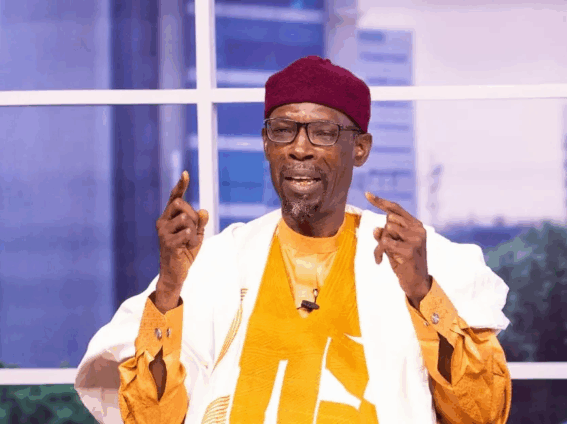
Spokesperson for the National Chief Imam, Sheikh Aremeyaw Shaibu, has called for restraint, patience and forgiveness among Christians and Muslims as Ghana seeks to contain tensions following a viral incident involving a pastor who was arrested for allegedly making derogatory comments about Prophet Muhammad.
Speaking at an engagement between the Inspector-General of Police (IGP), the Police Management Board (POMAB) and religious leaders on Friday, August 14, Sheikh Aremeyaw said the recent developments had generated strong emotions and risked pushing the country towards interfaith hostility.
He cautioned, however, that Ghana must not allow anger over religious provocation to undermine decades of peaceful coexistence between Christians and Muslims.
His appeal centred on a simple principle: peace must be treated as a permanent responsibility rather than a temporary response to moments of crisis.
“Peace, therefore, does not have a timetable,” Sheikh Aremeyaw said. “There is no moment in our lives when we will not need peace.”
Sheikh Aremeyaw said the developments of the past few days had created a volatile atmosphere, with heightened passions threatening to spill into wider religious confrontation.
He drew comparisons with conflicts in other parts of the region, citing the Central African Republic as an example of the consequences of allowing interfaith and communal tensions to deepen.
“In a few days, our country has been thrown into a state of turmoil, rising passion, indeed threatened to slip into interfaith hostility, the type that we have seen,” he said.
The Islamic scholar stressed that Ghana's circumstances were different because Christians and Muslims had lived together for decades, sharing communities, workplaces and social spaces.
“But we in Ghana have been together, like the IGP said, for the past decades. We've lived together,” he said.
He described the recent incidents as particularly disturbing because they threatened those longstanding relationships.
Sheikh Aremeyaw acknowledged the depth of Muslim sensitivity to remarks considered offensive to Prophet Muhammad.
He said the Islamic faith requires Muslims to hold all prophets in high esteem and stressed that the reverence was not limited to Prophet Muhammad.
“For us as Muslims, indeed, all prophets, without exception, are held as sacred beings, held in high esteem,” he said.
He noted that the names of prophets recognised in both Islamic and Christian traditions appear in the Holy Quran, arguing that this provides an important point of common ground between the two faiths.
“So just as we respect the Prophet Muhammad, peace be upon him, so we are not different from the Christian community when it comes to that,” he said.
The remarks were made against the backdrop of the viral incident involving the Christian pastor, whose alleged comments about Prophet Muhammad triggered strong reactions.
Sheikh Aremeyaw said he would not repeat the alleged comments because of their offensive nature.
“If you ask me to repeat it, me, I cannot. I cannot,” he said.
But he stressed that the hurt caused by the alleged remarks should not become a justification for violence.
“For all those who were hurt by it, I call for restraint and patience,” he said.
The National Chief Imam's spokesperson also recognised that Christians had grievances arising from the subsequent events surrounding the pastor.
He called on Christians who were angered by what had happened to remain calm and allow the matter to be handled through appropriate channels.
“And among the Christians, for also those who were hurt by what was done to the brother Apostle, [we] require cool heads to be able to deal with this matter,” he said.
His appeal therefore sought to acknowledge the grievances of both communities while discouraging either side from taking matters into its own hands.
The message was consistent with the broader call at the engagement for religious disagreements and alleged offences to be addressed through dialogue and the formal justice system rather than retaliation.
Sheikh Aremeyaw grounded his appeal in teachings common to Christianity and Islam, arguing that both faiths provide strong theological foundations for peaceful coexistence.
He quoted the Christian teaching, “Blessed are the peacemakers, for they shall be called the children of God.”
He then referred to a Muslim prayer centred on peace.
“The Muslim prays saying, ‘O God, you are peace. And from you proceeds peace. And from you and to you ascends peace. And so therefore grant us peace,’” he said.
He also invoked the commandment to love one's neighbour as oneself, saying a similar principle was central to Islamic teaching.
“The Holy Quran or the Holy Prophet also says, if you do not love your neighbour, you can claim that your faith is complete,” he said.
For Sheikh Aremeyaw, those shared teachings provide more than theological similarities; they offer practical guidance for managing the current dispute.
With the engagement taking place on a Friday, Sheikh Aremeyaw said religious leaders had an immediate opportunity to influence public attitudes through their sermons.
He disclosed that peace, forgiveness, pardon and compassion would form the focus of his own sermon and urged other imams to make similar appeals to their congregations.
“I hope that all other imams will courageously make this the issue of peace, forgiveness, pardon, compassion,” he said.
He described those virtues as values demonstrated by the prophets revered by Muslims and Christians.
“These are the virtues that were upheld by the great prophets of Jesus and the Prophet Muhammad,” he said.
The call effectively placed religious pulpits at the centre of the effort to de-escalate tensions, particularly at a time when inflammatory comments can spread rapidly through social media.
Sheikh Aremeyaw expressed confidence that consistent messages of peace from religious leaders could help the country return to calm.
“And I think that we are going to uphold this and preach it,” he said.
Sheikh Aremeyaw also commended the Inspector-General of Police for bringing religious leaders together to discuss the situation.
He expressed appreciation for what he described as the swift response by the police and the decision to create a platform for dialogue.
“My hope is that IGP will add my voice to the thanks that we want to give you for swiftly managing this situation and calling us together to engage in this dialogue,” he said.
For the National Chief Imam's spokesperson, dialogue between the security authorities and religious leadership is an important part of maintaining public confidence and preventing misinformation or anger from driving further confrontation.
Sheikh Aremeyaw's most significant warning, however, extended beyond the immediate controversy.
He argued that Ghana's interfaith harmony represents a valuable national asset that must be deliberately protected.
He recalled a comment attributed to the UN Resident Coordinator, who, according to Sheikh Aremeyaw, observed that Ghana exports commodities such as cocoa and gold but has another asset that could have significance beyond its borders: its ability to maintain peaceful relations between different faith communities.
“In Ghana, we are exporting cocoa, we are exporting gold. But there is one thing that we must export, and that is our interfaith harmony,” he said.
He acknowledged that the recent developments had caused a setback to that image.
“But that is what is suffering in some setback,” he said.
He nevertheless urged Ghanaians to rally around the country's tradition of religious tolerance and prevent the current tensions from causing lasting damage.
“But we must rally around and keep it intact,” he said.
For a country that has long been regarded as relatively stable in a region that has experienced political and communal conflicts, maintaining interfaith trust is particularly important.
While the police have a duty to investigate alleged offences and maintain public order, religious leaders, he said, have an equally important role in influencing how their followers respond.
Muslims offended by remarks about Prophet Muhammad must exercise restraint, he said, just as Christians angered by the treatment of the pastor must remain calm.
The emphasis on both sides was intended to prevent the issue from becoming a contest over which community had suffered the greater offence.
Instead, Sheikh Aremeyaw urged both communities to draw on their respective religious traditions of peace, forgiveness and compassion.
For him, Ghana's interfaith harmony is too valuable to be sacrificed to a cycle of provocation and retaliation.
The challenge now, he suggested, is to ensure that the recent controversy becomes an opportunity to reinforce the country's culture of religious coexistence rather than a turning point towards division.
Latest Stories
-
EOCO grants Suame MP John Darko enquiry bail in GH¢27m SIC investigation
46 seconds -
NPP cannot question EC appointment after appointing own people to Commission – Kwakye Ofosu
6 minutes -
BoG deepens public trust with regional stakeholder forum in Techiman
16 minutes -
‘We have turned the tide’ – Ato Forson says Ghana is ready to take off
21 minutes -
Police arrest man captured in viral video assaulting wife in Agona Nkwanta
23 minutes -
KATH Mother and Baby Unit construction stalled for 14 months over unpaid contractor arrears
37 minutes -
Government wanted to ‘tilt the balance’ with new EC appointments – Kwakye Ofosu
43 minutes -
Angry Tema Community 25 residents threaten to sleep at GWL over water shortage
56 minutes -
BoG takes financial literacy drive to Techiman, vows to protect depositors
56 minutes -
‘Stop the distractions’ – Akosua Manu demands answers over GH¢49.7m South Africa evacuation cost
57 minutes -
Formula 1 to return to Africa with Rwanda Grand Prix in early 2030s
1 hour -
Mahama says Ghana is safer today as he commissions 85-bed ward at Police Hospital
1 hour -
LA 2028: Black Queens face Zambia in final Olympic qualifier
1 hour -
WAFU Zone B: Black Starlets seal semifinal place with 3-1 win over Benin
1 hour -
Black Queens thrash Mauritius 7-0 to advance 10-0 on aggregate in Olympic Qualifiers
2 hours