

Audio By Carbonatix
The funeral mass for South African anti-apartheid campaigner Archbishop Desmond Tutu is set to take place on Saturday morning in Cape Town.
Tutu, a Nobel Peace Prize winner who helped end the racist regime in South Africa, died last Sunday aged 90.
His death prompted an outpouring of grief among South Africans.
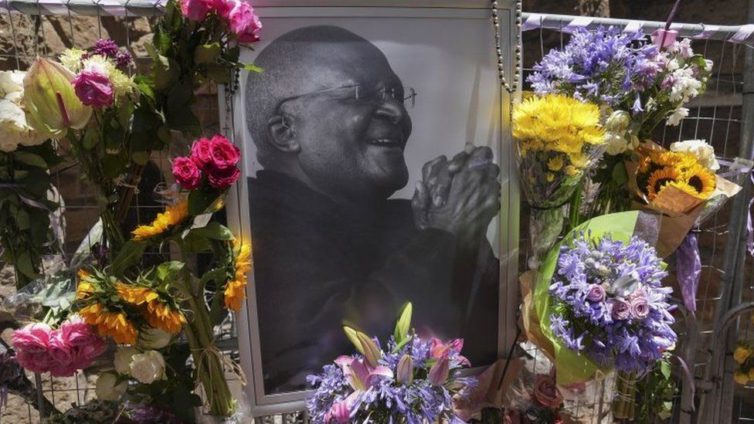
Thousands have paid their respects at St George's Cathedral where his body has been lying in state in a simple casket.
Tutu was one of the driving forces behind the movement to end the policy of racial segregation and discrimination enforced by the white minority government against the black majority in South Africa from 1948 until 1991.
He will be given an official state funeral with South African President Cyril Ramaphosa expected to deliver the main eulogy.
Tutu had insisted there should be "no ostentatiousness or lavish spending" on the ceremony and that he be given "the cheapest available coffin".
He also said the only flowers in the cathedral should be a "bouquet of carnations from his family", according to the Archbishop Tutu IP Trust and the Desmond and Leah Tutu Legacy Foundation.
His ashes are to be interred behind the pulpit at St George's Cathedral in Cape Town - the Anglican diocese he served as Archbishop for 35 years.
It was earlier revealed that Tutu is to be aquamated - a process using water that is described as an environmentally friendly alternative to cremation.
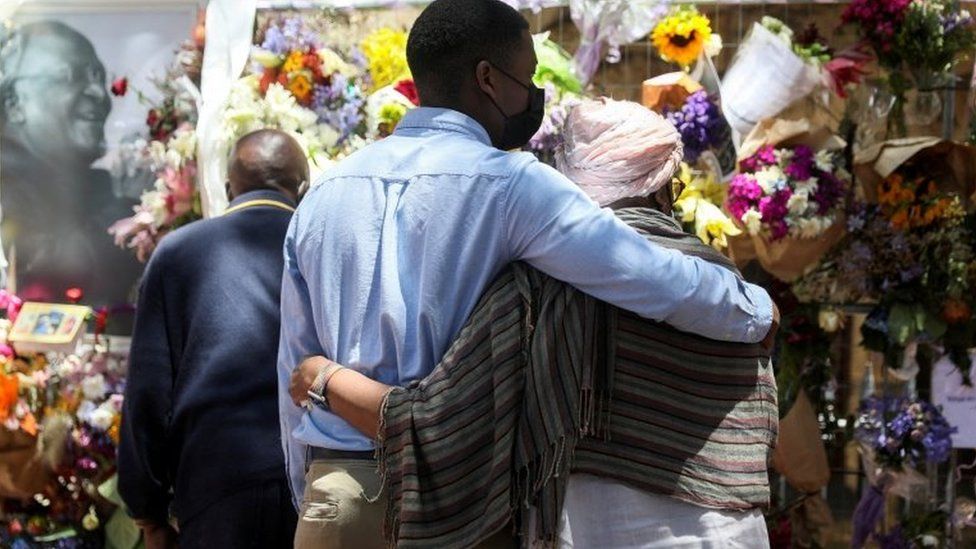
Many people in Cape Town turned up to file past the archbishop's coffin as it lay in state.
One man, Wally Mdluli, hitchhiked more than 1,000km (620 miles) across the country from Bloemfontein to Cape Town - enlisting the help of family and friends to pay for some of the trip and even sleeping at a petrol station on the way.
"I feel fulfilled after I saw the coffin. It's like his spirit is in me," he told the BBC's Nomsa Maseko in Cape Town.
Tutu used his high profile to speak out against the oppression of black people in his home country, always saying his motives were religious and not political.
After Nelson Mandela became South Africa's first black president in 1994, Tutu was appointed by him to a Truth and Reconciliation Commission set up to investigate crimes committed by both whites and blacks during the apartheid era.
Tutu was awarded the Nobel prize in 1984 for his role in the struggle to abolish the apartheid system.
He was also credited with coining the term Rainbow Nation to describe the ethnic mix of post-apartheid South Africa, but in his latter years, he expressed regret that the nation had not coalesced in the way in which he had dreamt.
Latest Stories
-
Gender Ministry supports Harriet Amuzu in ongoing abuse case
4 minutes -
AG joins plaintiff to scrap OSP ?: We should be mindful of the mischief in this – Bobby Banson
10 minutes -
Samson Lardy Anyenini questions willingness of Attorneys-General to prosecute political colleagues
13 minutes -
It is only fair the OSP is heard in Supreme Court case – Bobby Banson
18 minutes -
Asiedu Nketia resumes Ashanti tour, second leg kicks off on Sunday
27 minutes -
NLA denies salary cut claims, threatens legal action over reports
31 minutes -
BoG Governor honoured for stabilising cedi, improve inflation
33 minutes -
Kyebi Easter Homecoming 2026: A resounding success!
1 hour -
Trade Minister applauds GUTA as a pillar of economic growth; Prez Mahama honoured
2 hours -
President’s brother’s takeover of Damang Mines is ‘untidy’ – Alhassan Tampuli
2 hours -
It’s not true that gov’t decided not to renew the lease for Gold Fields – Bobby Banson
2 hours -
Ghana to boost tomato production with 60-hectare irrigated farms and processing initiatives
2 hours -
E&P’s takeover process of Damang Mines was very clean – Inusah Fuseini
2 hours -
Damang takeover: There is not going to be any job loss; it is a lease change – Bobby Banson
3 hours -
Gold Fields didn’t stop mining at Damang mines; such claims are untrue – Bobby Banson
3 hours