

Audio By Carbonatix
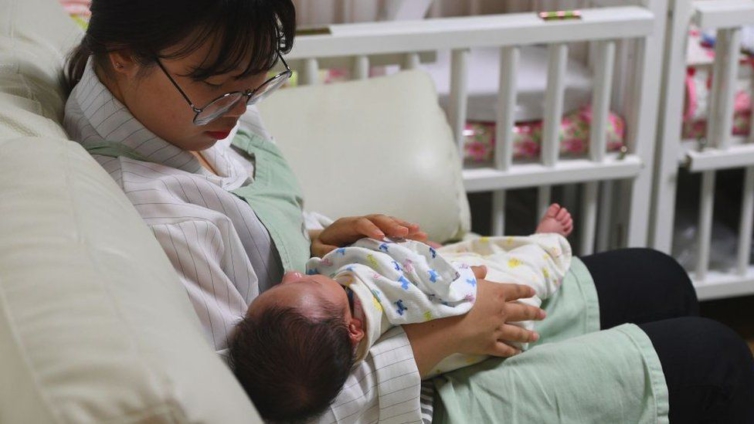
South Korea recorded more deaths than births in 2020 for the first time ever, raising fresh alarm in the country which already has the world's lowest birth rate.
Only 275,800 babies were born last year, down 10% from 2019. Around 307,764 people died.
The figures prompted the interior ministry to call for "fundamental changes" to its policies. A declining population puts immense strain on a country.
Apart from increased pressure on public spending as demand for healthcare systems and pensions rise, a declining youth population also leads to labour shortages that have a direct impact on the economy.

Last month, President Moon Jae-in launched several policies aimed at addressing the low birth rate, including cash incentives for families.
Under the scheme, from 2022, every child born will receive a cash bonus of 2 million won ($1,850; £1,350) to help cover prenatal expenses, on top of a monthly payout of 300,000 won handed out until the baby turns one. The incentive will increase to 500,000 won every month from 2025.
What's behind South Korea's falling birth rate?

Largely, it's because in South Korea, women struggle to achieve a balance between work and other life demands.
Hyun-yu Kim is one of them. The oldest of four, she dreamed of having a big family of her own. But faced with conditions that are not family friendly in South Korea, she is reconsidering her plans to have children.
She recently accepted a new job and had felt anxious about taking time off for maternity leave. "People tell me that it's safer to build my career first," she told the BBC.
Soaring real estate prices are another major issue. Ms Kim points out that rapidly rising property prices also discourage young couples.
"In order to have children, you need to have your own home. But this has become an impossible dream in Korea."
She is also unconvinced by the incentives being offered by the government.
"It's expensive to raise a child. The government providing an extra couple hundred thousand won won't solve our problems."
Latest Stories
-
Assemblies of God requires pastors to resign before entering partisan politics – Rev. Wengam
3 minutes -
Ghana targets 20% annual reduction in maternal deaths – Health Minister
8 minutes -
Cyber attacks in Africa grow faster than global rate, report finds
10 minutes -
Ghana signs UAE deal to create 5,000 overseas jobs
17 minutes -
One Million Coders Programme targets 100,000 digital jobs in two years – Sam George
20 minutes -
John Jinapor, Italian Ambassador explore opportunities for energy sector investment
22 minutes -
NHIA seeks legal reforms to support Free Primary Healthcare
26 minutes -
Beatrice Annan defends Afi Agbenyo’s EC appointment, cites record of gender advocacy
29 minutes -
Ghana seeks investment deals in Bangkok amid global economic crises
33 minutes -
IMF raises Ghana’s 2026 growth forecast to 5.7%, sees inflation falling to 4.8%
34 minutes -
Ablakwa urges Africans not to view immigrants as threat to national progress
39 minutes -
Mahama Cares must fund treatment, not looting – Asogli chiefs
40 minutes -
Ghana’s economic salvation lies not in shifting geo-political allegiances – Dr Atuahene
43 minutes -
BoG proposes tougher rules on loan repayment assessment
48 minutes -
Government plans mandatory drug tests for public service jobs — Muntaka
53 minutes