

Audio By Carbonatix
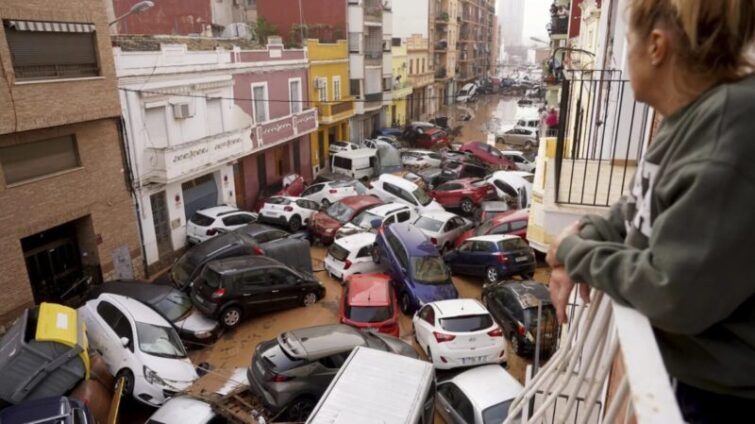
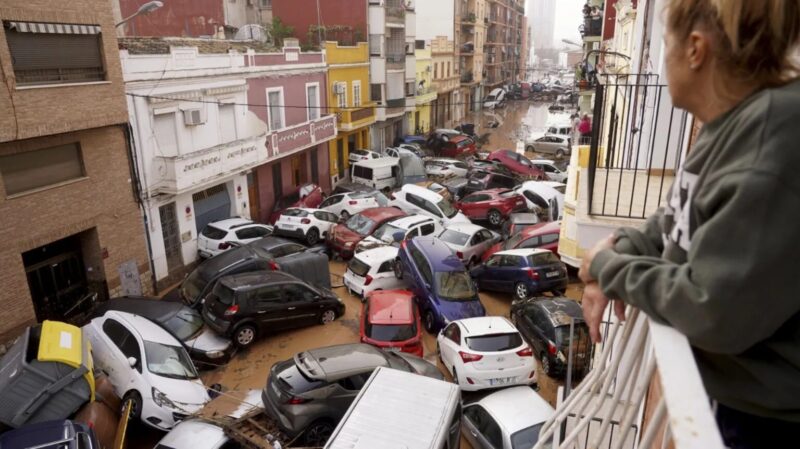
Spain is enduring its worst flooding disaster in decades, with at least 95 people dead and dozens more missing, after huge rains swept the eastern province of Valencia and beyond.
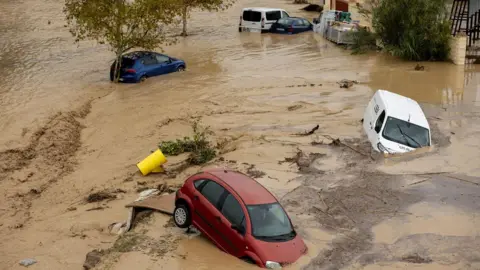
Torrential rain on Tuesday triggered flash floods which swept away bridges and buildings and forced people to climb on to roofs or cling to trees to survive.
Prime Minister Pedro Sánchez has declared three days of national mourning as the extreme conditions continue, restricting some rescue efforts.
The death toll is feared to climb as "there are many missing people", the government says.
At least 92 deaths were recorded in Valencia, with another two in Castilla-La Mancha to Valencia's west and one in Málaga - a 71-year-old British man who died in hospital after being rescued from his home.
The flooding death toll is the country's worst since 1973 when at least 150 people were estimated to have died in the nation's worst-ever floods in the south-east.
In his national address on Wednesday, Sánchez urged citizens to remain vigilant and pledged a full recovery, telling victims: “The whole of Spain weeps with you… we won’t abandon you.”
One of the first towns affected near Valencia, Chiva, reported one year's worth of rainfall on Tuesday in just a period of eight hours, according to national weather agency Aemet.
As Spanish army and emergency crews rushed to carry out rescues on Wednesday morning - including winching people to safety from balconies and car rooftops - survivors in Valencia recounted the horror of the floods on Tuesday night.
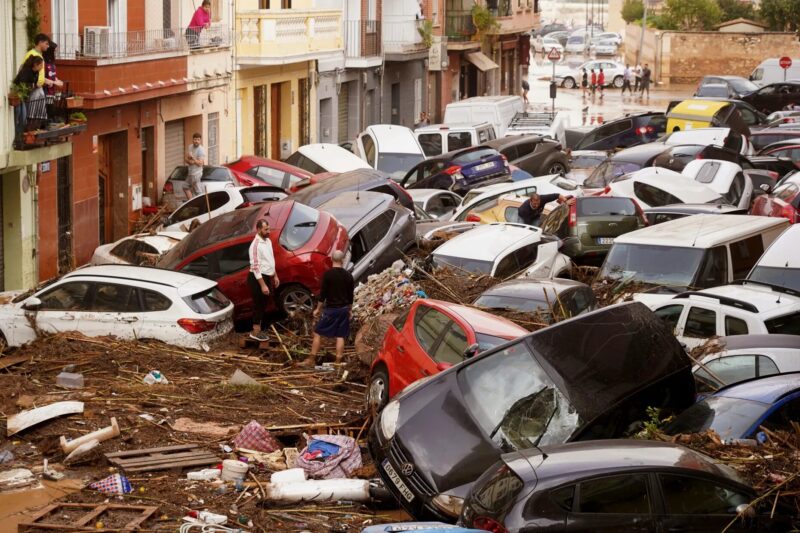
Sudden surges turned streets and roads into rivers, catching many motorists unaware.
Guillermo Serrano Pérez, 21, from Paiporta near Valencia, said the water had rushed down a highway “like a tsunami”, forcing him and his parents to abandon their car and climb on to a bridge to survive.
Another witness recounted a scene when motorway drivers realised a torrent of water was heading towards them and formed a human chain to escape along a raised central reservation.
“Thank goodness no one slipped because if anyone had fallen, the current would have dragged them away,” Patricia Rodriguez, 45, told El País newspaper.
One resident of La Torre told the BBC some of his friends had lost their homes, and on Tuesday night he "saw cars floating in the water" and the tides "breaking through some walls."
Meanwhile, the mayor of Horno de Alcedo, a town just outside Valencia, told BBC Newshour how the water levels rose by more than a metre in just a matter of minutes.
"The currents were so quick – and we called the emergency services who started rescuing some people who had water up to their necks", Consuelo Tarazon said.
There are widespread accusations in Spain that in many cases, disaster relief authorities were too slow to act with warnings, meaning people could not get off roads or seek higher ground.
The civil protection agency, deployed during national disasters, did not issue an alert until 20:15 on Tuesday evening local time – but by then, Chiva and several other towns had already been flooded for at least two hours.
Valencia’s regional government has also been forced to defend its decision to scrap the Valencia Emergency Unit, which had been set up by the previous government to tackle natural disasters such as flooding and wildfires.
Spain deployed more than 1,000 troops to help with rescue efforts on Wednesday, but many crews remain cut off from towns by flooded roads and downed communication and power lines.
The European Union's chief, Ursula von der Leyen, said it had activated its Copernicus satellite system to help co-ordinate Spanish rescue teams. Other European neighbours have also offered to send reinforcements.
Spain's Defence Minister Margarita Robles had said earlier on Wednesday the flooding across the region was "an unprecedented phenomenon".
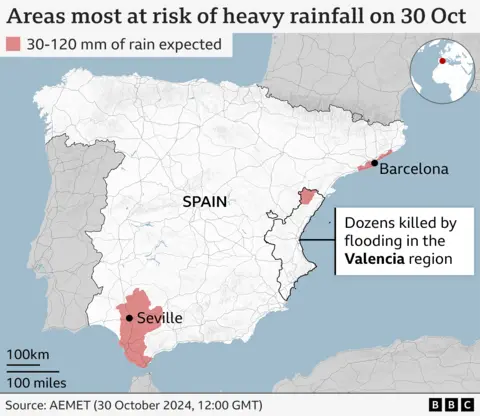
The downpour eased in the country's central-east on Wednesday, but weather officials warned the rains were moving north-east to the Catalonia region. Weather warnings have also been issued across several other parts of the country, urging people to brace for floods and take shelter.
Many factors contribute to flooding, but a warming atmosphere caused by climate change makes extreme rainfall more likely.
Weather researchers have identified the likely main cause of the intense rainfall as a “gota fria” – a natural weather event that hits Spain in autumn and winter when cold air descends on warmer waters over the Mediterranean.
However, the increase in global temperatures had led to the clouds carrying more rain, scientists told the BBC.
“With every fraction of a degree of fossil fuel warming, the atmosphere can hold more moisture, leading to heavier bursts of rainfall,” said Dr Friederike Otto, from Imperial College London, who leads an international group of scientists who are trying to understand the role that warming plays in these type of events.
“No doubt about it, these explosive downpours were intensified by climate change.”
The world has already warmed by about 1.1C since the industrial era began and temperatures will keep rising unless governments around the world make steep cuts to emissions.
Latest Stories
-
Renewed flood intervention at Mallam Junction raises hopes among residents, businesses
13 minutes -
St Augustine’s College retain National Investment Quiz title after nail biting grand finale
22 minutes -
Education infrastructure investment will drive Banda’s development – Ahmed Ibrahim
30 minutes -
Teacher unions strike: Gov’t presents fresh proposals as talks end inconclusively
1 hour -
51,000 teachers’ promotion arrears to be validated for October payment – Education Minister
2 hours -
Kwabena Boamah appointed Board Chair for Impact Investing Ghana
2 hours -
Striking teacher unions to meet Fair Wages and Salaries Commission on October 6
2 hours -
EOCO working with AG to arraign Nana Baffour Awuah before weekend court
2 hours -
Duraplast reassures customers after fire, announces October 5 reopening
2 hours -
Call off strike, gov’t will not renege on promotion arrears pledge – Haruna Iddrisu appeals to teacher unions
2 hours -
Committee set up to validate teachers eligible for 20% deprived-area allowance – Education Minister
2 hours -
Five-member committee to search for new Black Stars coach after Sports Ministry-GFA meeting
3 hours -
Pinktober: Breast cancer survival exceeds 90% when detected early – Breast Society of Ghana
3 hours -
TCDA to adopt Upper West’s MATCO mango farm as northern prototype, issues warning against felling shea trees
3 hours -
‘Fear delegates’ tag: Afoko touts genuineness among delegates ahead of NPP delegates conference
3 hours