

Audio By Carbonatix
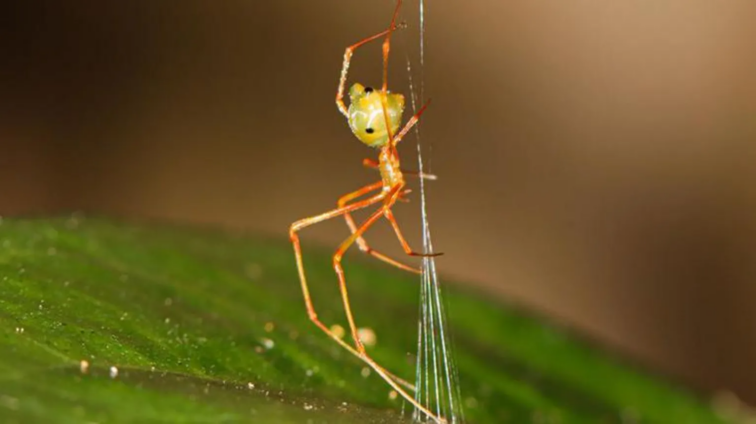
A new species of spider that weaves a catapult-like silk trap to snare a single ant species has been discovered in the remote rainforests of northern Australia.
Researchers believe the nocturnal predator developed the unique hunting method to make meals of aggressive ants, which are notoriously dangerous - and unusual - prey for arachnids.
The snare's "exceptionally high power" flings the ant into a bigger web at "15 times the most extreme g-forces experienced by jet pilots", said lead researcher Prof Ajay Narendra.
Though it is yet to be formally named, scientists have nicknamed the tiny spider "ballista", after the ancient weapon used to hurl stones in battle.
"The snare mechanism seems to have evolved as a highly specialised way of allowing the spider to 'pick off' potentially hazardous prey one at a time and transport them a safe distance away from ant trails and nests," researcher Dr Jonas Wolff said.
Ants have chemical defences, including the ability to sting in some species, and can rapidly recruit throngs of other ants as a backup to overcome potential predators, Narendra explained.
Their team, from Australia's Macquarie University, spent 10 nights in the tropical rainforests of northern Queensland, capturing the spider's behaviour using high-speed and infrared cameras.
According to their findings, published in the journal Current Biology, the ballista spider resides on trees occupied by the aggressive and territorial green tree ant Oecophylla smaragdina, spending the day in webs hidden beneath the underside of leaves.
After nightfall, it drops down by about 50cm to a leaf, a branch, or the forest floor and forms an anchor point with a silk line.
It then spends hours creating a cone-shaped "scaffold" of dozens of tension lines, around which it finally wraps a thinner type of silk before retreating upwards.
Within moments, scientists found green ants approached the trap and bit it - causing the snare to spring and the prey to be launched into the spider's web at "extreme" acceleration.
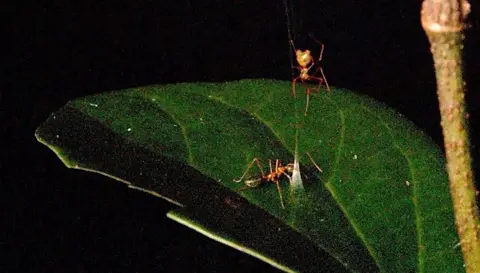
The scientists found that these green ants were the only prey captured by the spider, even when they released other nocturnal ants near the trap. They suspect the spider adds pheromones to the trap to lure and anger the green ants alone.
That is unprecedented, Narendra said.
"This seems to be the only case where a spider's web is designed to catch a single prey species, and where the mechanism is triggered by the prey rather than by the predator."
The spider, which belongs to the genus Propostira, was initially observed by biomedical researcher Greg Anderson - also a spider researcher and photographer.
Latest Stories
-
Kwabena Boamah appointed Board Chair for Impact Investing Ghana
53 seconds -
Striking teacher unions to meet Fair Wages and Salaries Commission on October 6
15 minutes -
EOCO working with AG to arraign Nana Baffour Awuah before weekend court
18 minutes -
Duraplast reassures customers after fire, announces October 5 reopening
26 minutes -
Call off strike, gov’t will not renege on promotion arrears pledge – Haruna Iddrisu appeals to teacher unions
28 minutes -
Committee set up to validate teachers eligible for 20% deprived-area allowance – Education Minister
33 minutes -
Five-member committee to search for new Black Stars coach after Sports Ministry-GFA meeting
1 hour -
Pinktober: Breast cancer survival exceeds 90% when detected early – Breast Society of Ghana
1 hour -
TCDA to adopt Upper West’s MATCO mango farm as northern prototype, issues warning against felling shea trees
1 hour -
‘Fear delegates’ tag: Afoko touts genuineness among delegates ahead of NPP delegates conference
1 hour -
John Boadu: The leader our party needs at this time – Amb. Edward Akwasi Boateng
2 hours -
Baffour Awuah: EOCO arrested, detained MP after hours of waiting, questioning – Afenyo-Markin
2 hours -
EOCO court warrant authorised search of Baffour Awuah’s law firm, not residence – Afenyo-Markin
2 hours -
NPP delegates conference: 3,000 to 4,000 police personnel deployed for security in Kumasi – Anthony Karbo
2 hours -
KGL Foundation commits $200,000 to support juvenile football for the next two years
2 hours