

Audio By Carbonatix
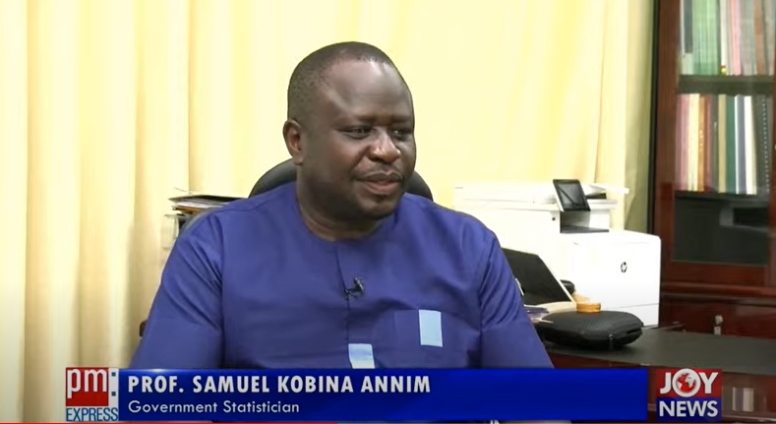
Government Statistician, Professor Samuel Kobina Annim, says the recent data on the country's inflation rate published by the Ghana Statistical Service is in no way an instructional material for policymakers.
According to him, the report is to help policymakers identify the sources of the factors driving the country’s inflation rate and to help them develop an informed policy.
Speaking on JoyNews’ PM Express Business Edition, the Statistician called for broader conversation on how the data released by the Statistics Service will be able to influence monetary policy and in the process slow down Ghana’s inflation.
He said, “So now we’re telling the policymaker that hitherto, locally produced items had a higher inflation rate than imported inflation, but now we’re seeing imported inflation recording 24.7% and locally produced 20.0%. this is not to tell the policymaker that prioritise imported items relative to local items, because I have gone ahead to mention to you that if you disaggregate the 99 items that saw rates higher than the national average, two-fifths of the 99 items are food items that are produced locally.
“So I am saying that let’s get the real sector ministry to look at our stock of grains and then once we look at our stock of grains we know that there is a potential of solving two-fifths of the 99 items that have seen an increase.
In the latest Statistical Service report, it was revealed that surging food prices once again drove inflation for the month of April, 2022 to 23.6%.
This is the highest since January 2004.
According to the GSS, four divisions – Transport (33.5%); Household Equipment and Routine Maintenance (28.5%); Food and Non-Alcoholic Beverages (25.6%), and Housing, Water, Electricity, Gas and Other Fuels (25.0%) recorded inflation rates above the national average of 23.6% with Transport recording the highest inflation.
National month-on-month inflation from March 2022 to April 2022 was 5.1%.
Whilst Food and Non-Alcoholic Beverages inflation was 26.6%, Non-Food inflation stood at 21.3%.
April 2022 food inflation (26.6%) is higher than both March 2022 food inflation (22.4%) and the average of the previous 12 months (13.5%). Food inflation’s contribution to total inflation however, decreased from 51.4% in March 2022 to 50.0% in April 2022
All the 15 food subclasses recorded positive month-on-month inflation with Fruit and Vegetable Juices recording the highest (15.3%).
For Non-Food inflation, year-on-year inflation on average went up again in April 2022 compared to March 2022 (from 17.0% to 21.3%). Only one out of the 12 Non-food Divisions had the 12 months rolling average to be higher than the year-on-year inflation for April 2022 for the divisions.
Furthermore, the inflation for imported goods was 24.7% which is higher than the 17.3% recorded for March 2022 while the inflation for locally produced items was 23.0% up from the 20.0% recorded in March 2022. This is the first time in 29 months that inflation for imported items exceeded domestic inflation.
Government Statistician, Professor Samuel Kobina Anim, called on policy makers to address the rising prices of goods and services in the country.
“So there should be further conversation to see the weight to which monetary policy will solve it, the pathways by which monetary policy will solve it, the extent to which we can identify the real sectors i.e the transport, the housing, the food, they all are recording rates higher than the national average of 23.6%. So we cannot just rely on one policy instrument and say that that is going to work,” he said.
Latest Stories
-
Nearly 2,000 displaced, schools damaged as windstorm wreaks havoc in Gushegu
4 minutes -
Ghana’s Derrick Kohn to work under Marie-Louise Eta as she becomes first woman to coach men’s Bundesliga team
9 minutes -
Accra Open Championships conclude with strong performances ahead of African Championships
16 minutes -
Ghana to begin camping with 12 athletes after Accra Open Championships – Bawa Fuseni
37 minutes -
Anthony Joshua declines showdown with Tyson Fury but admits they ‘probably’ clash next
50 minutes -
Tyson Fury dominates Makhmudov, calls out Joshua next
1 hour -
I have supported highway authority financially to fix roads in my constituency – A Plus
2 hours -
US, Iran fail to reach peace agreement after marathon talks in Pakistan
3 hours -
ECG kicks off Phase Two of transformer upgrades at Lashibi; brief outages expected
3 hours -
Port crises loom as 11,000 drivers threaten four-day strike
4 hours -
A source of excellence across generations – Vice President Opoku-Agyemang lauds Mfantsipim
5 hours -
(Photos) Mfantsipim School launches historic 150th anniversary
5 hours -
Knights and Ladies of Marshall group backs Catholic Bishops’ stance on anti-LGBTQ+
6 hours -
Bright Simons: All the Filla in the Ibrahim Mahama/E&P – Gold Fields Saga
7 hours -
Monetise Idiocy In Ghana
7 hours