

Audio By Carbonatix
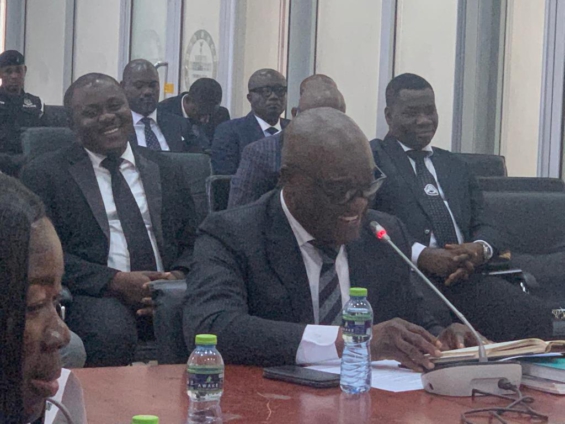
A judge nominated to the Supreme Court has admitted he failed to comply with the Asset Declaration Law when he took office as a High Court Judge in 2020.
Justice Ernest Yao Gaewu told the Appointments Committee of Parliament during his vetting on Wednesday, October 19, that he filled the forms as was required but simply forgot to submit them.
“It just got lost on me. I am sorry about that; I’ve apologised to even the Chief Justice,” he said.
Article 286 (1) of the 1992 Constitution states that “a person who holds a public office mentioned in clause (5) of this Article shall submit to the Auditor-General a written declaration of all property or assets owned by, or liabilities owed by him whether directly or indirectly (a) within three months after the coming into force of this Constitution or before taking office, as the case may be, (b) at the end of every four years; and (b) at the end of his term of office.”
The Constitution requires the declaration to be done before the public officer takes office.
However, Section 1 (4)(c) of the Public Office Holders (Declaration of Assets and Disqualification) Act directs public office holders to meet this requirement “not later than six months after taking office, at the end of every four years and not later than six months at the end of his or her term.”
Busy schedules, not negligence
Justice Gaewu explained that the situation occurred as a result of his busy schedules as a judge.
“The work of a judge is such that when you rise from your house straight to the courtroom, your whole attention is on court and attending to your matters. You get home, you have to write your rulings and come back the following [day].”
Meanwhile, he stated that it will be quite unfair for anyone to say he failed to declare his assets because he was negligent.
“Mr Chairman, negligence is too strong; it got lost on me,” he rejoined.
Asset Declaration Law
The law requires that public office holders submit to the Auditor-General written declarations of all property or assets owned by, or liabilities owed by them, whether directly or indirectly.
They include the President, Vice President, the Speaker of Parliament, Deputy Speakers of Parliament, members of Parliament, ministers and deputy ministers of state, ambassadors, the Chief Justice, Judges of Superior Court, Judges of Inferior courts and managers of public institutions in which the state has interest.
They are to declare their assets relating to: (a) lands, houses and buildings; (b) farms; (c) concessions; (d) trust or family property in respect of which the officer has a beneficial interest; (e) vehicles, plant and machinery, fishing boats, trawlers, and generating plants; (f) business interests; (g) securities and bank balances; (h) bonds and treasury bills; (i) jewellery of the value of ¢5 million [now ¢500] or above; objects of art of the value of ¢5 million or above; (j) life and other insurance policies; (k) such other properties as are specified on the declaration form.
Affiliation to NPP
During his vetting, it emerged the Supreme Court judge nominee had a political affiliation to the New Patriotic Party (NPP).
A question was posed by Member of Parliament for Bodi, Sampson Ahi, on how he would adjudicate a matter between the NPP and NDC when appointed.
But in response, Mr Gaewu said he is no longer a member of the NPP, adding that he seized to be one in 2020.
He also explained that he will always apply the law firmly irrespective of the partisan colours of cases that come before him.
Although he was an NPP member, he now belongs to the bench.
Death penalty
Touching on the death penalty, the judge said it ought to be scrapped, especially when some convicted persons go to prison and are later cleared of any wrongdoings or find themselves in a case of mistaken identity.
His position was supported by a colleague nominee, Justice Samuel Kwame Adibu Asiedu, who also called for its removal.
Although existing in law, no president - since the inception of the fourth republic - has signed the death warrant of persons sentenced to death.
The MP of Madina, Francis-Xavier Sosu, and some MPs are sponsoring a private members bill to remove the death penalty.
The Judge told the Committee, he would always uphold the laws of the land and will not be influenced by political colours.
Vetting
The Committee has wrapped up its work on the four nominees and is expected to present its report next week when Parliament reconvenes after a three-month break.
The nominees are Justice Barbara Ackah-Yensu, Justice George Kingsley Koomson, Justice Samuel Kwame Adibu Asiedu and Justice Ernest Yao Gaewu.
Latest Stories
-
TTAG raises alarm over proposed recruitment of 7,000 teachers, demands national posting roadmap
15 minutes -
Civilians feared killed after reports of air strike on Nigerian market
25 minutes -
Bishop Simon Kofi Appiah installed as new Jasikan Diocese Bishop
26 minutes -
Trump’s Strait of Hormuz blockade threat raises risks and leaves predicaments unchanged
28 minutes -
US Court backs extradiction of former MASLOC CEO Sedina Tamakloe-Attionu’s to Ghana
47 minutes -
Seven arrested as NAIMOS dismantles illegal mining camp, seizes firearms at Boin River
49 minutes -
Fire erupts at Madina Ritz Junction, destroys multiple wooden structures and containers
1 hour -
Daniel-Kofi Kyereh returns from long-term injury, registers assist for Freiburg U23
1 hour -
Knifeman calling himself ‘Lucifer’ slashes three at NYC’s Grand Central
2 hours -
Brands are built from within to without
2 hours -
Matriculants urged to pursue excellence as gov’t reaffirms support for Maritime education
2 hours -
See the areas that will be affected by ECG’s planned maintenance on Monday, April 13, 2026
2 hours -
GPL 2025/26: Salim Adams double fires Medeama back to summit after Kotoko rout
2 hours -
Two robbery suspects convicted following violent gold dealer attack in Obuasi
2 hours -
Supreme Court @150: Fanfare meets reflection as nationwide activities roll out
2 hours