

Audio By Carbonatix
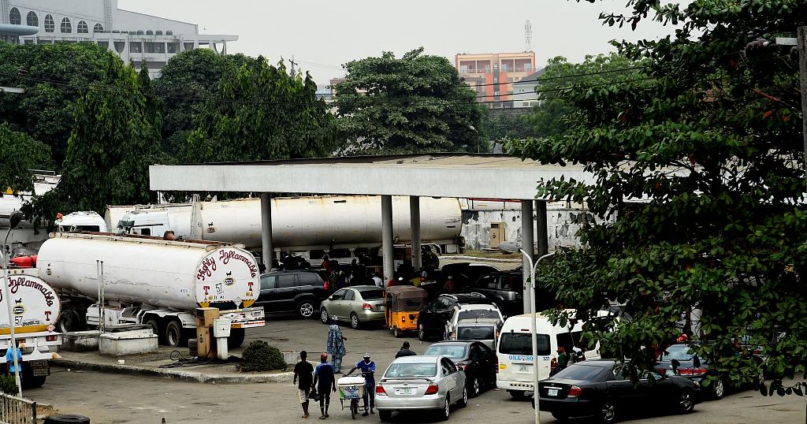
Nigeria's state-run oil company said it had started a 24-hour distribution of petrol to service stations to end a week-long scarcity that has caused traffic snarls in major cities.
The fuel shortage which started last week in the commercial city of Lagos and administrative capital Abuja has caused long queues with few petrol stations selling the product.
Transport fares have gone up in several cities, curtailing services and forcing some residents and workers to walk long distances to their destinations.
Most homes in Nigeria also rely on petrol and diesel to power their generators as the public power supply is unreliable and prone to blackouts.
The state-run Nigerian National Petroleum Corporation (NNPC) blamed the situation on importation of adulterated petrol by four oil marketers into the country.
The company said in a statement late Tuesday that measures, including around-the-clock distribution to service stations, had begun.
"In order to accelerate distribution across the country, we have commenced 24-hour operations at our depots and retail outlets."
The NNPC has also directed oil marketers, depot owners and service stations to begin 24 hours loading and dispensing activities in some of their designated outlets.
The NNPC said it had enough stock to end the shortage, while more supplies were expected by the end of February.
"As of today, NNPC has over one billion litres of certified PMS (petrol) stock that is safe for use in vehicles and machineries," the company said.
"As part of NNPC's strategic restocking, over 2.3 billion litres of PMS (petrol) is scheduled for delivery between now and end of February 2022 which will restore sufficiency level above the national target of 30 days."
It said a monitoring team, comprising security agents, to ensure smooth distribution of fuel nationwide had been set up.
The company appealed to Nigerians to avoid panic buying, adding that its measures would restore normalcy in a few days.
Nigeria, Africa's biggest crude producer, depends on fuel imports to meet local demand as its four refineries are either not working at all or operating below their installed capacity.
Petrol is sold below market rate in Nigeria as part of measures to make it affordable, but the IMF and the World Bank have advised the government to stop the so-called fuel subsidy scheme to free resources for development.
Latest Stories
-
NPP Delagates Congress: Confusion delays voting at Ashanti Region TESCON centre
11 minutes -
Fire ravages shops, houses near Koforidua Central Police Station
18 minutes -
NPP Delegates conference: The wisdom of the masses will prevail – Napo
51 minutes -
Flydubai co-pilot attacked captain with axe, UAE official says
60 minutes -
NPP Bosome Freho Constituency Chairman reportedly arrested over ballot paper incident
1 hour -
Medical plane with 6 on board missing off Massachusetts coast
1 hour -
Bolt driver jailed 25 years for robbing beautician
2 hours -
Happy 76th Birthday to the Daily Graphic!
2 hours -
Amin Adam celebrates Prof. Alhassan Musah on appointment as KAAF University Vice-Chancellor
2 hours -
Mahama reaffirms commitment to Volta development at Asogli Te Za
2 hours -
Bawumia urges NPP aspirants to accept results, reunite party after elections
2 hours -
Double fibre cut disrupts Telecel services, 72,754 subscribers affected
2 hours -
Bawumia demands probe into financiers behind Ghana-linked cocaine shipments
2 hours -
Spain beat Czech Republic to maintain winning run
3 hours -
Ronaldo ‘greatest symbol’ of Portugal – Fernandes
3 hours