

Audio By Carbonatix
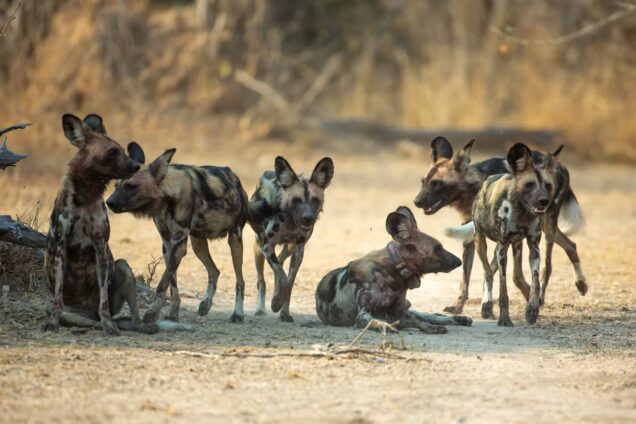
Three African wild dog brothers have travelled 4,126 kilometres across Zambia after leaving their pack in search of new breeding opportunities, making it the longest recorded dispersal by an African mammal.
The three males left the Mayukuyuku Pack in Zambia's Kafue National Park in July 2025. They were three years old and part of a large group of young dogs that had reached an age when dispersal from their birth pack was expected.
Researchers fitted the animals with GPS collars and followed their movements as they travelled eastwards through Zambia. Their journey took them through protected areas and unprotected landscapes, across roads and around large reservoirs, before they eventually reached the Luangwa Valley ecosystem.
By April 1, 2026, the three males had travelled 4,126 kilometres and settled in a new range in the Luano Game Management Area in the Luangwa Valley ecosystem. The distance recorded by researchers is the length of the route travelled. Their maximum straight-line distance from their starting point was 419 kilometres.
The findings were published in the journal Ecology in a study titled “Extraordinary movements connecting distant ecosystems by African wild dogs.”
A professor at Montana State University and the study's lead author, Scott Creel, said the scale of the movement was beyond what he had expected to see after years of studying the species.
“Together with Matt Becker and the Zambia Carnivore Programme, I’ve spent more than 16 years studying over 500 African wild dogs from over 50 packs every year, fitting them with GPS tracking collars,” Creel said in a statement he published.
The three brothers were not the only wild dogs making extraordinary journeys. The researchers tracked four dispersing groups whose movements covered a combined 9,863 kilometres.
One group consisted of four females that had also left the Mayukuyuku Pack. Another involved four females from the Kasweta Pack in South Luangwa National Park. A fourth involved three females, including a dog identified as EWD-1355, which had dispersed from the Luamfwa Pack in South Luangwa National Park.
The movements showed how far young wild dogs can travel when they leave their packs. African wild dogs live in cooperative packs in which breeding is normally limited to the dominant male and female. Subordinate animals can remain in the pack and help relatives or leave to search for opportunities to establish themselves elsewhere.
Dispersal is particularly common among two- and three-year-old animals. For the three Mayukuyuku males, the journey began with movement eastwards into unprotected areas in central Zambia.
They avoided the Great North Road and later encountered two large reservoirs that could not be crossed. Instead, they travelled around them and continued towards the Chisomo and Petauke Game Management Areas.
By November 9, 2025, they had reached areas connected to South Luangwa National Park. Five days later, they came within 14 kilometres of four females that had dispersed from the Kasweta Pack in South Luangwa National Park.
The two groups came within 1.6 kilometres of one another over a six-day period. By then, the females had travelled 1,538 kilometres and the males 2,356 kilometres from their respective birth ranges. But reaching another population does not necessarily mean that successful breeding or genetic exchange will follow.
The researchers say this distinction is important because African wild dogs can fight when unfamiliar animals meet, sometimes fatally. As a result, immigration into an established group can be difficult and unsuccessful.
The study therefore distinguishes between movement and connectivity. Despite the four groups travelling a combined 9,863 kilometres, the researchers found that these movements had produced little genetic or demographic connectivity.
The findings show that long-distance movement alone does not guarantee successful connectivity between wild dog populations. For dispersal to translate into genetic or demographic connectivity, animals must survive the journey and successfully immigrate into another population and reproduce.
The researchers said the movements showed that wild dogs remain capable of travelling between distant ecosystems. Their records include movements linking major wild dog populations in Zambia, as well as journeys extending into Mozambique and to within a few kilometres of Zimbabwe, Malawi, the Democratic Republic of Congo and Angola.
The journeys also highlighted the risks faced by wild dogs once they leave protected areas. The GPS records showed the animals moving through landscapes containing roads, urban areas and other human infrastructure.
Researchers found that wild dogs move differently outside protected areas. Their movements become faster and more direct as they travel through landscapes with greater human influence.
Outside protected areas, the study found that the dogs' mean speed increased 1.7-fold, while their mean turning angle decreased 2.4-fold, indicating faster and more linear movement.
But the journeys also exposed the dogs to threats they could not easily avoid, including wire snares. The researchers documented that danger in the case of EWD-1355, a three-year-old female that travelled more than 2,300 kilometres before dying in a wire snare in June 2022.
The female and two littermate sisters left the Luamfwa Pack in October 2021. Over the following 11 months, the sisters travelled more than 2,300 kilometres, repeatedly crossing rivers and highways and moving through national parks, game management areas, forest reserves and unprotected areas.
They eventually reached the home range of a large pack in Lower Zambezi National Park, on the border with Zimbabwe. They did not join the pack, however, and no males emigrated to join them. Having failed to find a reproductive opportunity, they moved on. EWD-1355 later died in June 2022 after becoming caught in a wire snare set for bushmeat hunting. The fate of her two sisters remains unknown.
The researchers say such incidents highlight the danger wire snares pose to dispersing wild dogs. The species is particularly vulnerable because pack members are highly reluctant to abandon a snared or injured companion. The researchers have observed that when one dog becomes caught in a snare, other members of the pack may repeatedly return to the same location.
The GPS tracking therefore allows researchers to reconstruct the routes the animals take, the landscapes and obstacles they encounter, and the threats they face along the way. For conservationists, the findings point to the importance of maintaining routes between strong wild dog populations.
The study says Zambia has some important protected corridors, particularly along the Luangwa Valley, but other corridors remain outside protected areas. The researchers argue that protecting such corridors could help maintain the possibility of movement between stronghold populations.
Chief executive of the Zambian Carnivore Programme, Matt Becker, said the movements showed that the existing connections between populations could still be strengthened.
“The dogs are showing us that connectivity still works; now we need to do more to protect and strengthen it,” Becker said in a statement published by the Reuters.
The researchers say the long-distance movements recorded in Zambia, together with similar movements documented in Tanzania, Botswana and Zimbabwe, suggest that many wild dog populations in Eastern and Southern Africa may still be connected. But they also stress that movement alone does not guarantee genetic or demographic connectivity: animals must survive dispersal and successfully immigrate into other populations.
The record 4,126-kilometre journey of the three brothers therefore tells two stories. It demonstrates the extraordinary ability of African wild dogs to travel across landscapes that are increasingly influenced by human activity.
At the same time, it shows that travelling between populations is not enough on its own to guarantee genetic or demographic connectivity between them.
The researchers say, whether movements like theirs can translate into lasting connections between wild dog populations will depend not only on whether the animals can reach new areas, but also on whether they can successfully immigrate and reproduce and whether the landscapes between populations remain safe enough for future generations to make the journey.
Latest Stories
-
Ghana moves to regulate growing electric vehicle charging sector
12 minutes -
Poverty must not decide who lives – Ga Mantse
41 minutes -
Meta bans TikTok ads on its platforms in US
52 minutes -
Model markets key to tackling foreign encroachment in informal retail – GIPA CEO
1 hour -
Christa Pike has ‘profound’ health turnaround after botched execution, lawyers say
1 hour -
Outspoken Indian actor Nana Patekar dies suddenly at 75
1 hour -
White House blocks Microsoft from foreign worker hiring program
2 hours -
ICE agent shoots man in New York City
2 hours -
Zambia signs US health deal after disputes over data-sharing
2 hours -
‘I’ll end a serious relationship if I find another guy who’s more attractive’ – Ayra Starr
2 hours -
Guinea-Bissau to delay elections following last year’s coup
3 hours -
‘Bold and inventive’ Canadian poet Anne Carson wins Nobel Prize in Literature
3 hours -
Faustina Ampofo shines at Ghana Airport Customer Service Awards
5 hours -
Venezuela’s ex-leader Nicolás Maduro charged with conspiracy to commit torture
5 hours -
Harry says he ‘slipped into depression’ after leaving UK
5 hours