

Audio By Carbonatix
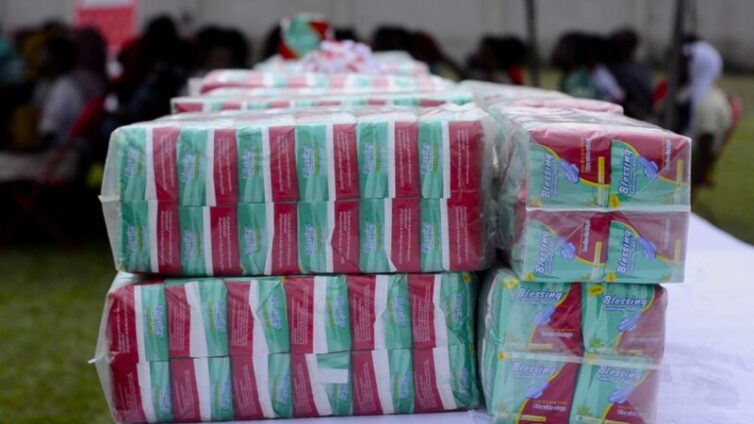
Menstruation, a periodic cycle for women and girls, presents them with daunting challenges of uneasiness compounded with the hefty cost of sanitary towels.
But girls with special needs face greater challenges in managing their menstruation hygienically and with dignity, often facing double stigma due to social norms around gender and having a disability.
Caretakers of these adolescent girls with special needs are also burdened with ensuring the girls are tidied up during such periods.
The Garden City Special School in the Ashanti region houses over 100 students with special needs.
More than 50 of them are adolescent girls who are unable to take care of themselves during menstruation.

They are between the ages of 12-40 years.
20-year-old Ivy Addo was born with cerebral palsy and has lived in the school for the past 5 years but unfortunately, she's unable to independently take care of herself.
Ivy has little or no idea what the pad is used for although she menstruates.
Only two female teachers take care of the girls during their menstruation.
They're responsible for bathing the girls and changing their pads during menstruation.
One of the teachers, Nancy Badu, narrates the barriers that come with taking care of girls.

"With their condition they're unable to calculate their menstrual cycle and they usually stain themselves.
“We bath them during their menses and even change their pads because they're unable to do it,” she noted.
In the absence of any female teacher, the girls will have to wear a single sanitary part the whole day.
This, according to medical experts, can lead to infections.
“If they're incapable of taking care of themselves then they'll have to depend on others for assistance.
But not having anyone to cater for them means the girls will be unable to wear or change their pads which is not advisable.
They need to be consistently taught to take care of themselves,” said Wendy Boatemaaa Ofori, a nurse.
The BBC surveyed nine countries around Africa to see how affordable period products are.
It compared the minimum wage to the local cost of the cheapest sanitary pads and found they were beyond the reach of many women.
While Ghana was the country with the least affordable menstrual products of those we surveyed, women across Africa are struggling with "period poverty.
Some of the low branded pads, which were sold on the open markets and at corner stores between GH₵ 3 and GH₵6, are now between GH₵25 cedis and GH₵30.
The premium brands are as high as GH₵50 at the malls and supermarkets.
These were products which were not more than GH₵15 last year.
Menstruation is a natural phenomenon and the imposition of taxes on sanitary pads which are basic necessities of life is reinforcing the gender and social norms we strive to minimize.
Ghana currently has a 12.5% Value Added Tax (VAT) and a 20% import tax on sanitary pads.
This has impacted the affordability of sanitary pads, making them inaccessible for a significant portion of Ghana’s female population, which constitutes 51% of the overall population.
According to the headmistress of the special school, Dr Roselyn Frimpong Agyapong, parents are unable to buy pads for girls.
She revealed most of the girls are from rural areas and lack support from the parents, leaving a burden on the school.
"Sometimes I have to purchase the pads for the girls and it's quite expensive
“Most of the girls are from poor homes so the parents don't really support," she bemoaned.
Despite the challenges faced by the school which raises children with special needs, Nancy said it was worrying that there was "zero attention from the government" for the plight of special children.
She’s calling for an increase in the amount allocated to special needs schools.

Meanwhile, the regional Girls' Education officer in the Ashanti Region is training and empowering district girls and school coordinators on how to make reusable sanitary pads to tackle period poverty in the region.
Hannah Amponsah noted “our goal is to eliminate period poverty in the Ashanti Region
In a few years, we hope to declare the region period poverty-free."
Latest Stories
-
Don’t let speed of information become your judgement – CJ tells new lawyers
34 minutes -
World Cup visa scandal: People have leveraged public office to facilitate fraud – Senyo Hosi
40 minutes -
Glut! Farmers count losses as prices crash, customers happy
1 hour -
GSA postpones auction of unserviceable vehicles
1 hour -
Man charged with attempted murder after stabbing
1 hour -
World Cup visa scandal: Senyo Hosi says issue goes beyond calls for Sports Minister’s resignation
1 hour -
Yaw Ampofo Ankrah hasn’t taken or received any money to facilitate visas – Lawyer insists
2 hours -
World Cup visa scandal: Senyo Hosi urges focus on constitutional accountability
2 hours -
La Beach demolition: Senyo Hosi condemns lack of consultation
2 hours -
Russian glide bomb attack on Zaporizhzhia kills at least 15 people
2 hours -
Jinapor warns underperforming energy sector CEOs of consequences, says no protection for failure
2 hours -
Fire destroys head of tipper truck on Lower Volta Bridge
2 hours -
Palmer signs new Chelsea contract until 2034
2 hours -
World Cup visa scandal: Mahama will act on corruption allegations – Abass Nurudeen
2 hours -
Abass Nurudeen accuses Minority of ‘scandal scavenging’ over World Cup visa controversy
2 hours