


Audio By Carbonatix
A team of research scientists from the CSIR-Crops Research Institute visited Wiamoase, in the Sekyere-South District of the Ashanti region to ascertain the veracity of the alleged apple fruiting in the community.
The team included the Agona District Director of the Ministry of Food and Agriculture, Mr. Ernest Owusu Kwarteng and was led by Mr. Beloved Mensah Dzomeku, a Principal Research Scientist and lead horticulturist of the Institute.
The alleged “apple” tree is growing on latitude 07o 03’ 333’’ N and longitude 001o 31’150’’ W, at an altitude 432m above sea level as a shade tree in a house.
On site, the team made the following observations:
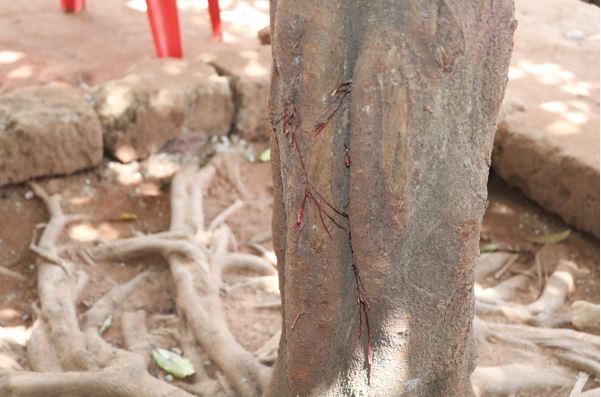
- Morphologically, the tree has several adventitious roots emerging from the stem and branches (see photos below).
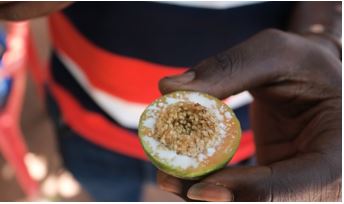
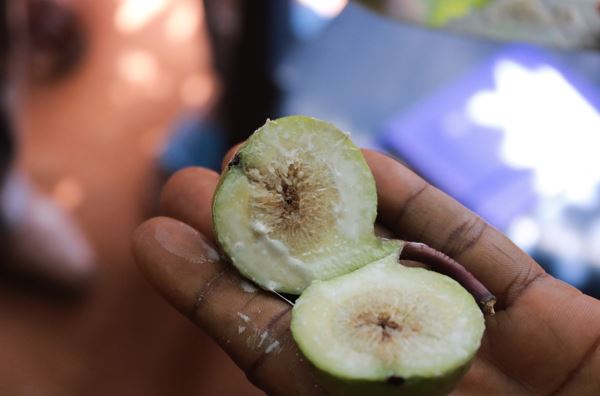
- The transverse and longitudinal sections of the immature fruits show several seeds within the fruit (see photo below).
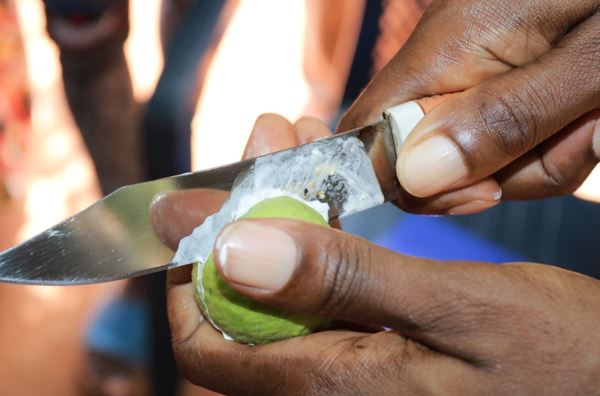
- The peel of the fruit contains a thick whitish latex which sticks to objects and the hand and is difficult to clean.
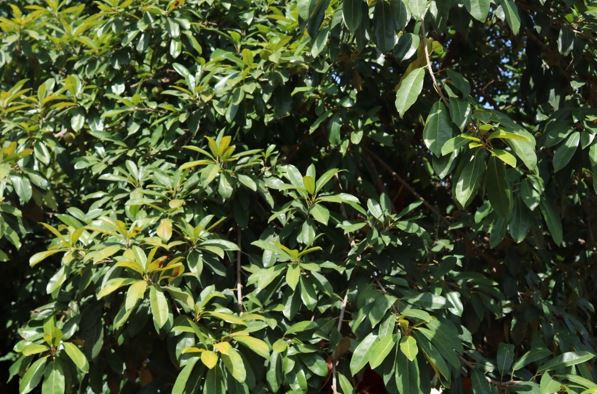
Additionally, the team used PlantSnap, a high-tech, comprehensive and accurate plant identification mobile app which is able to identify over 90 percent of all known species of plants and trees to match the leaves of the supposed plant and confirmed that indeed it was a fig tree (Ficus sp.) and not an apple tree as previously claimed.
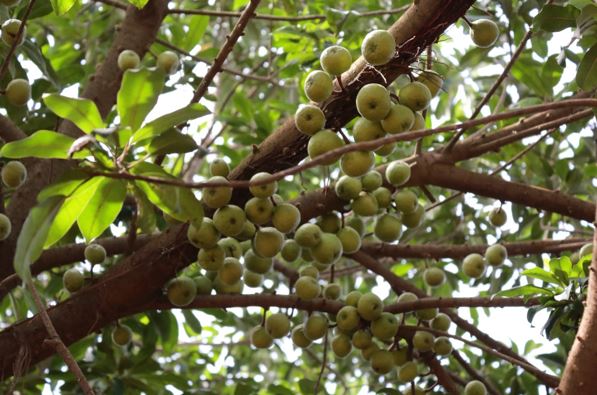
The Institute believes that the said tree could be Ficus sycomorus or Sycamore figwhich is native to tropical Africa, South of the Sahel as well as North of the Tropic of Capricorn. Its fruit is a large edible fig, 2–3 cm in diameter, ripening from buff-green to yellow or red. They are borne in thick clusters on long branchlets or the leaf axil.
Ecology of Fig
Fig belongs to the family Moraceae (sometimes called Mulberry family). There are over 850 different types of fig in the world. Available literature indicates that the Fig infructescence is pollinated by symbiosis with fig wasp (Blastophaga psenes). Various reports also state that the fertilized female wasp enters the fig through the scion, which has a tiny hole in the crown (the ostiole).
She crawls on the inflorescence inside the fig and pollinates some of the female flowers. She lays her eggs inside some of the flowers and dies. After weeks of development in their galls, the male wasps emerge before females through holes they produce by chewing the galls.
The male wasps then fertilize the females by depositing semen in the hole in the gall. The males later return to the females and enlarge the holes to enable the females to emerge. Then some males enlarge holes in the scion, which enables females to disperse after collecting pollen from the developed male flowers.
Females have a short time (<48 hours) to find another fig tree with receptive scions to spread the pollen, assist the tree in reproduction, and lay their own eggs to start a new cycle.
It was not surprising that having cut open the immature fruits, there was an insect in it.
In 2017, the total world production of fig was 1,152,799 tonnes with the leading producing countries being Turkey (305,689tons), Egypt (177,135tons), Morocco (137,934tons), Algeria (128, 684 tons) and Iran 70,730 tonnes (FAOSTAT, 2018)
Latest Stories
-
‘I was beaten, threatened with death, and was told to stay’ – Abuse survivor recounts ordeal in marriage
22 minutes -
Ato Forson has performed wonders with common fund releases – Northern Regional Minister
43 minutes -
Zelensky accuses US of inaction as Russian strikes kill over 70 in two days
47 minutes -
Bipartisan majority of Americans blame Trump policies for rising costs, Reuters/Ipsos poll finds
47 minutes -
New Trump rules will make it harder for farmers to access US funds for energy projects
48 minutes -
John Jinapor warns energy sector board chairs, CEOs against toxic working relationships
49 minutes -
Recover, protect and properly account for every cedi of public money – Finance Minister
52 minutes -
GTA denies collecting money for US, Canada visas ahead of 2026 World Cup
58 minutes -
GTA CEO Maame Efua Houadjeto denies involvement in World Cup visa scandal
1 hour -
Rockland Farms CEO Calls for Greater Support for Women in Agriculture
2 hours -
AFCON 2027Q: Interim Black Stars technical team to take charge of November games
2 hours -
Gov’t suspends implementation of L.I. restricting preaching and hawking in moving vehicles
2 hours -
Three Saudi nationals killed in Houthi attacks on Riyadh airport
2 hours -
Jinapor demands accountability from energy sector agencies ahead of 2027
2 hours -
Cars torched and shops looted as anti-migrant violence erupts in South Africa
2 hours