

Audio By Carbonatix
In March 1900, when Governor Frederick Hodgson stood in Kumasi and demanded the Golden Stool, the men of Asante fell silent.
Nana Yaa Asantewaa, Queen Mother of Ejisu, did not. She rose, spoke the words every Ghanaian child now knows, and led the last Asante war against the British Empire. She lost. She was exiled to the Seychelles. But she made a point that has echoed through Ghanaian public life for one hundred and twenty-six years: when the political order breaks, the women can hold.
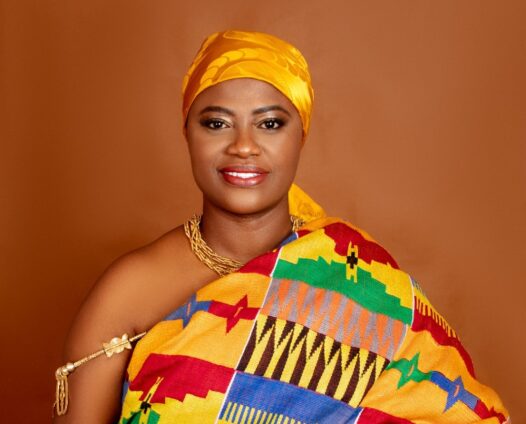
I have been thinking about that point a great deal since my enstoolment this April as Nkosuohemaa of Kwabre Abirem. I have also been thinking about it as a professional who spends her weekdays in the financial regulatory world of the United States, and as a doctoral candidate whose research keeps returning to a single question. Why is it that a country whose history has been so profoundly shaped by the leadership of its women continues to design its economic future as though those women do not exist?
This piece is my answer to that question, and my first public offering as Nkosuohemaa.
What the Stool Is For
Let me begin by naming the office I now hold, because most Ghanaians outside the traditional space do not fully understand what it means. An Nkosuohemaa is not a ceremonial title. The word itself means "queen mother of progress," and the office was elevated across the Asante kingdom during the reign of Otumfuo Osei Tutu II precisely to give queen mothers an explicit developmental mandate: to mobilize women, to champion education, to attract investment, to advocate for health, and to translate the aspirations of the community into action.
When I sat in state on my enstoolment day, I did not sit down to be admired. I sat down to work.
This distinction matters because the wider Ghanaian conversation about traditional leadership has drifted, over decades, into a lazy assumption that chiefs and queen mothers exist to bless projects, cut ribbons, and give the state a photograph. That assumption suits certain politicians. It suits certain donors. It does not describe the actual life of a Ghanaian community, and it does not describe the actual work of the stool.
The Economy That Is Already Here
Anyone who wants to understand the Ghanaian economy should spend a morning at Kejetia. Or Makola. Or Techiman. Or the yam market at Ejisu. What you will witness is not a market in the textbook sense. You will see a governance system.
The market queen - the Ohemaa of tomato, of onion, of second-hand cloth, of dried fish - fixes prices. She sets credit terms for junior traders. She arbitrates disputes that would otherwise end in fistfights and slashed sacks. She maintains relationships with the farmers, hauliers, and warehouse owners that keep goods moving into the city. She does all of this without a bank account for most of her working capital, often without formal literacy, and always without a salary from the state. The system holds because it is built on generations of trust, and because everyone in it understands the consequence of breaking that trust.
This is the queen mother principle applied to commerce. And it has been running Ghanaian trade since before Ghana was called Ghana.
What our modern women have built on top of it should humble anyone who thinks female leadership in this country is a new import. Esther Ocloo started with six shillings and orange marmalade and ended by co-founding Women's World Banking, one of the first serious efforts to move credit to women at a global scale. Susanna Al-Hassan, from the north, became the first woman to hold a cabinet post anywhere in sub-Saharan Africa. Justice Annie Jiagge, from the Volta Region, sat on the Court of Appeal and served on the United Nations body that drafted what became CEDAW. Dr. Letitia Obeng became Ghana's first woman doctorate in the sciences. Nana Konadu Agyeman-Rawlings, herself of the Asante royal house, named after Queen Mother Nana Konadu Yiadom II, and grand-niece of the Asantehene Prempeh I whom Yaa Asantewaa followed into exile, built the 31st December Women's Movement into the largest mass mobilization of Ghanaian women in our history, opening preschools, income-generating groups, and credit lines that reached rural women no formal bank had ever bothered to serve. May her memory continue to give the movement of Ghanaian women the courage she gave it in her lifetime.
And today, that line reaches its highest point in our republic's history. Professor Naana Jane Opoku-Agyemang, a Cape Coast woman, a literature scholar, a two-time Fulbright fellow, the first woman to lead a state university in Ghana as Vice-Chancellor of the University of Cape Coast, a former Minister for Education who spent that portfolio fighting for the girl child, an advocate whose voice on child marriage, domestic violence, and sexual abuse has shaped a generation of policy conversation, became, in January of 2025, the first female Vice President of Ghana. She now occupies the second-highest office in our republic. Her rise is not a break with the tradition I have been describing. It is its continuation. From the Ejisu palace where Yaa Asantewaa rose in 1900, through the market stalls of Makola, through the courtrooms and cabinet rooms and lecture halls in which twentieth-century Ghanaian women earned the ground they stood on, the line runs unbroken to the Vice-Presidential residence at Golden Jubilee House.
None of these women invented the ground they stood on. They inherited it. And they inherited it from the same tradition that produced Yaa Asantewaa.
Why the Development Sector Keeps Missing This
For more than forty years, Ghana has been on the receiving end of one development model after another. Structural adjustment. HIPC. Poverty reduction strategies. Middle income status. Ghana Beyond Aid. Each arrived with its own vocabulary, its own consultants, and its own certainty that this time the answer had been found.
Some of these programmes helped. Many were forgotten within a decade of their arrival. What was rarely tried, and what I want to argue for here, is a development approach that begins with what is already working.
In every Ghanaian community I have ever visited, there is an institution that already convenes women, already mobilizes savings, already influences whether girls stay in school, already shapes decisions about when a young woman marries, already sits at the centre of the moral and economic life of the town. That institution is the queen mother's stool and the council of women around it. It is chronically under-resourced. It is rarely written into any national development plan. It is regularly bypassed by NGOs who prefer to build their own committees. And it continues, quietly, to do the work anyway.
Imagine what would happen if we stopped treating this institution as decorative and started treating it as infrastructure.
A Practical Proposal
I am not writing this piece to complain. I am writing it because I believe there is a specific and achievable path forward, and because as an Nkosuohemaa I am now part of the constituency that must argue for it.
First, girls' education. When the Ministry of Education, the Ghana Education Service, and the various NGOs working in this space design their programmes, the queen mothers of the affected communities should not be invited to the launch. They should be co-authors of the design. We are the ones who know which families are about to withdraw a girl from school and why. We are the ones the mothers actually listen to. Free tuition alone will not close the gender gap. Trusted advocacy inside the community will. This is a cause our current Vice President has championed for decades, and it is one on which the traditional women's councils of this country stand ready to be her partners.
Second, susu and rural credit. The savings groups that queen mothers convene across this country are functioning credit institutions. They should be recognized as such. The Bank of Ghana, working with the Ministry of Finance and the traditional councils, can build a regulatory pathway that connects these groups to the formal banking sector on terms that respect their existing governance rather than replacing it. Nana Konadu Agyeman-Rawlings's work in the 1980s and 1990s showed how much rural women can do with even modest working capital. The infrastructure to scale it exists. What is missing is political imagination.
Third, maternal health. The gap between what our clinics know and what our women do is not a gap of information. It is a gap of trust. Health messaging that flows through queen mothers reaches places that radio jingles and posters never will. The Ghana Health Service has the science. We have the reach. A serious partnership between the two would move the maternal mortality numbers in a way that no amount of imported technology has yet managed.
Fourth, land. Queen mothers should sit on the committees that decide how customary land is allocated for commercial agriculture, for mining, and for infrastructure. The disputes end up in our courts anyway. Involving us at the design stage is not a favour to tradition. It is a way to prevent the litigation, the community anger, and the stalled projects that we all know follow when land decisions are made without the women who will live with the consequences.
Fifth, the coordinating work itself. Queen mothers currently do this work for free, which allows the state and the donor community to treat it as if it costs nothing. It costs a great deal. It costs our time, our fuel, our telephone credit, our health, and our family lives. If a percentage of the funding currently flowing into parallel structures were redirected into the traditional women's councils that already exist, the return on that investment would surprise the sector.
What This Requires of Us
I want to be honest with my sisters in the traditional space, because the argument I am making places a demand on us as well.
If we want queen mothers taken seriously as developmental leaders, we must lead. That means investing in the education of the young women in our communities, not tolerating practices that hold them back. It means using our authority to protect girls from early marriage and to champion their right to complete their schooling. It means opening the councils to the voices of the young, and not treating age as the only qualification for wisdom. It means welcoming scrutiny of our own decisions with the same grace we expect from those we hold to account. The stool is a public trust. It must behave like one.
Although Yaa Asantewaa lost the war, she preserved something the British Empire could not carry away: the memory of a woman who stood when the men could not, and the demonstration that Asante leadership was never the property of only one gender.
Conclusion
Ghana's development story has been told, for two generations, largely in the vocabulary of imports: imported models, imported credit, imported reforms, and, more recently, imported infrastructure. What has never left, what has continued to organize the daily life of Ghanaian communities across every regime change since independence, is the network of traditional institutions - the Asante Ohemaa, the Ga Manye, the Dagomba Gundo-Naa, the Ewe Mamaga, and their counterparts in Fante, Nzema, Guan, and every other tradition this country contains.
These institutions are our inheritance. They are not the past. They are a working part of the present. And within them, the queen mother's stool is one of Africa's most underutilized development assets.
From Yaa Asantewaa at Ejisu in 1900 to Naana Jane Opoku-Agyemang at Golden Jubilee House in 2026, Ghanaian women have shown, generation after generation, that leadership is not something we borrow. It is something we already possess. The question I put to Ghanaian policymakers, to the development community, to the donors, and to my fellow traditional leaders is a simple one. What would our economy look like if we finally built on what we already have?
I intend to spend my time on the stool helping to find the answer.
Nana Konadu Yiadom I is the Nkosuohemaa of Kwabre Abirem in the Ashanti Region. Professionally known as Barbara Acheampong, MBA, EA, NTPI-F, she is a Tax Resolution Strategist, PhD candidate, and Board Chair of the Otumfuo Foundation USA.
Latest Stories
-
Daily Insight for CEOs: The CEO’s role in strategic reflection
22 seconds -
John Jinapor reiterates government’s commitment to Salaga transmission project
2 minutes -
‘I predicted Tinkler would resign as Kotoko coach’ – Kojo Addae Mensah
19 minutes -
Ghana-China programme opens AI pathways for young Ghanaians
30 minutes -
We went to the ground – NDC defends research behind 2024 manifesto
38 minutes -
NDC orders halt to premature parliamentary campaign activities
44 minutes -
GoldBod dismisses claims of rift with BoG over Asiama’s board exit
51 minutes -
NDC communicator defends manifesto process, Mahama’s delivery record
52 minutes -
Ghana, Algeria explore stronger scholarship and academic exchange opportunities
53 minutes -
Law enforcement officers trained to tackle emerging human trafficking threats
59 minutes -
Ministries, assemblies cannot claim blanket exemption from vehicle tint laws – ACP Alexander
1 hour -
Is Ghana safely becoming a narcotic transit coast?
1 hour -
Tinted vehicles could facilitate crime and endanger road users — ACP Alexander
1 hour -
BoG Governor appoints Second Deputy Governor Matilda Asante-Asiedu as rep on GoldBod board
1 hour -
The fight against terrorism requires regional and international cooperation – Mahama
2 hours