

Audio By Carbonatix
US President Donald Trump has signed an executive order to begin the process of withdrawing the US from the World Health Organization (WHO).
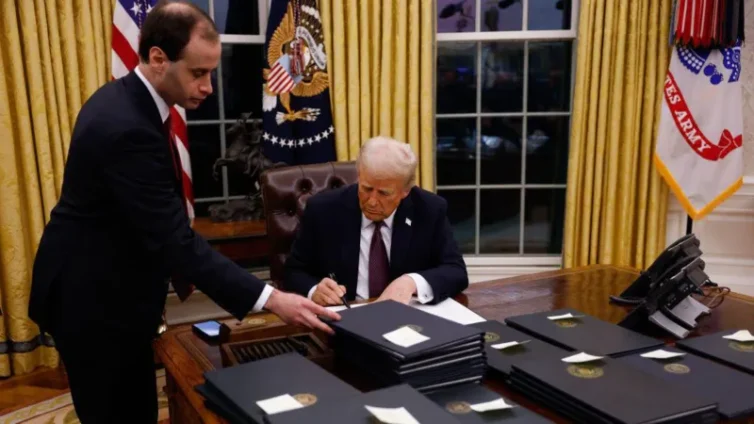
"Oooh, that's a big one," the newly inaugurated US president said as he approved the document after arriving back at the White House. It was one of the dozens of executive actions he put his signature to on day one in office.
This marks the second time Trump has ordered the US be pulled out of the WHO.
Trump was critical of how the international body handled COVID-19 and began the process of pulling out from the Geneva-based institution during the pandemic. President Joe Biden later reversed that decision.
Carrying out this executive action on day one makes it more likely the US will formally leave the global agency.
"They wanted us back so badly so we'll see what happens," Trump said in the Oval Office, referring to the WHO, perhaps hinting the US might return eventually.
The order said the US was withdrawing "due to the organization's mishandling of the Covid-19 pandemic that arose out of Wuhan, China, and other global health crises, its failure to adopt urgently needed reforms, and its inability to demonstrate independence from the inappropriate political influence of WHO member states".
The executive order also said the withdrawal was the result of "unfairly onerous payments" the US made to the WHO, which is part of the United Nations.
When Trump was still in office the first time around, he was critical of the organisation for being too "China-centric" in its tackling of the COVID-19 pandemic.
Trump accused the WHO of being biased towards China in how it issued guidance during the outbreak.
Under the Biden administration, the US continued to be the largest funder of the WHO and in 2023 it contributed almost one-fifth of the agency's budget.
The organisation's annual budget is $6.8bn (£5.5bn).
It is possible that funding could disappear almost immediately, and it is not clear that other nations will step up to fill the gap. A US withdrawal could have an impact on WHO's ability to respond to emergencies such as an Ebola outbreak, or MPOX – let alone another COVID-19-style pandemic.
Public health experts have suggested there could be other consequences for Americans' health if progress is reversed on fighting infectious diseases such as malaria, tuberculosis, HIV and Aids.
Ashish Jha, who formerly worked as Covid-19 response co-ordinator under President Biden, previously warned leaving would "harm not only the health of people around the world but also US leadership and scientific prowess".
"It's a cataclysmic presidential decision. Withdrawal is a grievous wound to world health, but a still deeper wound to the US," Lawrence Gostin, a global public health expert and Georgetown University professor said.
There are also concerns that America's withdrawal could ultimately open the door to greater Chinese influence over the global body, not less.
The upsides to the move are few, but some argue it could prompt further reforms of how the WHO works, meaning it better serves public health needs of people worldwide.
If that happens, it might be enough to tempt the US back into the fold. However, the tone of the language coming from Washington suggests this second attempt by President Trump to pull the US out of the international health body will not be reconsidered.
Latest Stories
-
T-bills auction: Government exceeds target marginally; yield on 91-day bill remains unchanged
3 hours -
GPL 2026/27: 10-man Aduana hand Kotoko defeat in Kumasi
3 hours -
GPL 2026/27: Medeama ease past Basake Holy Stars
4 hours -
Appiah Adomako writes: Why DVLA must stop treating every expired licence holder as delinquent
4 hours -
Localization must transfer decision-making power, not just project responsibilities
4 hours -
Modernising Ghana’s traditional markets through the 24-Hour Economy markets initiative
4 hours -
New economy will boost local production and create jobs – Finance Minister
4 hours -
Real-Time VAT on cross-border digital services – not a new tax and does not violate double taxation principle
5 hours -
Digitalisation, AI key to Ghana’s tourism transformation – GHATOF
5 hours -
Stronger GTA-private sector partnership needed to grow tourism – GHATOF
5 hours -
Amazon eyes Ghana for broadband expansion after talks with Mahama
6 hours -
National Investment Quiz 2026: Six schools qualify for quarter-finals
6 hours -
‘Do not let Russia pay for its madness with lives of your people’ – Zelensky to Ghana, 46 other countries
6 hours -
6,079 promotion cases fully processed and paid – CAGD says amid nationwide teachers’ strike
7 hours -
Teacher unions to meet government Monday over nationwide strike
7 hours