

Audio By Carbonatix
US President Donald Trump has accused South Africa of human rights violations against white farmers, continuing a dispute that escalated this week as the US froze aid to the country.
On Sunday Trump wrote on his Truth Social account: "South Africa is confiscating land, and treating certain classes of people VERY BADLY."
On Friday, Trump signed an executive order freezing financial aid to the country.
The South African government says Trump's actions were based on "a campaign of misinformation and propaganda aimed at misrepresenting our great nation".
The status of white South African farmers has long been a rallying cry on the right and far-right of American politics.
Trump said he was bringing in the aid freeze because of South Africa's new land law, which he says is violating people's rights, and also because of its international court case accusing Israel of genocide.
In response, South Africa's Ministry of International Relations and Cooperation said the move "fails to recognize South Africa's profound and painful history of colonialism and apartheid".
Trump's close adviser Elon Musk, who was born in South Africa, also joined in the criticism - asking on X why President Cyril Ramaphosa had "openly racist ownership laws".
Ramaphosa has not responded but previously defended South Africa's land policy after Trump's threat on Sunday.
He said the government had not confiscated any land and the policy was aimed at ensuring equitable public access to land.
The new law was signed last month and allows land seizures without compensation in certain circumstances.
Land ownership has long been a contentious issue in South Africa with most private farmland owned by white people, 30 years after the end of the racist system of apartheid.
There have been continuous calls for the government to address land reform and deal with the past injustices of racial segregation.
South Africa's new law allows for expropriation without compensation only in circumstances where it is "just and equitable and in the public interest" to do so.
This includes if the property is not being used and there is no intention to either develop or make money from it, or when it poses a risk to people.
The order said the US "cannot support the government of South Africa's commission of rights violations in its country", and as long as it "continues these unjust and immoral practices" then the US will not provide aid or assistance.
The White House said Washington will also formulate a plan to resettle South African farmers and their families as refugees.
It said US officials will take steps to prioritise humanitarian relief, including admission and resettlement through the United States Refugee Admissions Program for Afrikaners in South Africa, who are mostly white descendants of early Dutch and French settlers.
The executive order also references South Africa's role in bringing accusations of genocide against Israel before the International Court of Justice (ICJ).
The order said: "In addition, South Africa has taken aggressive positions towards the United States and its allies, including accusing Israel, not Hamas, of genocide in the ICJ, and reinvigorating its relations with Iran to develop commercial, military, and nuclear arrangements."
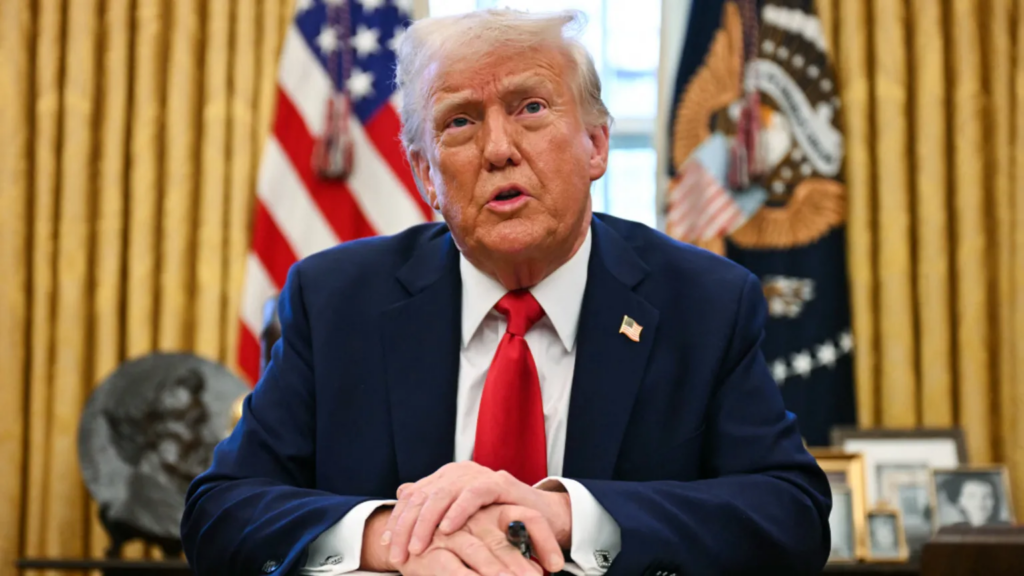
Earlier in the week, Trump said in a briefing with journalists that South Africa's "leadership is doing some terrible things, horrible things".
"So that's under investigation right now. We'll make a determination, and until such time as we find out what South Africa is doing - they're taking away land and confiscating land, and actually they're doing things that are perhaps far worse than that."
For years, right-wing activists in South Africa and the West have accused the South African government of illegal land confiscation and of turning a blind eye to the murders of white farmers.
Trump echoed those calls in 2018 when he said he was ordering then-Secretary of State Mike Pompeo to investigate "large-scale killings of farmers".
Ramaphosa moved to defuse the row with Trump's new US administration over the new land law by speaking to Musk on the phone.
Ramaphosa's office said, in that call to Musk the president "reiterated South Africa's constitutionally embedded values of the respect for the rule of law, justice, fairness and equality".
Latest Stories
-
Haruna Iddrisu calls for limits on annual university accommodation fee increases
8 minutes -
Today’s front pages: Tuesday, October 13, 2026
55 minutes -
Wealth Over Water: How Galamsey Is Threatening Ghana’s Water Security
2 hours -
LA 2028: Black Queens pumped up for second leg of Mauritius tie
2 hours -
LA 2028: Black Queens hold final training session ahead of second leg against Mauritius
2 hours -
Standards are not Seasonal: What the EC appointments teach both sides
2 hours -
King Mohammed VI urges private sector to create youth jobs and spread benefits of growth
2 hours -
KGL U17 Colts 2026: Greater Accra win title after penalties win over Western Region
2 hours -
UK Investment Roadshow opens in London to advance UK-Ghana growth partnership
3 hours -
Assemblies of God requires pastors to resign before entering partisan politics – Rev. Wengam
3 hours -
Ghana targets 20% annual reduction in maternal deaths – Health Minister
3 hours -
Cyber attacks in Africa grow faster than global rate, report finds
3 hours -
Ghana signs UAE deal to create 5,000 overseas jobs
3 hours -
One Million Coders Programme targets 100,000 digital jobs in two years – Sam George
3 hours -
John Jinapor, Italian Ambassador explore opportunities for energy sector investment
3 hours