

Audio By Carbonatix
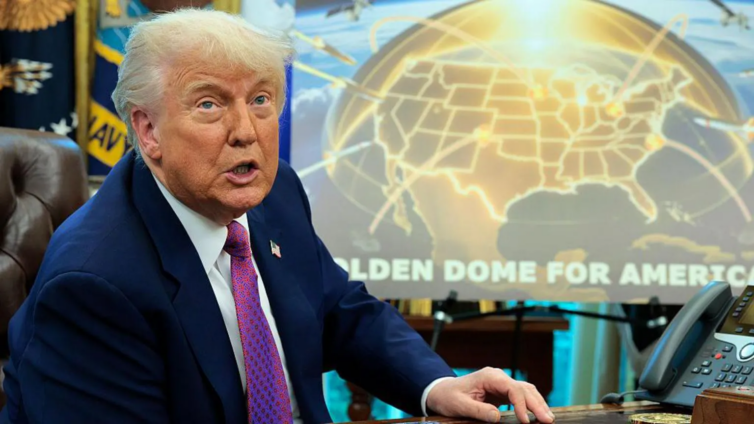
US President Donald Trump's futuristic "Golden Dome" missile defence system will cost about $1.2 tn (£882bn) to develop, deploy and operate over two decades, the nonpartisan Congressional Budget Office estimates.
That figure is significantly higher than the initial sum of $175bn (£129bn) that had been earmarked.
And the system designed to shield the US against ballistic and cruise missiles might not even work. The new CBO report warned the Golden Dome could be vulnerable to a full-scale attack by Russia or China.
Acquisition costs alone would be over $1tn, including for the interceptor layers and a space-based missile warning and tracking system, the fiscal scorekeeper said in a new report.
Just days after returning to the White House in January, Trump unveiled plans for the system, aimed at countering "next-generation" aerial threats.
He said last year that the programme would require an initial investment of $25bn, with a total cost of $175bn over time.
Democratic Senator Jeff Merkley, who requested the estimate in the report, said on Tuesday: "The President's so-called 'Golden Dome' is nothing more than a massive giveaway to defense contractors paid for entirely by working Americans."
The BBC contacted the White House and the Pentagon for comment.
There have been doubts about whether the US would be able to deliver a comprehensive defence system for such a huge land mass.
Officials have warned that existing systems have not kept pace with increasingly sophisticated weapons possessed by potential adversaries.
Despite the projected costs of the Golden Dome, "the system could be overwhelmed by a full-scale attack mounted by a peer or near-peer adversary", the CBO said.
An executive order calling for the creation of what was initially termed the "Iron Dome for America" noted that the threat of next-generation weapons has "become more intense and complex" over time, a potentially "catastrophic" scenario for the US.
A week into his second term, Trump ordered the Defence Department to submit plans for a system that would deter and defend against aerial attacks, which the White House said at the time remained "the most catastrophic threat" facing the US.
Trump said the system would consist of "next-generation" technologies across land, sea and space, including space-based sensors and interceptors.
The system would be "capable even of intercepting missiles launched from the other side of the world, or launched from space", the president said last year.
SpaceX and Lockheed Martin last month won contracts worth up to $3.2bn to develop space-based missile interceptor prototypes for the system.
Latest Stories
-
Education Minister inaugurates NDU Governing Council, announces $25m seed funding
2 minutes -
THE LAW 101: La Beach Demolitions – The State’s own documents, the courts’ orders – and the bulldozers
4 minutes -
DVLA contributes GH¢17.7m to Consolidated Fund in 2025
8 minutes -
Why disaster risk reduction must connect early warnings, preparedness and financial protection to household-level resilience
15 minutes -
The AI Gold Rush: Who strikes gold and who gets left behind?
38 minutes -
What Is Wrong With Us: We queue for the Colosseum while our own Castles crumble
1 hour -
Dangote IPO fever could deepen Africa’s capital markets, Citi Bank executive says
2 hours -
US hopes diesel deal can ‘soften’ Moscow on peace talks, sources say
2 hours -
Oil falls as Russia diesel supply prospects counter Gulf supply risks
2 hours -
Moroccan centrist party agrees to form coalition government with three other parties
2 hours -
IMF cites AI slowdown, spiking yields as looming global market risks
2 hours -
Nvidia’s China AI-chip share falls as Huawei closes gap, report finds
2 hours -
Trump says he does not believe China and Russia are helping Iran ‘at all’
2 hours -
One dead and several hurt after rollercoaster incident at Six Flags
4 hours -
Afrobeats singer Ayra Starr on making history at her NFL half-time show
4 hours