

Audio By Carbonatix
Ghanaian legal luminary Tsatsu Tsikata has proposed a solution to Ghana's recurring Cedi depreciation.
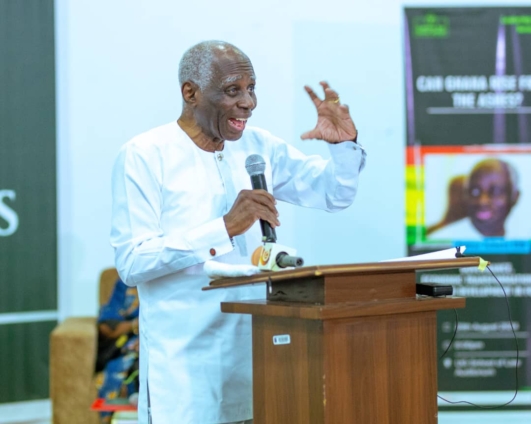
Speaking at the 14th Leadership Dialogue organised by the Centre for Social Justice (CSJ), Mr Tsikata's proposal focused on an approach he terms the “foreign exchange footprint” of individuals, aimed at bolstering the nation's economy and mitigating the impacts of Ghana cedi's devaluation.
The former Chief Executive of the Ghana National Petroleum Corporation (GNPC) began his presentation by addressing pressing issues faced by Ghana, including brain drain and the persistent depreciation of the cedi.
He noted that while many young professionals are leaving Ghana for opportunities abroad, this situation also presents a chance to leverage the economic potential of the Ghanaian diaspora.
"The diaspora and indeed Africans beyond Ghana have a unique relationship with the country that can be economically beneficial," Tsikata explained on Wednesday, August 28, 2024.
Mr Tsikata made the proposal when he delivered the keynote address at the 14th Leadership Dialogue organized by CSJ, a think tank, with support from Friedrich-Ebert-Stiftung (FES-Ghana) and Woezor TV.
The Leadership Dialogue Series is the flagship civic education platform of CSJ, a left-of-centre think tank. For years, the Leadership Dialogue has sought to nurture mass political participation and patriotic values through stimulating discussions with experts and prominent national leaders.
On the issue of dealing with Ghana's depreciating cedi, Tsikata further noted that remittances in foreign exchange from Ghanaians abroad often surpass the revenue from mineral exports, underscoring the financial significance of this global connection.
Forex Footprint
The crux of Tsikata's proposal lies in redefining how Ghanaians approach their consumption of foreign goods.
He introduced the concept of a "foreign exchange footprint," drawing a parallel with the contemporary practice of assessing one's carbon footprint.
"We need to examine our individual foreign exchange footprint. By evaluating how much we depend on foreign products and identifying areas where we can switch to local alternatives, we can reduce our dependence on imported goods and strengthen local production," he explained.
Ghana's perennial forex challenge
According to a paper by the International Institute for the Advanced Study of Cultures, Institutions, and Economic Enterprise, on an annual basis, there has not been a single year when the cedi has not lost value since the country moved from the fixed exchange rate regime to the current floating exchange rate system as part of the economic reform program embarked on in April 1983.
Over the past few decades, the cedi has lost about 99.9841% of its value against the US dollar.
The least rate of annual depreciation of 0.9 per cent occurred in 2005 while the year 2000 saw the highest cedi depreciation of 49.8 per cent since 1984.
On average, the cedi has depreciated annually by a rate of 20.3 per cent in three decades. $1 currently sells for close to 16 Ghana cedis (GH₵15.65) as of August 30, 2024.
The depreciation of the cedi exacerbates inflationary pressures and erodes business capital, thereby worsening the overall economic situation of the country.
A Novel Approach
Tsikata's approach makes a case for a comprehensive review of personal and collective consumption patterns to identify which foreign products can be replaced with locally produced alternatives.
His strategy aims to reduce Ghana’s import dependency, thus alleviating the pressures that contribute to the cedi's depreciation.
"The goal is to drive local production and create a self-sustaining economy that relies less on external factors," Tsikata added.
The proposed solution highlights the need for systemic changes in how Ghanaians interact with the global economy, suggesting that individual actions can collectively impact national economic health.
Tsikata’s call is a shift towards a more introspective and proactive approach to managing Ghana’s economic challenges.
He urged economists and experts to consider his proposal and improve it if necessary.
Ghana needs a great leader
Tsikata also addressed the broader context of Ghana's economic challenges, calling for leadership that is honest, humble, and capable of leveraging the nation’s resources effectively.
He urged leaders who are committed to tackling economic issues with transparency and a willingness to seek external expertise when necessary.
Latest Stories
-
Snake Village: A look at Volta Region’s hidden snake village and its tourism potential (Video)
7 minutes -
Election Watch Ghana calls for constitutional reforms to strengthen Electoral Commission independence
9 minutes -
NACOC, Postal and Courier Services Regulatory Commission intensify efforts to curb drug trafficking
11 minutes -
Ga Mantse chairs committee to drive Accra Green and Clean City Initiative
13 minutes -
Drivers threaten to remove traders from lorry stations over TrafficTech concerns
16 minutes -
AI could create 10 to 20 times more jobs despite current recruitment slowdown – Hubtel CEO
18 minutes -
Sexual abuse in schools persists because perpetrators are not held accountable – Dr Nyarkoa
26 minutes -
Chief Justice has designated Achimota Court to handle petroleum diversion cases – NPA CEO
29 minutes -
Philip Nai and friends gear up for bigger seventh Christmas outreach
30 minutes -
GSA strengthens electricity meter testing to protect consumers and improve energy reliability
31 minutes -
‘Dismissed or suspended? Ghanaians deserve clarity’ – NPP demands clarity on Ampofo Ankrah’s fate
35 minutes -
Teach consent and sexual boundaries from pre-school to prevent abuse – Gender advocate
40 minutes -
Zonda Tec launches HOWO T3M truck to support agric and logistics
49 minutes -
Obuasi SHTS scandal: Eduwatch calls for sex offenders’ register and mandatory background checks for teachers
1 hour -
GloMeF CEO urges intensified public education on new road traffic regulations
1 hour