

Audio By Carbonatix
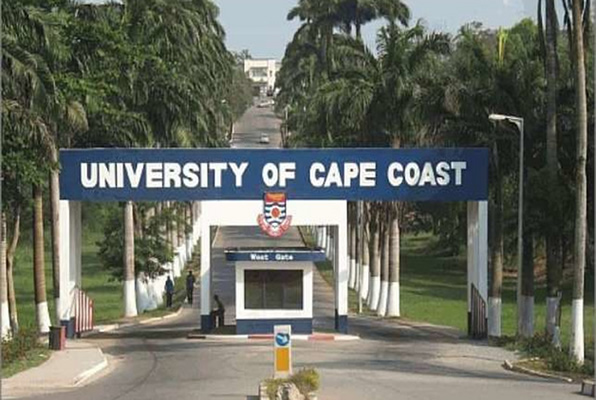
The University of Cape Coast (UCC) has held a day’s National Policy Dissemination workshop on five key areas of Ghana’s economy.
Senior lecturers from the UCC School of Economics took turns to present published research articles of some important sectors of the economy that need urgent attention when it comes to Ghana Beyond Aid.
The Provost of the College of Humanities and Legal Studies, Professor F. E. Amuquandoh, intimated that research has become the most important tool in impacting teaching, identifying problems in various sectors and finding solutions to them.
He, therefore, said that there is the need to identify the users of the information in addressing issues of the economy.
“Research is identifying where the problem lies so that we can cure it. Our research will not be complete if we don’t disseminate the outcome,” he said.
Dr. Camara Obeng with the Department of Economics Studies, UCC, presented on “the Export Efficiency and Diversification in Ghana”. He stated that, one of the areas that is likely to give Ghana appreciable resources to help in promoting the country beyond aid is export.
Dr. Obeng argued that Ghana is commodity-dependent, making it difficult to generate the needed resources in boosting the economy.
According to him, being commodity-dependent means Ghana exports more commodities than exported and thus there is the need to find other available commodities for export, especially with the introduction of the African Continental Free Trade Area (AFCTA) agreement.
“Ghana is commodity-dependent and it’s going to be difficult for us to generate resources that we need, so this task is to find out other products that are available given our current commodity base,” he stated.
The researchers came up with recommendations which when implemented, will help in addressing issues of export and commodity-dependence.
The second session was based on the theme, “Estimating Ghana’s Tax Capacity and Effort”. Professor W. G. Brafu-Insaidoo of the Department of Data Science and Economics Studies – UCC, addressed issues of the increasing tax revenue and strategies that are needed in achieving the Sustainable Development Goals (SDGs).
He said, “We live in a global economy and we are a member of the world trade and anything related to fair international trade, we’re signatory. And we have the Sustainable Development Goals which most countries have agreed to come up with strategies to achieve them.“
He was convinced that enhancing domestic tax mobilization is one key factor to achieving the SDGs and this means there should be ways and strategies of improving tax revenue collection efforts.
Dr. Isaac Bentum-Ennin who led the third and fourth sessions on “Determinants and Economic Impact of Tourism in Ghana” and “Distributional Aspect of Ghana’s Value-Added Tax” respectively, stated that Nigeria is Ghana’s keen competitor in terms of tourism and Ghana has to do more in retaining its tourists and keep them forthcoming.
Dr. Francis Kwaw Andoh and Richard Nkrumah contributed to the discussion. They analyzed how VAT has been distributed among households in Ghana and the exemptions in the distribution.
Professor E. Ekow Asmah presented the last session on “Financing Ghana’s National Health Insurance Scheme: How Buoyant is Existing Funding Arrangements?”. He mentioned that the behaviour of the people of Ghana, technically known as moral hazards, have changed. He said almost all who have the NHIS card utilize it because they know someone must pay. This has led to high expenditure as compared to income in recent years. According to him, the providers of the service have submitted claims to government to pay the cost incurred.
“The providers of care are submitting claims to government to pay and these claims could be inflicted. There should be somebody who should be monitoring and checking, doing clinical audit to be sure the claims and the cost build-up from the providers are what exactly must be paid.”
He added that the other contributing factor to the high expenditure is the exemptions. He said, a large group of people are benefiting from the NHIS without paying, therefore making funding difficult.
Professor Asmah further indicated that there is political interference in the work of the National Health Insurance Authority (NHIA) and that the NHIA needs new officials to manage the scheme independently.
Latest Stories
-
US, Iran fail to reach peace agreement after marathon talks in Pakistan
55 minutes -
Port crises loom as 11,000 drivers threaten four-day strike
2 hours -
A source of excellence across generations – Vice President Opoku-Agyemang lauds Mfantsipim
2 hours -
(Photos) Mfantsipim School launches historic 150th anniversary
3 hours -
Knights and Ladies of Marshall group backs Catholic Bishops’ stance on anti-LGBTQ+
4 hours -
Bright Simons writes: All the Filla in the Ibrahim Mahama/E&P – Gold Fields Saga
4 hours -
Monetise Idiocy In Ghana
4 hours -
ECG kicks off Phase Two of transformer upgrades at Lashibi; brief outages expected
5 hours -
The Ghanaian prophet and the mysterious death of his scottish wife Charmain Speirs
5 hours -
Nearly 400 sentenced in Nigeria for links to militant Islamists
5 hours -
Ghana’s recovery supported by gold strength despite global oil price pressures – Standard Bank Research
5 hours -
Methodist Church hails Mfantsipim@150; calls for “fresh consecration” to excellence
6 hours -
‘Excellence is our inheritance’ – Nana Sam Brew-Butler hails Mfantsipim’s 150-year reign in leadership
6 hours -
Kwaku Azar writes: A-G vs OSP
6 hours -
Mfantsipim–Adisadel rivalry built excellence, not division – Sam Jonah
6 hours