

Audio By Carbonatix
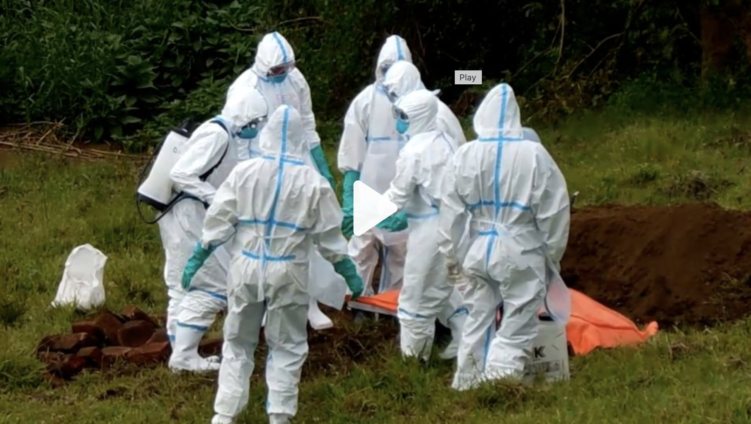
Ugandan President Yoweri Museveni has declared an immediate three-week lockdown in two high-risk districts as the country battles a rise in Ebola infections.
All movement in and out of the Mubende and Kassanda districts will be halted, Museveni said in a televised address on Saturday – although cargo trucks will be allowed to enter and leave the areas.
Curfews will also be imposed. Places of worship, bars, gyms, saunas and other entertainment venues will close but schools will remain open, he added.
“Given the gravity of the problem and to prevent further spread and protect lives and livelihoods, the government is taking extra measures that require action from all of us,” Museveni said.
The Ugandan health ministry will also increase contact tracing and assistance to local health facilities.
Ebola is a rare but deadly disease. It spreads through direct contact with body fluids and is not transmitted through airborne viral particles, the US Centers for Disease Control and Prevention (CDC) says.
It has no cure, and there is no approved vaccine, although there is a concerted effort to create one.
Speaking at a media briefing earlier this month, World Health Organisation Director-General Tedros Adhanom Ghebreyesus said the vaccines used successfully to curb recent Ebola outbreaks in the Democratic Republic of the Congo are not effective against the type of Ebola virus now circulating in Uganda.
“However, several vaccines are in various stages of development against this virus, two of which could begin clinical trials in Uganda in the coming weeks, pending regulatory and ethics approvals from the Ugandan government,” said Tedros.
Uganda has experienced four Ebola outbreaks. The deadliest left more than 200 people dead in 2000.
Museveni declared an Ebola outbreak in September after a case of the relatively rare Sudan strain was confirmed and cases began to rise across districts.
The latest outbreak has so far killed 29 amid 63 recorded cases.
According to the CDC, a person infected with Ebola “is not contagious until symptoms appear (including fever, headache, muscle and joint pain, fatigue, loss of appetite, gastrointestinal symptoms, and unexplained bleeding).”
The virus spreads through direct contact with body fluids and is not transmitted through airborne viral particles, the CDC says.
Latest Stories
-
Daily Insight for CEOs: Preparing for 2027 Board and Executive Conversations
11 minutes -
World Cup Visa Scandal: There is no ‘justification’ to dismiss me – Kofi Adams
22 minutes -
2028 Olympic Games qualification ‘really tough’ – Black Queens coach Björkegren
48 minutes -
GRFU, GOC Women’s Commission hold breast cancer awareness, expresses gratitude to Sunda International Ghana
51 minutes -
COCOBOD raises GH¢3.4bn as Cocoa Capital PLC lists inaugural commercial paper on GFIM
1 hour -
No Party Card, just a Party Microphone! A Ghanaian story of Elections, Referees and Convenient Amnesia
1 hour -
Minority welcomes suspension of teachers’ strike, demands timely payment of promotion arrears
1 hour -
Customary ownership accounts for 80% of land; it complicates land administration – Lands Commission
1 hour -
NRSA to auction vehicles of non-subscribers who fail to pay towing charges within 21 days
1 hour -
WAFU B U17: Black Starlets target AFCON slot after booking semi-final place
2 hours -
Ghana faces $6.1bn debt-service burden from 2027 to 2029 due to Akufo-Addo’s DDEP – Haruna Iddrisu
2 hours -
GoldBod targets 150 hectares of forest reclamation in 2027
2 hours -
Despite substantial accommodation capacity, room demand still weakens – GSS report
2 hours -
No amount of foreign exchange is worth a lost forest – GoldBod
2 hours -
Chelsea’s defensive crisis: Alonso’s system, missing pieces, or individual errors?
2 hours