

Audio By Carbonatix
The UK has become the "most expensive place in the world" to build nuclear power plants, according to a government review which criticises "overly complex" bureaucracy around the sector.
The report, which was commissioned by Prime Minister Sir Keir Starmer,calls for a "one-stop shop" for nuclear decisions.
A "radical reset" of the rules around nuclear power could save Britain "tens of billions" in costs and reverse the industry's "decline" in recent years, the Nuclear Regulatory Taskforce said.
It comes as the UK government looks to build a new generation of nuclear plants to meet the country's future energy needs and net zero targets.
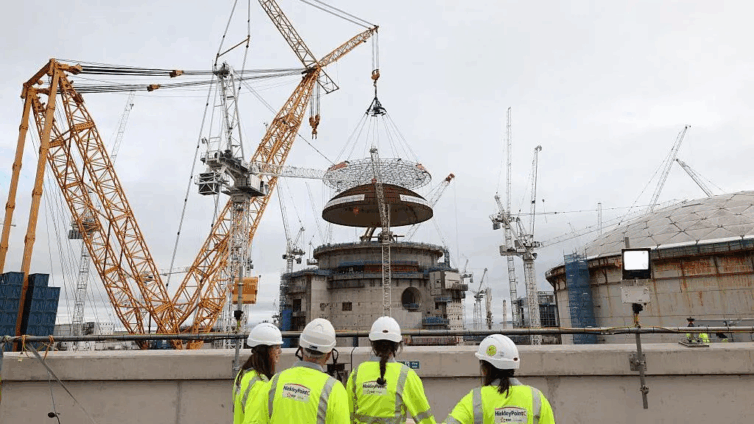
Hinkley Point C in Somerset is expected to start operating in the early 2030s, while Sizewell C - which the government says will becapable of powering six million homes - will follow later that decade.
The UK is also setting up small nuclear power stations, which are faster to build than full-size reactors.
The taskforce's report said the planning system needed to be streamlined and the risks associated with nuclear energy should be brought in line with the rest of the world
It said the UK had excessively risk-averse policies in place, including "overly conservative" rules on radiation exposure levels for workers.
A "fragmented" regulatory system has led to "conservative and costly decisions not proportionate to the actual risk being managed", it said.
The report said nuclear plants - which generate electricity by using atomic reactions to produce heat - were "essential to the UK's future", with the country at risk of missing out on a "worldwide nuclear renaissance".
Taskforce chair John Fingleton said: "Our solutions are radical, but necessary. By simplifying regulation, we can maintain or enhance safety standards while finally delivering nuclear capacity safely, quickly, and affordably."
Speaking to the BBC's Today programme, Mr Fingleton said the UK's regulations have "made us the most expensive place in the world to build nuclear".
Limitations on exposure to radiation are stricter in an energy setting than in a dentists or doctors, he said.
"Motorways wouldn't be very useful if we all drove at five miles an hour but that's sort of what we're doing in nuclear safety."
The government is expected to address the report's findings later this month in the Budget.
Energy Secretary Ed Miliband said: "This government is delivering a golden age of new nuclear as we drive for energy sovereignty and abundance.
"A crucial part of that is delivering the reforms we need to drive forward new nuclear in a safe, affordable way."
Several major economies are reassessing their nuclear strategies and expanding capacity.
The number of planned and proposed nuclear plants currently in the works is roughly equivalent to the number already in operation around the world.
The UK is among 30 other countries that have signed a global pledge to triple their nuclear capacity by 2050 in a bid to cut carbon emissions.
Britain's existing nuclear power stations account for about 15% of the electricity generated in 2024.
The UK runs nine nuclear reactors but they are ageing, with eight set to shut by 2030, and the new plants will take several years to come online.
Beyond the UK, France plans to build at least six new reactors, while China has nearly 30 under construction.
The US completed its first new reactor in over three decades last year, and Japan - which temporarily shuttered its nuclear programme after the 2011 meltdown at Fukushima - now plans for it to supply a fifth of its electricity by 2040.
In contrast, Germany has phased out its use of nuclear power, prioritising alternative renewables like hydrogen.
The development of nuclear energy remains divisive, with public opinion shaded by high-profile safety incidents, including Fukushima and the 1986 disaster at Chernobyl.
Latest Stories
-
SEC to develop Social Bond Guidelines; over half of listed firms report on ESG indicators
4 minutes -
Insurance firms have up till January 2027 to incorporate ESG in financial reporting
10 minutes -
High Court throws out Afenyo-Markin’s GH¢15m defamation suit against Sammy Gyamfi
21 minutes -
Rollover cost of T-bills reduced substantially, one-year bill yield drops 19% since December 2024
21 minutes -
Daily Insight for CEOs: Preparing for 2027 Board and Executive Conversations
43 minutes -
World Cup Visa Scandal: There is no ‘justification’ to dismiss me – Kofi Adams
54 minutes -
2028 Olympic Games qualification ‘really tough’ – Black Queens coach Björkegren
1 hour -
GRFU, GOC Women’s Commission hold breast cancer awareness, expresses gratitude to Sunda International Ghana
1 hour -
COCOBOD raises GH¢3.4bn as Cocoa Capital PLC lists inaugural commercial paper on GFIM
2 hours -
No Party Card, just a Party Microphone! A Ghanaian story of Elections, Referees and Convenient Amnesia
2 hours -
Minority welcomes suspension of teachers’ strike, demands timely payment of promotion arrears
2 hours -
Customary ownership accounts for 80% of land; it complicates land administration – Lands Commission
2 hours -
NRSA to auction vehicles of non-subscribers who fail to pay towing charges within 21 days
2 hours -
WAFU B U17: Black Starlets target AFCON slot after booking semi-final place
2 hours -
Ghana faces $6.1bn debt-service burden from 2027 to 2029 due to Akufo-Addo’s DDEP – Haruna Iddrisu
2 hours