

Audio By Carbonatix
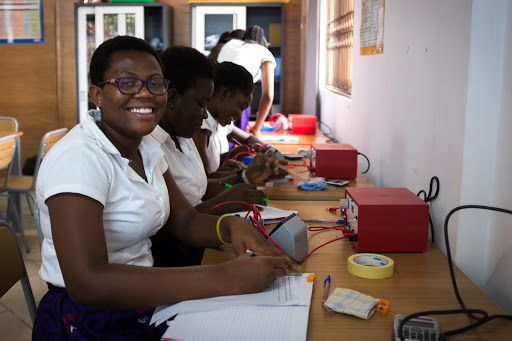
Women in Ghana, according to the Global Education Monitoring Team in 2018, account for less than a quarter of all Science, Technology, Engineering, and Mathematics (STEM) degree holders, a Member of Parliament for Kwesimintsim has said.
Dr Prince Armah, says the evidence from the Ministry of Environment, Science, Technology and Innovation in 2018 showed that, out of a total of 5,573 researchers in public research institutions, only 1452 representing 26.1% were females.
As if that is not bad enough, out of 233 scientists in nuclear science who were counted in 2018, only 23.2% were women.
The first time MP made these comments to mark the International Day for Women and Girls in Science commemorated on the 11th of February every year.
Dr Prince Armah said the under representation of women in professional and academic endeavours, especially in the sciences, could pose a major risk to the future of the country.

“We are currently in the midst of a technological revolution that has made science integral to our personal lives and our national destinies. We cannot afford to leave women behind. In fact, we will be unable to move forward without them,” he said in the statement.
According to him, “women were routinely shut out of many mainstream activities, including the right to formal education.
He added, “this created a self-perpetuating myth about the supposed abilities of women, which in turn led to further discrimination and exclusion.”
He stated that the country cannot continue to shut out the greater proportion of our populations from contributing to such a significant endeavour, insisting, “we deprive ourselves of talents and potentially world-changing innovations”.
Dr Prince Armah, who is also an advocate for inclusive education, admits attempts have been made in the past to reduce the gaping disparity between men and women in the pursuit of STEM education and career prospects but a lot more needs to be done.
“I believe, we will need to do is to tackle the inequity in STEM education in relation to gender stereotypes, deprivation, rurality, and disability in STEM education and careers, particularly in districts that are under-served by STEM learning and other science engagement activities.
Explaining why it is important to have increased participation of women in STEM, Dr Armah said: “The education of females in science, technology, engineering, and mathematics is imperative from three perspectives based on empirical studies on gender and STEM. The first perspective is that of human rights — the need for all to be educated and be given equal opportunities.
"The second perspective is scientific — women boost scientific outcomes in terms of diversity, creativity, bias reduction, and promotion of robust knowledge and solutions. The third perspective is developmental — that is, the ability of men and women to acquire knowledge in and benefit from STEM opportunities. In fact, STEM fields have been shown by research to be prerequisites to societal and individual advancement.”
Among the interventions needed to change the narrative, Dr Prince Armah said “we have to expose our daughters to STEM and related career options as early as possible. We can do this through our natural interactions as parents, guardians and teachers…We can go back to the Girls in Science programmes or create new programmes with similar missions.
"We can set up STEM centres with a focus on women and girls. The important thing is to allow girls a chance to learn about science, interact with mentors and where possible, acquire basic skills in the field. This is what we did in Kwesimintsim when we organised a “Women in ICT" programme to equip young women with basic ICT skills.
Women and girls have every potential they need to succeed in science, they simply need our support to start the journey.”
In addition, the Kwesiminstim MP, who was also the immediate past Director General of the National Council for Curriculum and Assessment (NaCCA) said the roles of women in science and related fields must be highlighted across the country to encourage young women.
“Around the country, we have many sterling women who are playing exceptional roles in the sciences, including in the ongoing global battle against Covid-19. We need to show young women and girls that they are just as able as their male counterparts,” he stated.
He was also quick to applaud the organizers of the National Science and MathsQuiz for the consistent use of women as Quiz mistresses and the conscious efforts to inspire women to the sciences.
“The urgency of this task is not in doubt. Ghana cannot be left out of the science-based revolution that is sweeping the world. We cannot do this with one hand tied behind our backs, as it were. But that is exactly what we will be doing if we do not get more women involved in the sciences. That is why this day is especially important. The opportunity it affords us to reflect, revise and retool must not be missed. A generation from now, our girls could be at the forefront of global innovation. It is possible if we begin now,” he stated.
Latest Stories
-
Philanthropist Alhaji FuZak donates Da’wah bus to Ambariya Sunni community
7 minutes -
GUTA calls for suspension of Publican AI system over trade disruptions, demands temporary halt in import activities
10 minutes -
TTAG raises alarm over proposed recruitment of 7,000 teachers, demands national posting roadmap
43 minutes -
Civilians feared killed after reports of air strike on Nigerian market
53 minutes -
Bishop Simon Kofi Appiah installed as new Jasikan Diocese Bishop
54 minutes -
Trump’s Strait of Hormuz blockade threat raises risks and leaves predicaments unchanged
56 minutes -
US Court backs extradiction of former MASLOC CEO Sedina Tamakloe-Attionu’s to Ghana
1 hour -
Seven arrested as NAIMOS dismantles illegal mining camp, seizes firearms at Boin River
1 hour -
Fire erupts at Madina Ritz Junction, destroys multiple wooden structures and containers
2 hours -
Daniel-Kofi Kyereh returns from long-term injury, registers assist for Freiburg U23
2 hours -
Knifeman calling himself ‘Lucifer’ slashes three at NYC’s Grand Central
2 hours -
Brands are built from within to without
2 hours -
Matriculants urged to pursue excellence as gov’t reaffirms support for Maritime education
2 hours -
See the areas that will be affected by ECG’s planned maintenance on Monday, April 13, 2026
2 hours -
GPL 2025/26: Salim Adams double fires Medeama back to summit after Kotoko rout
2 hours