

Audio By Carbonatix
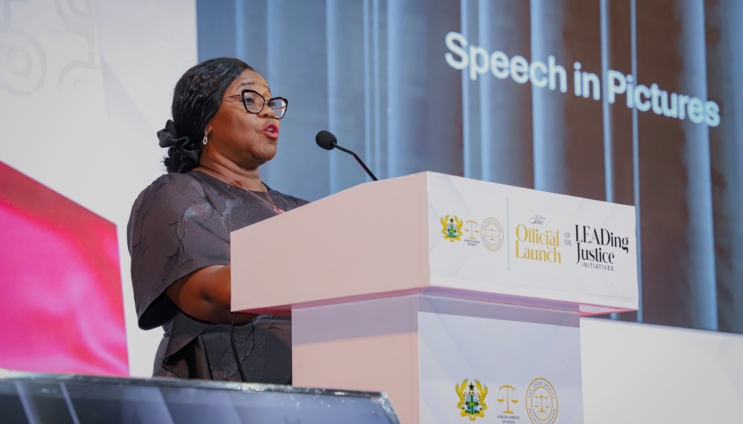
Chief Justice Gertrude Araba Esaaba Sackey Torkornoo says there is an urgent need to build a modern archive centre to store all records.
She said that would ensure easy retrievals whenever citizens and court users needed them.
The Chief Justice was speaking at the launch of an initiative dubbed ‘LEADing Justice’, a strategic framework for increasing Legality, Ethics, Assets, Digitalisation, and due process in justice delivery.
The new reforms form part of her vision for improved capacity of all workers within the justice delivery system and a continuous drive towards efficiency.
She said as the documents were being stored, they must be digitised for electronic storage and easy retrieval.
“Again, it is only after digitisation that we can even remotely anticipate effective e-justice. Because virtual trials cannot be conducted without electronic dockets,” she added.
The Chief Justice said it was a strong goal of the vision statement to move registries into paperless modes as soon as possible.
She said the LEADing Justice vision was anchored on the high use of technology to increase speed and transparency in the justice delivery process.
Justice Torkornoo said goals had been set for digital libraries so that all staff and judges would have access to learning, notwithstanding, which part of the country they were.
“Goals have also been set to obtain centrally managed transcription rooms for the early processing of court proceedings so that requests for court processes cannot be affected by localised interests within the courtroom,” she added.
She said that would remove the burden of court users paying courtroom recorders to produce transcripts of proceedings.
The Chief Justice said it would also ensure that records were made available to stakeholders without unnecessary waste of time and costs through travelling to a registry, queuing to pay for a record, and being told to go and come back.
The Chief Justice said land mapping, verification of property details from records on property rates with District Assemblies, verification of details of vehicles from DVLA, and verification of account holding in banks during execution processes, could all be easily done via dedicated and authenticated e-processes between the courts and the relevant institution.
“This can save staff from institutions spending productive time in court just to relay information,” she added.
She said many of those electronic verification processes would cut out the horrible spectre of forgeries that the courts sometimes experienced.
Latest Stories
-
New health training facility at Ampoma-Jema to address admission shortfalls, but Minister flags missing amenities
6 minutes -
Black Challenge unveiled with sights set on Amputee World Cup glory
26 minutes -
Pay striking teachers before expressway spending, Dr Kingsley Agyemang tells government
1 hour -
Customs intercepts assault rifle, two pistols and 610 rounds of ammunition at Tema Port
1 hour -
PKO boxers secure wins at Odwira Festival
2 hours -
South Tongu Records Rise in Teenage Pregnancy
2 hours -
Cabinet threw out US health compact faster than anything I’ve seen – Mahama
2 hours -
MoFA urges Finance Ministry to reverse World Bank food programme withdrawal over GH¢643m commitments
2 hours -
NAGRAT demands signed timelines before calling off strike
2 hours -
National Investment Quiz: West Africa SHS, St. Louis SHS advance to semi-finals
3 hours -
Shatta Wale appeals to Mahama for balanced framework to tackle social media abuse without stifling free speech
3 hours -
Education Ministry urges data-driven talks to resolve teacher impasse
3 hours -
‘What we wanted was money to buy medications’ – Dr Nawaane on US health support
3 hours -
Osman Ayariga leads NDC team to vet constituency aspirants in Central Region
3 hours -
‘We shouldn’t allow their drugs in just because they’re giving us $100m’ – Dr Nawaane
3 hours