

Audio By Carbonatix
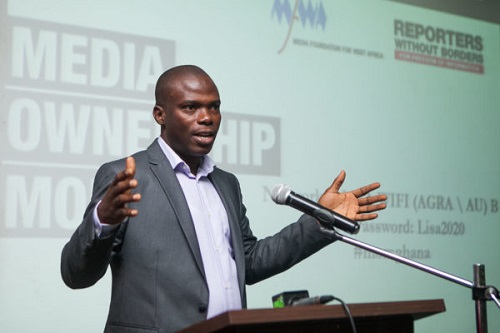
Executive Director of the Media Foundation for West Africa (MFWA), Sulemana Braimah, says Ghanaians need to admit that every sector and institution is becoming quite partisan.
He was speaking in reference to comments made by former president, John Dramani Mahama, at the NDC Lawyers’ Conference where he said the Akufo-Addo administration has packed the bench with judges politically inclined to the NPP.
According to Sulemana Braimah, the former president should not be chastised for commenting on a ‘worrying’ trend, as such comments and questions are needed to protect the sanctity of the judiciary.
“I think that we need to admit that increasingly every sector of our society, every state institution is getting quite partisan and that must be worrying to all of us. And for the judiciary, I often say that when we lose the judiciary it will be the end of our democracy and perhaps the end of our progress. So it is important that we protect the sanctity of our judiciary.
“But the protection of it is not to criticize it when we see things going wrong. If indeed what we’re observing is increasing appointment and packing the courts with those who are inclined to a particular political tradition then we need to say it just as it is said in the US and I believe elsewhere,” he said.
He, however, noted that John Mahama’s comment on balancing the bench with NDC judges was not the right call, rather the entrenchment of the same problem he had identified.
“I think my only problem with the former president’s statement was to say that what we are observing is wrong and when I get the chance to come to power, I would also do the same wrong thing. I think that is what I find fundamentally wrong.
“But for people to accuse him of raising the question about how judges may be of a certain political orientation are getting appointed to the court, I think that is fair, I think we need to have real debate about that,” he said.
To buttress his earlier point, he cited a study carried out by Professor Atuguba which showed that judges were likely to rule in line with the political inclination of their appointing authority in political cases.
Thus the NPP administration stuffing the bench was indeed a matter of concern.
“If you remember in 2018 I think, the revered Professor Raymond Atuguba did a study looking at about a 100 cases that he classified as political cases, and at the end the conclusion was that when you look at the cases and the judges who sat on the cases and who appointed those judges, the conclusion was you’d find that the judgements are always tilted towards the inclinations of those who appointed them. And so we cannot rule it out that that is not a problem we need to talk about and that is the only way we can protect the sanctity of the judiciary,” he said.
Latest Stories
-
Fairtrade Africa’s Cocoa Hubs Project strengthens rural service centres in cocoa-growing communities
2 minutes -
SEC cautions investors against fraudulent investment schemes
4 minutes -
Land Ministry urges rCOMSDEP operators to reserve earnings for land reclamation
7 minutes -
Commercial drivers give authorities one week to clear traders from lorry terminals, bus stops
12 minutes -
Nana B denies claims that Kojo Bamba was his driver and bodyguard
39 minutes -
Engage Now Africa to construct a 10-unit classroom block for struggling Navrongo Vocational Training Centre
46 minutes -
One digital financial breach could expose linked accounts to fraud – Financial Crimes Manager
51 minutes -
Ghana Russia Centre signs ICT cooperation agreement with Moscow University
55 minutes -
The powerhouses of the village: Honouring Ghana’s rural women on International Rural Women’s Day
55 minutes -
Vincent Assafuah petitions CHRAJ to investigate alleged irregularities in 2026 World Cup visa arrangements
56 minutes -
12-year-old boy found dead in muddy pit at Opeikuma
58 minutes -
GHS begins Yellow Fever vaccination campaign in three Upper West districts
59 minutes -
Organised Labour pushes for higher 2027 base pay despite slowing inflation
1 hour -
Parliament’s Human Rights Committee demands swift justice in Obuasi SHTS sexual abuse case
1 hour -
From Campaign Propaganda to Gov’t Accountability: When the message-makers demand a seat at the table
1 hour