

Audio By Carbonatix
Mon, April 8, 60 days before the start of the war between Israel and Iran, Abdelmadjid Tebboune received the head of Iranian diplomacy, Abbas Araghtchi, at the El Mouradia Palace, who sent him an invitation for an official visit to Iran. While this war jeopardises the Algerian president's trip to the land of the mullahs, the invitation nonetheless underlines the excellence of Algerian-Iranian relations. Indeed, on Friday, June 13, Algerian diplomacy was quick to condemn the Israeli offensive against Iran, referring to an "aggression which would not have been possible without the impunity enjoyed by the aggressor." Of the three Maghreb countries, Algeria is thus the only one to express unambiguous support for Iran. The two countries have in common, in particular, that they consider Israel a sworn enemy.
This is because between Algiers and Tehran, there is a long history of services rendered, good offices, ruptures and reconciliations. In the 1970s, at a time when Algiers was the Mecca of revolutions, President Boumediene invested in an operation aimed at settling the old dispute between Iran and Iraq over the river borders between the Tigris and the Euphrates. In March 1975, after several months of discussions under the patronage of the Algerians, Shah Mohammad Reza Pahlavi and Saddam Hussein signed an agreement in Algiers, sealing the end of this ancestral conflict.
The golden age of Algerian diplomacy
It was the golden age of Algerian diplomacy, whose services Iran will seek four years later. It was November 1979, eleven months after the start of the Islamic Revolution led by Ayatollah Khomeini. In the wake of this uprising, which overthrew the Shah's regime and forced him to flee, hundreds of Iranian students invaded the American embassy in Tehran and took 63 people hostage. America was in shock, and the world followed this affair with its unpredictable consequences day by day. About ten of the staff members held by these students were released.
The release of the remaining hostages was further compromised when a CIA operation launched in April 1980, codenamed "Eagle Claw," turned into a fiasco in the Iranian desert. This impossible mission would tarnish the end of Jimmy Carter's presidency, which was succeeded by Ronald Reagan. How could the new Iranian leaders be forced to give in and bring the hostages home?
Algeria was then approached to lead a mediation operation, which would be led by Foreign Minister Mohamed Seddik Benyahia, a skilled negotiator and seasoned diplomat. Algerian mediation was all the more sought after because Algiers had already been approached in 1978 by Lebanese Shiite leader Moussa Sadr to offer asylum to Imam Khomeini, before he found asylum in France.
After months of back-and-forth between Washington, Paris, and Tehran, Benyahia managed to get both parties to sign an agreement in Algiers on January 19, 1981, under which the United States agreed not to intervene in Iran's internal affairs and to lift the freeze on Iranian assets. In return, Iran agreed to release the captives. The next day, the 52 American hostages walked onto the tarmac of Algiers airport after 444 days of captivity. America will be eternally grateful to the Algerians. The mullahs in power in Iran will be just as grateful.
Fallout between 1993 and 2001
As war raged between Iraq and Iran since September 1980, thus burying the 1975 Algiers Agreement, Algerian diplomacy was once again called upon to play its part in halting this murderous madness between the two neighbours. And it was the same Seddik Benyahia who was tasked with this mission, which would be cut short by a terrible tragedy. On Monday, May 3, 1982, the Grumman G2 carrying Benyahia back from a mission to Tehran was flying over the Turkish-Iranian border when it was pulverised by a missile fired from an aeroplane. The Algerian minister, eight members of his delegation, and the four crew members perished.
Who shot down the negotiators' plane? Iraqis and Iranians blamed each other. But after months of investigation, the Algerians presented the results of their investigations to Saddam Hussein at his palace in Baghdad. Faced with a fait accompli, Hussein acknowledged his air force's responsibility and offered compensation, which Algiers declined. Ironically, Seddik Benyahia had escaped death a year earlier when his plane crashed near the Bamako airport in Mali.
For a large proportion of Algerians, Iran's theocratic regime will lack gratitude and recognition. In the early 1990s, the Islamic movement was on the brink of power in Algeria, thanks in part to the support of Saudi Arabia and Iran. When the country plunged into civil war in January 1992, the Algerian army and intelligence services were convinced that the Iranians were aiding and financing armed Islamic groups that were sowing terror.
So much so that in March 1993, Algiers broke off diplomatic relations with Tehran and recalled its ambassador to Sudan, another country that supported Algerian terrorists. The dispute lasted until 2001, when President Bouteflika decided to reestablish ties with Iran. He visited Iran twice, in 2003 and 2008.
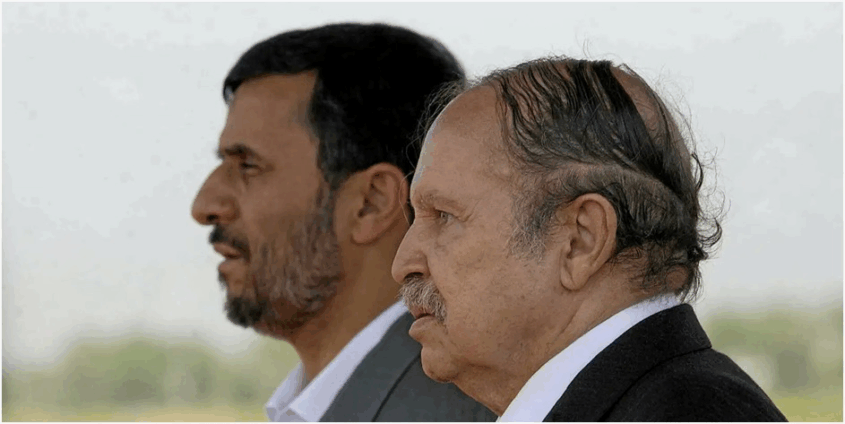
He was even scheduled to return in 2010, but the trip was cancelled. In turn, he hosted Mohamed Khatami in Algiers in 2004 and Mahmoud Ahmadinejad in 2007 and 2010. At the time, Iranian leaders could count on Bouteflika to support "Iran's right to acquire nuclear technology for peaceful purposes."
Latest Stories
-
Ghana eyes stronger trade ties as Australia hosts multicultural trade and investment forum
39 seconds -
Margaret-Marie Krakue
3 minutes -
Ayariga announces plans for live broadcast of MMDAs’ meetings on local radio stations
6 minutes -
Mrs Anna Tackie
8 minutes -
Ghana links Afghan heroin and Brazilian cocaine to global drug markets – Global Organised Crime Index
16 minutes -
NHIA launches nationwide inter-school quiz to deepen students’ knowledge of NHIS
22 minutes -
Political protection could be masking Ghana’s cocaine trade – Global Organised Crime Index
27 minutes -
AFCON 2027Q: ‘We have to dissolve the GFA’ – Effia MP after Black Stars lose to Gambia
29 minutes -
NPP announces voting schedule and ID requirements for October 3 national elections
31 minutes -
Lupus can mimic HIV symptoms and damage kidneys if untreated – KNUST expert
34 minutes -
Focus on Sickle Cell Foundation seeks to introduce sickle cell education through comics in Ghanaian schools
40 minutes -
NPP rewrites the campaign playbok as opposition reality shapes National Executive contest
42 minutes -
Road safety education will fail without enforcement – NRSA boss
42 minutes -
Daily Insight for CEOs: Finishing Q3 strong and entering Q4 with purpose
43 minutes -
National Ambulance Service begins ‘Operation Restore Fleet’ to restore grounded ambulances
44 minutes