

Audio By Carbonatix
The 2024 KPMG Customer Experience Survey has revealed that the Ghanaian investment landscape reflects a cautious approach to investments with interests in both low and medium risk opportunities as individuals navigate economic challenges in pursuit of financial security and independence.
According to the report, the recent insights reveal that treasury bills remain the most preferred investment option, with 39% of respondents opting for these low-risk instruments.
Fixed or term deposits closely follow at 25%, further reinforcing the cautious approach among many Ghanaians, who prioritise stability and guaranteed returns amidst economic uncertainty.
However, the report said there are signs of gradual diversification in investment choices.
Mutual funds, selected by 23% of respondents, are gaining traction as a medium-risk option offering balanced returns.
Additionally, commodities such as precious metals and agriculture products, accounted for 20%, which demonstrated a growing appetite for alternative investments as a hedge against inflation and economic instability.
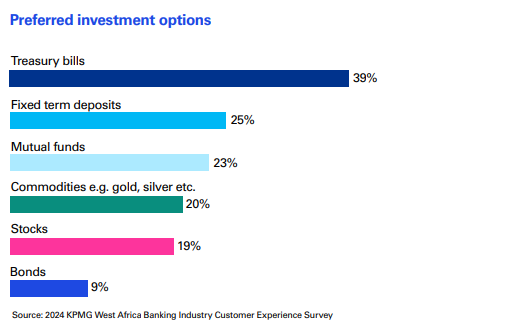
Expectedly, higher-risk instruments such as stocks (19%) and bonds (9%) remain underutilised, pointing to limited confidence.
The report added that the hesitancy of Ghanaians to adopt these investment options highlights the need for banks to provide education and solutions to bridge knowledge gaps and demystify complex financial products.
Despite these trends, the survey also revealed that 34% of respondents are willing to take risks with their investments, signalling an underlying desire for wealth creation and financial independence.
Despite these challenges, the survey also highlighted how Ghanaians are channelling resources toward personal growth, financial security and family welfare.
24% Ghanaians Invest in Skills Acquisition, Businesses
When asked about their top three priorities, approximately 24% of respondents are investing in skill acquisition and business ventures reflecting a desire for career advancement and financial independence.
Family obligations remained a central priority, with 24% dedicating funds to education, healthcare and general welfare.
Similarly, wealth generation through investments and property sales also gained traction, with 22% of respondents pursuing these strategies.
Latest Stories
-
Don’t throw away empty egg cartons — 6 smart ways to reuse them
30 seconds -
GoldBod poised to surpass 2025 forex performance – Sammy Gyamfi
1 minute -
Old students of Peki SHS break ground to give 70-year-old school infrastructure a facelift
16 minutes -
Ablakwa facing ‘personal vendetta’ over refusal to grant Nana B service passport – Majority
16 minutes -
Every year, the lawyers come out, and so does the nonsense! – Ace Ankomah writes
29 minutes -
Digital transformation without an ownership culture can digitise poor service
32 minutes -
Fishing communities demand revocation of offshore gold exploration licences over livelihood concerns
35 minutes -
How Ghanaian tycoon Manoj Lakhiani built a water and plastics empire from a $25,000 loan
36 minutes -
GoldBod recovers GH¢38.7m of GH¢55.8m outstanding receivables; remainder subject to legal action – Sammy Gyamfi
43 minutes -
GEXIM Bank donates GH¢200,000 worth of medical equipment to Korle-Bu Child Health Department
46 minutes -
Majority rejects Minority’s claims over GH¢49.7m South Africa evacuation
48 minutes -
GEXIM urges banks to support refurbishment of Korle-Bu Teaching Hospital’s Child Health Department
51 minutes -
Don’t appoint your cheerleader as referee
55 minutes -
Ghana needs stronger international cooperation to fight cybercrime – CSA
58 minutes -
CSA warns of growing cyber threats as Ghana’s digital dependence increases
1 hour