

Audio By Carbonatix
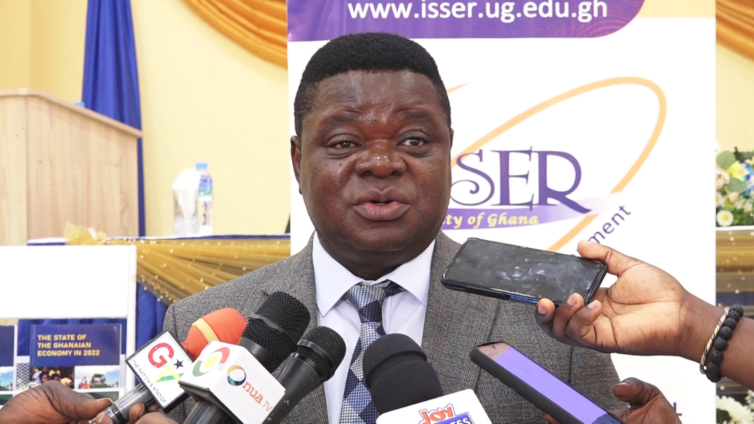
Director of the Institute of Statistical, Social and Economic Research (ISSER), Prof Peter Quartey has urged government to establish a sinking fund to ease Ghana’s repayment schedule at the end of the IMF moratorium.
The Finance Minister, Ken Ofori-Atta, has revealed on a yet-to-be-aired PM Express Business Edition that Ghana has been granted a four-year moratorium on debt repayment to allow the country some breathing space to focus on developmental projects.
This represents a departure from previous programmes, where all the cash disbursed under the IMF programme was directed towards supporting Ghana’s balance of payment needs.
“We should not rule out the fact that these funds coming in will help the Bank of Ghana improve its reserves, a move that will help stabilise the Ghana cedis,” he said.
According to Prof. Peter Quartey, while the moratorium is welcome news, government should not sleep on their oars but get to work saving money towards the end of the moratorium.
Speaking on Joy FM’s Super Morning Show on Tuesday, he said, “It does give us breathing space. But we should also note that it is not free, it is not debt forgiveness, so we need to prepare, we need to set aside some money to pay when it’s due and that’s very critical.
“If we don’t, and knowing our history, sometimes we tend to forget and do not do the needful then it comes to bite. But I think if there’s a sinking fund where annually we earmark funds and put it down so that when it’s due in 2027, we have the resources to pay. That is fine so that we get some good breathing space.”
The ISSER Director added that government does not need to reintroduce new taxes to pay the nation’s debts.
He called for enhanced efficiency in the collection of already existing levies and urged government to negotiate for interest rate cuts as well to give the country more breathing space.
"I’m yet to see the fine details of the term sheet. But I know for sure that there is going to be some interest rate cuts as well, and that will save us money.
"I’m speaking from the example of Zambia where there were interest rate cuts but not principal and that also helped to free some resources for the country.
“So there’ll be some benefit, but of course, these are debts we have accumulated in the past and we have to pay so we should brave ourselves to pay.
"We don’t need new taxes, we don’t need higher taxes, if we’re efficient in what we’re collecting I think we should be able to pay this without overburdening the already burdened Ghanaian,” he said.
Latest Stories
-
Vibes The Movie: Big Ghun’s Ghanaian film earns five nominations at 2026 REFFA
17 minutes -
MamaCare CEO warns unresolved conflicts among health workers could undermine maternal and neonatal care
41 minutes -
Health professionals urged to translate medical knowledge into practice to save mothers
47 minutes -
Conflicts among care providers linked to maternal, neonatal deaths – Expert
2 hours -
GIS marks 10th TIME conference, champions improved teaching practices
2 hours -
BRICS Or Balance? What Ghana’s bid really means
3 hours -
GPRTU wants full TRAFFITECH-GH implementation to start in 2027
3 hours -
Mahama announces plans to import electric wheelchairs for PWDs
3 hours -
KGL U17 Colts 2026: Western beat Prempeh Elite Academy to set up final final with Greater Accra Region
4 hours -
Late Solanke strike salvages 10-man Spurs draw at Man United
4 hours -
Gender Ministry to monitor welfare of Nana Akua Addo’s children amid domestic violence case
4 hours -
Benedict Okyere Yeboah: Ghana’s football problem goes beyond sacking a coach
4 hours -
GPL 2026/27: Darkwah Wiafe’s winner sees All Blacks beat Kotoko
4 hours -
ITF World Tour : Patel Wins Boys’ Singles Final at J100 Accra
4 hours -
Ghana must pursue BRICS partnership if it brings economic benefits – Kpebu
4 hours