

Audio By Carbonatix
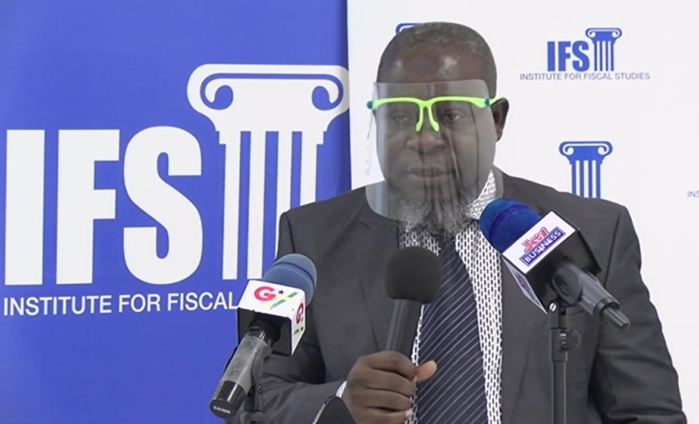
The Institute of Fiscal Studies (IFS) has criticised government’s social intervention programs amidst the coronavirus pandemic saying they were poorly executive and lack fiscal prudence.
With Ghana’s debt servicing taking 72 per cent of government revenue, the Institute warns of Ghana’s fiscal position getting worse.
It wants austere measures like immediately seeking debt reliefs from debtors and slashing down employee salaries are taken.
Senior Research Fellow with the IFS, Dr Saeed Boakye described these decisions as “head-scratching”.
“Since the pandemic hit the country, government has taken certain fiscal actions that are quiet head scratching, and which were reflected in the 2020 reviewed budget.
"These include the announcement of a 15 per cent salary increase for civil servants in March 2020.
"While it was commendable on the part of government to help vulnerable cope with the pandemic, it went ahead of providing free water for all including those who are not vulnerable,” he lamented.
According to the IFS, the review of the 2020 budget estimates shows Ghana’s fiscal position has dramatically worsened.
So far, the total revenue and grants for 2020 are projected to be ¢53.7 billion. However, debt service expenditure is also projected at ¢38.5 billion while employee compensation is projected at ¢27.1 billion.
Based on the figures, some economists say Government will have to borrow to the tune of ¢11.8 billion or 22.1 per cent of total revenue and grants before it can fully service its debt and pay for employee compensation alone.
The IFS has termed this as “unprecedented in the Fourth Republic and perhaps in the country’s history”.
Solutions
Senior Research Fellow at the IFS, Dr. Saeed Boakye, in his presentation, has offered some recommendations that the IFS believe can ease the country from the constraints of “this fiscal predicament”.
1. The IFS has called on government to refrain from populism as the 2020 elections loom. According to the Institute, fiscal populism has been one of the main causes of Ghana’s recurring deficit.
2. Government has been urged to seek debt forgives from the country’s main creditors. This, according to them, consumes the biggest chunk of revenues.
3. Take steps to reduce the rate of growth in employee compensation in order to minimize its relative size over time.
4. Take steps to generate more revenue particularly from the extractive sector of the economy in the shirt to medium term.
Since the outbreak of the coronavirus pandemic in Ghana in March, economic policymaking has been dominated by strategies to address the many impacts of the pandemic.
In addition to policies introduced since March, government recently announced the Ghana CARES Program which involves a ¢100 billion development initiative designed to mitigate the economic challenges brought about by the pandemic.
Latest Stories
-
Ampem Darkoa Ladies miss out on CAF Champions League qualification after penalty shootout loss
1 hour -
Herbal Medicine: Less than 15% practitioners registered
4 hours -
Road inspections not a witch-hunt against contractors — Agbodza
4 hours -
HTU clinic upgraded to primary hospital after HeFRA inspection
4 hours -
“When I am gone, just like Kwame Nkrumah people will appreciate me” – Kurt Okraku
5 hours -
“I love people who are not only critical but constructive” – Kurt Okraku
5 hours -
TECNO’s Modular Phone and TAURUS win gold at IFA 2026, recognising breakthroughs in mobile and gaming technology
5 hours -
Youth Forum in Accra calls for debt cancellation, reparations and African economic independence
5 hours -
Dr Abu Sakara urges African youth to seize global upheaval for economic emancipation
5 hours -
Fulham booed off after third defeat in a row
5 hours -
Joy FM Back-to-School Fair 2026 ends in massive success after two days of discounts and one-stop shopping
5 hours -
Man City maintain 100% start with win over Coventry
6 hours -
Kwesi Pratt urges African youth to reject ‘Gen Z revolution’, reclaim Africa’s resources
6 hours -
Forest and Tottenham both still looking for first win after scrappy draw
6 hours -
Inter Milan mount stunning comeback to beat Napoli
6 hours