

Audio By Carbonatix
Ranking the first runner-up in West Africa for access to electricity behind Cape Verde according to the UN 2019 statistics report of sustainable development goal 7 (SDG7) (ensure access to affordable, reliable, sustainable and modern energy for all), Ghana has failed its own agenda for universal access to electricity by 2020 as millions of Ghanaians are still in darkness.
In 2019, 79.30 per cent of the Ghanaian population had access to electricity according to the UN report of sustainable development goal 7. A ranking to reckon which allows Ghana to score 77.23 on a scale of 100.
Ghana on the basis of the score however trails behind the sub-region role-model; Cape Verde, which last year managed to provide electricity to 96.61 per cent of its population and scored 91.87 out of 100.
Far away from universal access to electricity target of the UN by 2030.
The UN SDGs will hit the end mark in 2030. On the goal 7, the international community pledged to achieve universal access to electricity. The target is still 10 years ahead.
Between 2009 and 2016, a policy paper by Washington DC-based Center for Global Development issued in 2017, established annual electricity access rate in Ghana at 2.60 per cent, from 66.7 percent in 2009, 80.51 percent in 2015 to 82.5 percent in 2016.
Compared to the past rates, Ghana regressed and therefore is likely set to miss the 2030 target.
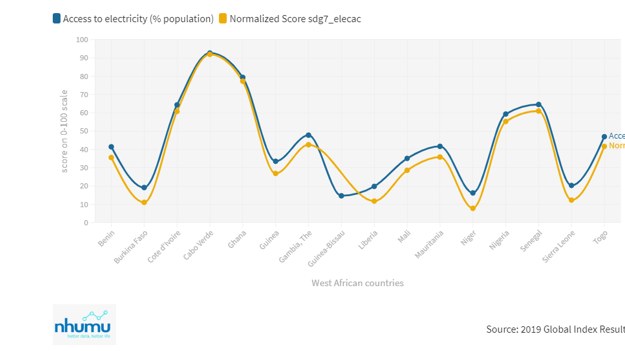
to electricity (% population) in 2019
Year 2020 target out of touch
Ghana back in 1989 committed to universal access to electricity by 2020, when only 15-20 per cent of the population had access to electricity. The National Electrification Master Plan according to the paper provided electricity to 82.5 per cent of the population until end of 2016. Four years on now, the per cent of coverage is 79.30
Why is access to electricity a must for sustainable development?
Electricity according to the World Bank, is the second most important constraint to business activities. At the time the world is reeling with the covid-19 pandemic, electricity stands out as a critical utility for health facilities.
It is equally strategic to foster any industry and advance other human activities.
Renewable energy
Electricity generation in Ghana is provided through hydro and thermal sources. Given the environmental damages and the high cost for electricity attached to the installation of the two sources, renewable energy can help close the gap in providing affordable energy to the populations.
Ghana’s solar market is relatively untapped with an immense potential. The monthly average solar irradiation is between 4.4 and 5.6 kWh/m2 /day (16-20 MJ/m/day), with sunshine duration of between 1,800 and 3,000 hours per annum according to Business Opportunities for Renewable Energy in Ghana report produced by the Dutch embassy, in March 2016.
Few initiatives by the Ghanaian government coupled with private ventures have undertaken and started producing electricity from solar farms but the projects have been insufficient to replace hydro and thermal installations for electricity.
Non-Governmental Organizations (NGOs), businesses and civil society groups can a play role to help cover the remaining of the Ghanaian population still unable to afford electricity thanks to the existing pro-renewable energy policies namely the Renewable Energy Act, 2011, Act 832.
For more information, contact +223 59 116 9800
Latest Stories
-
“The Darkest Chapter”: Latif Abubakar’s 21st production brings President Mahama’s UN reckoning to the National Theatre stage
3 minutes -
Teacher, three others investigated over alleged kidnapping of suspected MoMo fraudster in Kumasi
4 minutes -
Afenyo-Markin mourns Bernice Offei, describes her songs as ‘sermons set to music’
4 minutes -
Don’t just learn AI tools, use them to improve productivity – ALX Enterprise
11 minutes -
Free rabies vaccination campaign targets 25,000 dogs and cats nationwide
17 minutes -
Ghana needs a system to track child protection funding to where risks are highest – ARK Foundation
20 minutes -
AI may not replace humans, but workers who fail to adapt could lose jobs – ALX Enterprise
22 minutes -
Gideon Boako: Bretton Woods is fraying; Ghana has built a bridge
23 minutes -
Ghana’s child protection system failing children despite laws and policies – ARK Foundation
24 minutes -
‘Future of Black Queens is safe for many years’ – Black Princesses boss Charles Sampson
28 minutes -
Titus Glover questions Laboma Beach demolition, proposes widening Kpeshie Lagoon outlet
28 minutes -
NACOC arrests 3 suspects linked to Dutch fugitive drug kingpin
49 minutes -
Workers must complement AI skills with professional expertise to remain relevant – ALX Enterprise
1 hour -
Companies that delay AI adoption risk losing market opportunities – ALX Enterprise
1 hour -
‘The future is bright’ – Gyan backs Black Princesses squad after U-20 World Cup exit
1 hour