

Audio By Carbonatix
Members of the United Nations Working Group on the Rights of Peasants have raised concerns over worsening conditions facing Ghana’s rural communities, warning that weak enforcement of laws, environmental destruction and policy gaps are threatening livelihoods, food security and social stability.
The concerns emerged during the Group’s recent country visit, where engagements with farmers, fishers and pastoralist communities revealed what it described as a growing disconnect between Ghana’s legal protections and the realities confronting rural populations.
At the centre of the concerns is land access and ownership.
According to the Working Group, Ghana’s plural land tenure system — where customary and statutory systems coexist — continues to create uncertainty, particularly in rapidly developing rural and peri-urban areas.
Although the Land Act, 2020 provides accountability measures, the Group said enforcement remains inconsistent, exposing many smallholder farmers to displacement and livelihood loss as land becomes increasingly commercialised.
The Group noted that while legal remedies exist, many vulnerable farmers struggle to access them due to high costs, limited information and unequal power dynamics.
Women and young people were identified as among the hardest hit.
Despite playing key roles in agriculture and fisheries, many women continue to face exclusion from land ownership and decision-making because of entrenched social norms and structural barriers.
The Working Group also highlighted the plight of older women farmers, some of whom face displacement linked to witchcraft accusations and social exclusion.
Climate change and illegal mining, widely known in Ghana as galamsey, were also cited as major drivers of the crisis.
The Group warned that erratic rainfall, declining fish stocks, shrinking grazing lands and repeated crop failures are already affecting food production systems across the country.
These pressures, it said, are being worsened by weak infrastructure, poor storage systems and limited access to climate information and financing.
At the same time, illegal mining activities continue to destroy farmlands and pollute water bodies through the use of toxic substances such as mercury and cyanide.
The Working Group said the effects of galamsey now extend beyond mining communities and have become a national security, public health and food security concern.
While acknowledging that illegal mining provides short-term income opportunities for some young people, the Group stressed that the situation reflects broader structural failures in job creation and sustainable livelihoods.
It called for stronger political commitment to address both the economic drivers and vested interests sustaining the practice, insisting that enforcement alone will not solve the problem.
The Group, however, commended Otumfuo Osei Tutu II for his public opposition to illegal mining, describing his stance as an example of how traditional leadership can support national efforts to tackle environmental destruction.
Another major area of concern was Ghana’s evolving seed policy framework.
While government policy currently supports traditional seed systems, the Group warned that recent reforms increasingly favour certified and commercial seed varieties, potentially undermining farmers’ rights to save, exchange and reuse indigenous seeds.
Concerns have also been raised over ongoing debates surrounding genetically modified crops, including GM cowpea trials.
Speaking on the issue, Geneviève Savigny cautioned that Ghana’s seed policy reforms must balance innovation with the protection of farmers’ rights and indigenous knowledge systems.
“Seed governance must not exclude farmers, but instead actively involve them in shaping policies that directly affect their livelihoods,” she said.
According to her, restrictions on non-certified seeds and the growing influence of biotechnology policies risk weakening traditional farming systems that have sustained communities for generations.
The Working Group further pointed to long-standing market challenges confronting farmers and fishers, including poor road networks, inadequate storage facilities and exploitative supply chains dominated by middlemen.
Access to credit also remains a major challenge, particularly for smallholder farmers and artisanal fishers who often lack the collateral required by formal financial institutions.
In the fisheries sector, the Group warned that illegal practices such as light fishing and the use of harmful chemicals are contributing to declining fish stocks and threatening coastal livelihoods.
Women involved in fish processing and marketing were also said to face limited access to finance and exclusion from governance structures.
The Group noted that while the Fisheries and Aquaculture Act 2025 signals progress, effective implementation remains critical.
Pastoralist communities, especially Fulbe herders, were also identified as facing deep structural exclusion due to weak legal protections, poor documentation systems and increasing land-use conflicts with farming communities.
The Working Group called for improved land-use planning, stronger mediation systems and greater inclusion of pastoralists in national policy discussions.
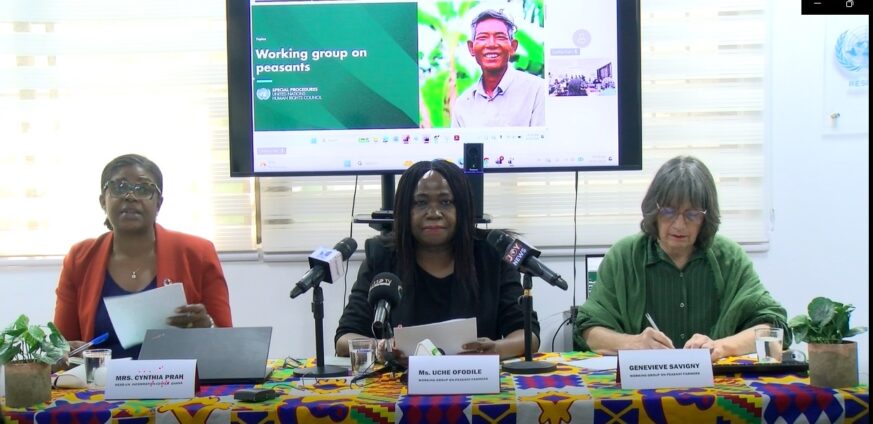
Presenting the preliminary findings on May 14, 2026, Africa Representative of the UN Working Group on the Rights of Peasants, Professor Uche Ofodiye, said the issues raised extend far beyond agriculture.
According to her, the challenges have implications for national security, youth employment, public health and Ghana’s long-term food sovereignty.
She stressed that Ghana’s biggest challenge is not the absence of laws or policies, but the urgency of translating them into meaningful change for rural populations.
Latest Stories
-
Conflicts among care providers linked to maternal, neonatal deaths – Expert
2 hours -
GIS marks 10th TIME conference, champions improved teaching practices
2 hours -
BRICS Or Balance? What Ghana’s bid really means
2 hours -
GPRTU wants full TRAFFITECH-GH implementation to start in 2027
2 hours -
Mahama announces plans to import electric wheelchairs for PWDs
2 hours -
KGL U17 Colts 2026: Western beat Prempeh Elite Academy to set up final final with Greater Accra Region
3 hours -
Late Solanke strike salvages 10-man Spurs draw at Man United
3 hours -
Gender Ministry to monitor welfare of Nana Akua Addo’s children amid domestic violence case
3 hours -
Benedict Okyere Yeboah: Ghana’s football problem goes beyond sacking a coach
3 hours -
GPL 2026/27: Darkwah Wiafe’s winner sees All Blacks beat Kotoko
3 hours -
ITF World Tour : Patel Wins Boys’ Singles Final at J100 Accra
3 hours -
Ghana must pursue BRICS partnership if it brings economic benefits – Kpebu
4 hours -
Success and Wright Claims J100 Accra Girls’ Doubles Championship
4 hours -
ITF J100: America’s Wright wins J100 Accra Girls’ Singles Title
4 hours -
Expedition hopes to find aviator Amelia Earhart’s plane on remote island
4 hours