

Audio By Carbonatix
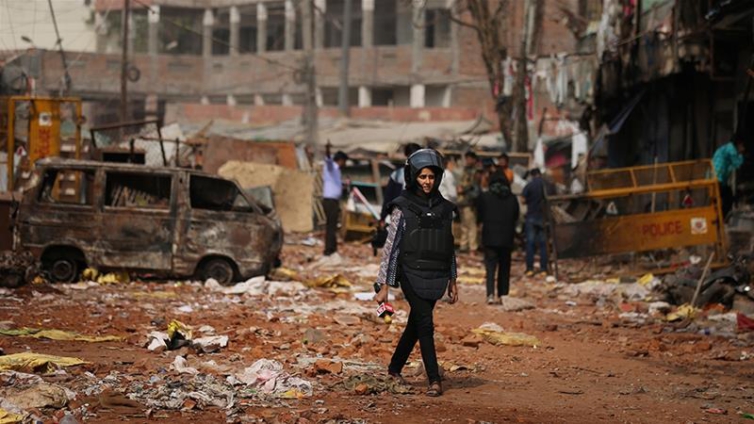
Indian police have filed charges against 15 people over Hindu-Muslim riots in the capital, a spokesman said on Thursday, prompting criticism from rights groups that authorities were targeting the opposition and minority Muslims.
February's violence killed more than 50 people and drove thousands from their homes, most of them members of the Muslim minority, which forms about 15 percent of the country's roughly 1.3 billion population.
The riots followed months of protests against a new citizenship law that critics say discriminates against Muslims. The Citizenship Amendment Act (CAA), passed last December, fast-tracks nationality for minorities from three neighbouring countries but excludes Muslims.
The charges were filed in a court in eastern New Delhi, said police spokesman Anil Mittal, adding that the evidence against the accused runs to more than 17,000 pages.
Mittal did not identify those charged, but domestic media have named former members of two opposition parties and academics at one of the main protest sites, the Muslim-dominated university of Jamia Millia Islamia.
Arbitrary arrests
"By arbitrarily arresting outspoken activists, the government is not only attempting to silence dissent but also sending a message to supporters that they have free rein to commit abuses against minority communities," said Meenakshi Ganguly, South Asia director of New York-based Human Rights Watch.
Why is India’s citizenship law causing so much anger?| Start Here
Prashant Bhushan, a Supreme Court lawyer and vocal government critic, said the charge-sheet was "farcical".
Broadcaster NDTV called the investigation a "whitewash", adding that several members of the ruling Hindu nationalist Bharatiya Janata Party made incendiary speeches hours before February's riots but had escaped censure.
Amnesty International India in its report published last month accused Delhi police of "complicity and bias" in the February violence.
The government and Delhi police have defended their handling of the case, saying those involved in the riots will be punished regardless of political or religious ties.
This latest move follows the arrest of a former student leader who was arrested on Sunday for his alleged role in the February violence, a move denounced by activists as "a witch-hunt exercise".
Umar Khalid, 33, was arrested under the stringent Unlawful Activities (Prevention) Act (UAPA) in connection with the riots.
Legal experts have questioned the police's application of the UAPA on students and activists, as the law reduces the scope for bail, meaning jail terms without trial.
Latest Stories
-
British couple on honeymoon killed in helicopter crash on Greek island
3 minutes -
Man, 20, drowns while helping travellers cross Ghana-Togo border river
12 minutes -
Top 10 online bill payment platforms in Nigeria
17 minutes -
Fire destroys more than 27 wooden structures at Spintex Coastal junction
20 minutes -
GoldBod: Day of reckoning will come – Afenyo-Markin
23 minutes -
In Photos: Defence Ministry welcomes Kenneth Gilbert Adjei as new Defence Minister
33 minutes -
CSA fines EY Ghana GH¢360,000 for providing cybersecurity services without a licence
41 minutes -
Bonsu Baah scores and assists in Al Qadsiah big win in Saudi King’s Cup
41 minutes -
The Galamsey war and GWL’s fictitious and inaccurate rebuttal
54 minutes -
Afenyo-Markin demands answers over alleged GH¢22bn GoldBod loss
55 minutes -
GoldBod ‘Losses’: We’re not ignorant, we know our job – Afenyo-Markin
58 minutes -
GoldBod cannot hide behind agency role to escape accountability – Afenyo-Markin
1 hour -
‘You don’t get to keep the fees and disown the costs’ – Afenyo-Markin challenges GoldBod
1 hour -
GNPC turns 40, targets oil production recovery and $3.5bn fresh investment
1 hour -
Minority will speak boldly on GoldBod losses despite attacks – Afenyo-Markin vows
1 hour