

Audio By Carbonatix
Sets of 120,000-year-old footprints belonging to humans have been discovered in Saudi Arabia.
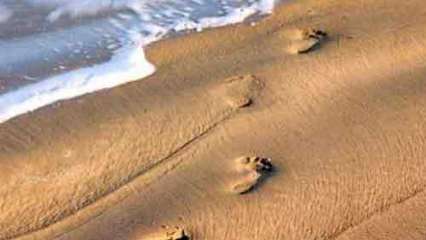
The set of seven human footprints, found around an ancient dry lake in the northern region of Tabuk, are the earliest evidence of humans in the Arabian peninsula.
Experts believe they are the footprints of at least two people, and say they could help understand the routes taken by humans out of Africa.
The new research suggests "inland routes, following lakes and rivers, may have been particularly important to humans" leaving the continent, according to Mathew Stewart from the Max Planck Institute for Chemical Ecology.
The “first genuine human footprints of Arabia” have been identified and dated to around 120,000 years ago. https://t.co/yQjA2CTDCC
— News from Science (@NewsfromScience) September 18, 2020
He added: "Footprints are a unique form of fossil evidence in that they provide snapshots in time, typically representing a few hours or days, a resolution we tend not to get from other records."Advertisement
The researchers think the footprints belong to modern humans, on the basis of stature and mass inferred from them, rather than Neanderthals, who aren't known to have been in the region at the time.
Mr Stewart said: "We know that humans were visiting this lake at the same time these animals were, and, unusually for the area, there's no stone tools.
"It appears that these people were visiting the lake for water resources and just to forage at the same time as the animals."
Footprints of elephants and other animals were also identified alongside 233 fossils.
Human and animal footprints dating back 120,000 years have been found in the province of Tabuk, north-western Saudi Arabia. https://t.co/TZ4thL6YQO
— Gulf News (@gulf_news) September 17, 2020
Today, the Arabian peninsula consists of vast deserts which would have been uninhabitable for early humans and the animals that they hunted.
However, over the last decade, researchers have found that the area experienced much greener and humid conditions due to natural variation in the climate.
Richard Clark-Wilson, from Royal Holloway, University of London, said: "At certain times in the past, the deserts that dominate the interior of the peninsula transformed into expansive grasslands with permanent freshwater lakes and rivers."
"The presence of large animals such as elephants and hippos, together with open grasslands and large water resources, may have made northern Arabia a particularly attractive place to humans moving between Africa and Eurasia," added Michael Petraglia, from the Max Planck Institute for the Science of Human History.
Latest Stories
-
ICC London rules in favor of Ghana against Tullow over $400m tax charge
8 minutes -
We are disappointed in ICC’s ruling over our corporate income tax assessment in Ghana – Tullow Oil
18 minutes -
Cost of building inflation for August 2026 increases to 4.6% – GSS
19 minutes -
Today’s front pages: Wednesday, September 30, 2026
50 minutes -
Bawumia highlights agricultural, compulsory insurance reforms in IBAG engagement
51 minutes -
Ghana will secure Tullow tax revenues while protecting Jubilee, TEN investments – Ato Forson
60 minutes -
Ghana wins $393m Tullow tax arbitration as tribunal upholds GRA assessment
1 hour -
Gender Minister assures women’s group of action on Affirmative Action, Development Bank
2 hours -
Over 2,000 teachers in Dormaa comply with strike – GNAT Secretary
2 hours -
Food Buffer Stock seeks stronger liquidity buffer despite record profit
2 hours -
LPG investments key to achieving 50% access target by 2030 – Energy Minister
2 hours -
Jinapor: New LPG terminal strengthens Ghana’s energy security
2 hours -
Agbodza directs road agencies to fast-track design approvals to prevent project delays
2 hours -
Housing Minister urges stakeholders to prioritise quality education in Banda District
2 hours -
Government redeems pledge to complete abandoned projects – Kofi Buah
2 hours