

Audio By Carbonatix
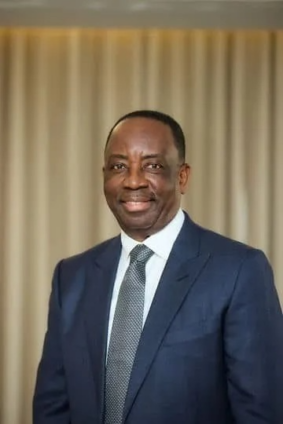
The Executive Chairman of KGL Group, Alex Apau Dadey, has called for a deliberate effort to build globally competitive African enterprises capable of transforming local economies and positioning the continent as a major force in the global economy.
Speaking at the 10th Ghana CEO Summit and Expo in Accra on the theme "Raising African Champions: Leadership, Resilience and Industrial Scale—Lessons from Ghana's Business Transformation," Mr. Dadey argued that Africa's future prosperity will depend not on its natural resources or population size, but on its ability to build enduring institutions and indigenous business champions.
According to him, Africa has spent decades being described as a continent of immense potential, rich resources, and entrepreneurial energy, but the time has come to move beyond promise and focus on building globally competitive enterprises.
"There comes a defining moment in the journey of every nation and every continent when it must confront a fundamental question: Are we content with merely participating in the global economy, or are we prepared to build African institutions, enterprises, and business champions capable of competing globally while transforming our economies locally?" he asked.
Mr. Dadey stressed that economic transformation throughout history has been driven by strong indigenous enterprises and institutions rather than natural resources alone.
"The truth is, natural resources and population size do not transform nations. Potential alone has never transformed a nation. Institutions do. What Africa and Ghana must now produce intentionally and at scale are enduring institutions," he stated.
Drawing from nearly three decades of experience across different markets and business cycles, the KGL Group Executive Chairman said African leaders must focus on building transgenerational businesses with strong governance structures, industrial capacity, and innovation.
He noted that while CEOs manage companies, business champions transform economies.
"A CEO manages an enterprise or a company. But a business champion transforms an economy. The distinction is important," he said.
Reflecting on his own journey, Mr. Dadey disclosed that after spending nearly 30 years building a successful corporate and entrepreneurial career in the United Kingdom, he made a deliberate decision to return to Ghana because he believed African-owned businesses could build world-class institutions.
"I returned to Ghana because I believed that African-owned enterprises could build world-class institutions powered by technology, governance, disciplined execution, and long-term strategic vision," he explained.
He said KGL Group invested heavily in governance systems, technology, and long-term planning despite operating in a challenging business environment.
"What began as a Ghanaian enterprise with a bold vision has steadily evolved into something much bigger, a truly African story of ambition, resilience, innovation, and continental transformation," he said.
Today, KGL Group operates in more than 10 African markets, including Côte d'Ivoire, Nigeria, and Liberia, while pursuing expansion opportunities in East Africa.
Mr. Dadey emphasised that successful African enterprises must go beyond extracting value and instead reinvest in the broader ecosystem to stimulate economic growth.
He revealed that through KGL Capital, the group's investment arm, millions of dollars have been invested in startups, emerging businesses, and struggling enterprises across Africa and beyond.
"Our journey reinforced a critical lesson. Building an African champion requires more than capital. It requires resilience, institutional discipline, and innovation. It requires governance credibility and technological adaptation. Above all, it requires long-term strategic thinking," he noted.
Despite the progress made by indigenous businesses, Mr. Dadey highlighted persistent challenges, including limited access to patient capital, regulatory complexities, and infrastructure deficits.
He urged policymakers and regulators to adopt a balanced and consistent approach toward indigenous businesses, arguing that successful local enterprises should be viewed as national assets rather than targets of suspicion.
"As an indigenous company begins to scale, scrutiny naturally intensifies, and rightly so. But in some instances, scrutiny evolves into suspicion. Scale begins to be viewed not as a national asset to be strengthened, but as something to be contained," he observed.
He stressed that accountability remains essential for all businesses, but must be applied fairly and consistently.
"Accountability is not optional. It is foundational. But accountability must also be consistent. "It must be predictable, proportionate, and institutionally mature," he said.
Mr. Dadey further called for equal treatment of indigenous firms and foreign multinationals, noting that local companies often face harsher scrutiny despite their contributions to job creation, investment, and tax revenue.
As evidence of KGL Group's commitment to national development, he disclosed that one of the group's subsidiaries had recently paid more than $153 million in taxes, exceeding an earlier commitment made to the government.
"We will continue to support the system. We will be announcing another significant tax payment for a second company within the next month," he revealed.
He concluded by urging business leaders, policymakers, and investors to work together to build African enterprises capable of competing globally while driving sustainable economic transformation across the continent.
According to him, Africa's next phase of development will be determined not by its potential but by its ability to create strong institutions, resilient businesses, and globally competitive champions that retain value on the continent and contribute meaningfully to national development.
Latest Stories
-
Power restoration fault suspected in Kumasi Central Market fire
2 hours -
The 7-foot giant of Ngleshie Amanfro: Seven-foot Ghanaian Ephraim Saawa dreams of joining the national basketball team
3 hours -
Government promises support for Kumasi Central Market fire victims
3 hours -
Vibes The Movie: Big Ghun’s Ghanaian film earns five nominations at 2026 REFFA
4 hours -
MamaCare CEO warns unresolved conflicts among health workers could undermine maternal and neonatal care
4 hours -
Health professionals urged to translate medical knowledge into practice to save mothers
4 hours -
Conflicts among care providers linked to maternal, neonatal deaths – Expert
6 hours -
GIS marks 10th TIME conference, champions improved teaching practices
6 hours -
BRICS Or Balance? What Ghana’s bid really means
6 hours -
GPRTU wants full TRAFFITECH-GH implementation to start in 2027
6 hours -
Mahama announces plans to import electric wheelchairs for PWDs
7 hours -
KGL U17 Colts 2026: Western beat Prempeh Elite Academy to set up final final with Greater Accra Region
7 hours -
Late Solanke strike salvages 10-man Spurs draw at Man United
7 hours -
Gender Ministry to monitor welfare of Nana Akua Addo’s children amid domestic violence case
7 hours -
Benedict Okyere Yeboah: Ghana’s football problem goes beyond sacking a coach
7 hours