

Audio By Carbonatix
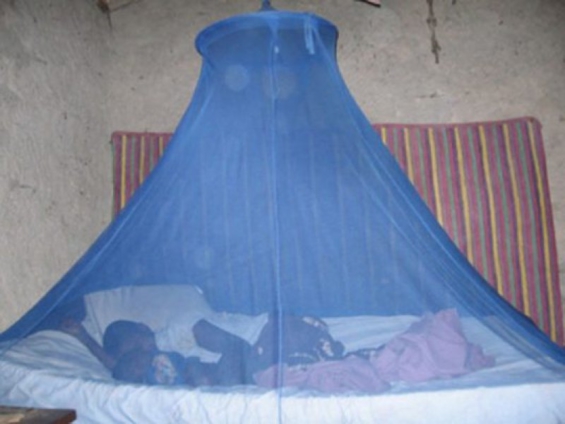
Low usage of Long Lasting Insecticide Treated Bed Nets (LLITNs) identified in New Juaben South Municipality remain a grave challenge to Ghana’s drive in achieving zero malaria.
This is because many people in the Municipal capital, Koforidua, in the Eastern Region, though have access to the treated nets, fail to use them due to social myths and perceptions.
Some claimed they had no space to hang the nets because of their large family sizes, while others said it was uncomfortable sleeping under it as it produced heat.
This came to light in a survey conducted by Ghana News Agency between January and February 2021 in over 12 communities within the Municipality.
The survey sought to establish weather people were using the insecticides bed nets as a form of personal protection to reduce malaria illness, severe disease, and death due to malaria.
In community-wide trials in several African settings, ITNs were shown to reduce the death of children under five years from all causes by about 20 percent.
The survey was part of the National Media Malaria campaign in collaboration with the African Media Malaria Research Network (AMMREN) and the National Malaria Control Programme (NMCP).
Some of the communities surveyed included; Srodae, Betom, Nsukwao, Zongo, Nyamekrom, Densuano, Debrakrom, Apenkwa, Aberewa Nkwanta and Central Business District in the New Juaben South Municipality.
The survey established that almost every household had access to two or more LLITNs distributed freely, mostly through their children in school.
The delivery was done during Child Welfare and Ante-natal clinics and other mass point of distribution programmes by the Ghana Health Service (GHS) in line with planned strategies to reduce malaria burden in communities countrywide.
Madam Aku Doe, a mother of three, said she had about four bed nets during antenatal clinics, while two were given through her children at school.
However, she said she was not using them “due to the heat it generates,” adding, getting space to hang them posed a challenge.
She has therefore opted to burn mosquito coils, as another control measure, to knock down the leeches.
Another mother of four, Madam Rose Doryoe, also said she had two-bed nets but had also chosen to be burning coils orange peels to ward-off mosquitoes.
Madam Rose said she had to burn coils and peels because she slept on floor with her family and also didn’t know how to fix the nets.
A 40-year-old teacher, Mr Charles Derke, with his children said he felt like “sleeping in a coffin” anytime he slept under bed nets. Though, he had more than three pieces of bed nets given to him by GHS, he only used one
sometime ago and had not tried it for his children.
Malaria remains one of the top diseases recorded at Out-Patients-Department in health facilities in the Municipality. In 2018, a total of 37,736 confirmed cases of malaria were recorded.
Reverend Richard Yeboah, Eastern Regional Focal Person for Malaria, said sleeping under treated bed nets was one of the surest ways to prevent malaria.
The public was encouraged to use bed nets to protect them against malaria bites and its transmission. Rev Yeboah also explained that LITNs last three years, hence the rationale behind the mass distribution every three years to ensure every household had access to new ones to replace the old.
He appealed to the public to use the nets for their own safety, and dispelled the popular notion that malaria was not only transmitted by the bite of an infected anopheles mosquito, but through fatigue, walking in sunshine and doing hard work.
He stressed that the NMCP treated bed nets were widely distributed through several means under the mass distribution exercise, which included; schools, health facilities and mass distribution points in communities.
However, he said it was regrettable some people were accosted for using the treated nets for different purposes. In view of the low utilization of bed nets, he said plans were advanced to intensify education in various communities on the need to sleep under treated nets.
He announced that a three-year period of mass distribution of treated insecticides bed nets would be rolled out soon.
Latest Stories
-
Muzic Mensah finds healing and renewed love in new single ‘WayƐ Late’
48 seconds -
FIFA to offer extra £2.6bn for football development
3 minutes -
Government backing is no EPA permit – Authority warns GoldBod, ministries
11 minutes -
Real Madrid produce stunning late fightback to down Roma
23 minutes -
EPA orders immediate halt to unpermitted reclamation and dredging nationwide
32 minutes -
Afenyo-Markin’s lawsuit against Sammy Gyamfi takes focus away from development – Kpebu
47 minutes -
FWSC urges media to guard against misinformation in proposed IPEC transition
47 minutes -
MoMo Fest 2026: Shatta Wale to Rock Accra Stadium on October 17
49 minutes -
GTEC’s letter directing public universities to reopen by October 16 is unprofessional – GAUA
1 hour -
Suspect in viral video assaulting wife jailed for 3 months
1 hour -
GAUA insists strike will end only after Fair Wages addresses market premium issue
1 hour -
Kpemka seeks compensation as he sues BOST over alleged unlawful termination
1 hour -
GES asks applicants to check status of 2026 promotion applications on October 15
2 hours -
Kobe Boujee joins Olympics.com team for Dakar 2026 Youth Olympic Games
2 hours -
Slaty egret’s shifting nesting sites offer clues to changing ecosystems
2 hours