

Audio By Carbonatix
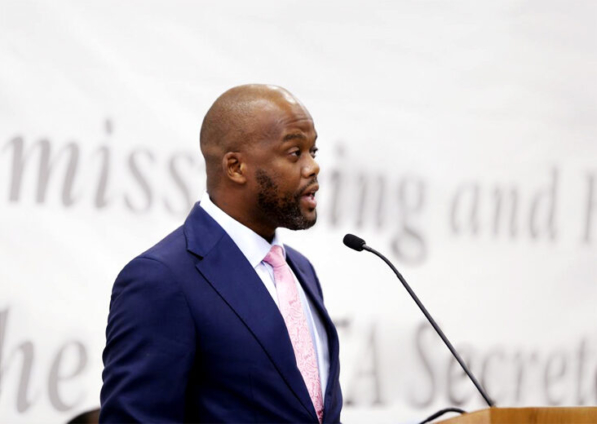
The Secretary-General of the African Continental Free Trade Area (AfCFTA), Wamkele Mene says it is about time Africa moved from being a net importer of refined petroleum products to become a net exporter.
He noted that Africa still exports raw crude oil to the outside world which is refined and sold back to the continent at higher cost.
Mr Mene made these remarks in a keynote address to the Ghana International Petroleum Conference organised by the Ghana Chamber of Bulk Oil Distributors (CBOD).
"The conference was held under the theme 'Positioning the Downstream Petroleum Industry for AfCFTA.'
He noted that so far 36 out of 55 countries in Africa have submitted their instruments of ratifications.
This, he said, “means that these countries have legally accepted the obligations to open their markets to reduce barriers to trade, to reduce barriers to investments and to adhere to a single set of rules for trade and investment on the African continent.”
He added, “This is an unprecedented achievement for Africa, particularly giving the history of Africa’s economic growth in the last 60 years.”
Mr Mene bemoans the continuous use of the colonial economic model of trade in Africa where the continent still engages in the export of raw materials without value addition.
“All of these factors contribute to the very low [rate] of intra-African trade which is 18% as we all know relative to other regions,” he said.
“It is significantly low when you compare that to intra-European trade which is at 40% and above. We in Africa trade more with the rest of the world than we trade amongst ourselves. And this is something that AfCFTA seeks to change in the next 15-30 years.”
Mr Mene stressed that the petroleum industry is the core of Africa’s industrialization drive that will contribute to the continent’s growth and development following the implementation of AfCFTA.
Also addressing the conference, Vice President Dr Mahamudu Bawumia said the success of AfCFTA depends on the collaboration between industry and bureaucrats at the implementation level.
He indicated that as continental multilateral policies are formed, success will always depend on the operational framework and the commitment of all actors.
“AfCFTA is a decision of the Authority of the Heads of States of Africa, but its success depends on the work of industry and the collaboration between industry and bureaucrats at the implementation level,” he said.
“It is for this reason that I find the Ghipcon 2021 theme very relevant and important towards the success of AfCFTA in the petroleum sector.”
According to the vice president, bureaucratic bottlenecks in intra-African trade have set nations apart in the area of economic cooperation and investment.
Dr. Bawumia noted that AfCFTA, however, provides industry with a perfect opportunity to contribute towards the realisation of a first world Africa.
“We trade about 85% with the world and just 15% with ourselves. This is in sharp contrast with trade amongst the EU at 67%, Asia at 61% and 47% in the Americas. This situation must change if we are truly committed to Africa’s economic transformation,” he stressed.
The Vice President noted that Africa has considerable mineral, oil and gas resources that can help accelerate growth if used strategically.
“We are at an economic crossroads, one that needs teamwork to achieve the transformation of our economies for the betterment and sustainability of our people,” he said.
“With all our natural and human resources endowment, we risk an economic catastrophe with many of our teeming youth unemployed and angry if we fail to harness them productively to accelerate growth.”
Dr Bawumia noted that that Africa is responsible for the annual production of much of the world’s natural resource: 9.6% of global crude oil supplies, 80% of platinum, 77% of cobalt, 51% of manganese, 46% of diamonds, 39% of Chromium and 22% of gold.
The challenge, he indicated, is building factories and refineries to add value to the continent’s natural resources.
He called on African nations to work together in the development of regional assets including refineries and logistical assets, to achieve the economies of scale required for commercial viability.
“This drives productivity and puts our able youth to work, which in turn preserves and enriches their dignity,” the vice president said.
Latest Stories
-
NPP Techiman South demands immediate release of detained Nurse Salomey Awiti Baffoe
6 minutes -
‘Let’s stop the politics’ — Dafeamekpor calls for united fight against drug trafficking
7 minutes -
Chief Justice Baffoe-Bonnie leads new 11-member Council for Legal Education and Training Board
12 minutes -
Decades of silent diplomacy: Baba Issifu Kamara at 70
24 minutes -
30% transport fare hike still on the table, talks resume Tuesday – GPRTU
33 minutes -
KATH marks 70th anniversary with inter-directorate games
1 hour -
Black Stars: Godwin Attram replaces Desmond Ofei as assistant coach
1 hour -
Nkrumah never dies
2 hours -
CalBank ‘Abakade Promo’ rewards 5 customers with GH¢25,000 in first draw
2 hours -
Ecobank, Joy Business to host financial dialogue on green finance and inclusive agri-growth in Ghana
2 hours -
Nkrumah’s vision remains relevant to Ghana’s future — Mahama
2 hours -
Hitz FM announces Beach Rave for October 31
3 hours -
CPP calls for protection and revival of state-owned enterprises to honour Nkrumah
3 hours -
emPLE Life Insurance named Rising Brand of the Year at 6th CIIG Insurance Excellence Awards
3 hours -
St Peter’s old boys to build 1,000-seater dining hall and modern kitchen for 70th anniversary
3 hours