

Audio By Carbonatix
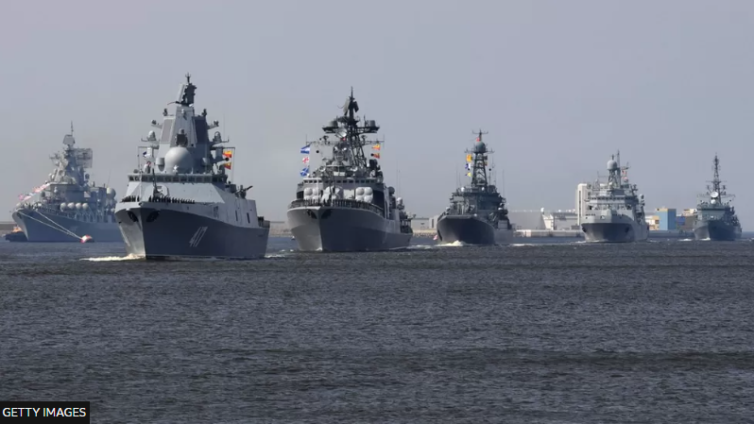
South Africa is due to start a joint military exercise with Russia and China.
The naval drills coincide with the first anniversary of Russia's invasion of Ukraine, and have been criticised by the US.
What are South Africa, Russia and China doing?
The 10-day naval exercise will take place from 17 February in the Indian Ocean, off the South African coast.
The South African National Defence Force (SANDF) says 350 members of its armed forces will take part.
Russia has announced it will send its Admiral Gorshkov warship, which carries Zircon hypersonic missiles. These fly at nine times the speed of sound and have a range of 1,000 km (620 miles).
Moscow "will be trying to show that despite its setbacks in the war in Ukraine, its armed forces are still very powerful", says Denys Reva from South Africa's Institute for Security Studies.
The SANDF has said little about the forthcoming exercise, but a 2019 joint drill between the three countries involved seven ships - one warship from each nation, plus fuelling ships and survey ships.
They practised tackling coastal fires and floods, and recapturing ships from pirates.
Why is this exercise controversial?
A White House spokesperson said in January: "The United States has concerns about any country... exercising with Russia as Russia wages a brutal war against Ukraine."
South Africa previously abstained from a UN vote condemning the invasion. It also refused to join the US and Europe in imposing sanctions on Russia.
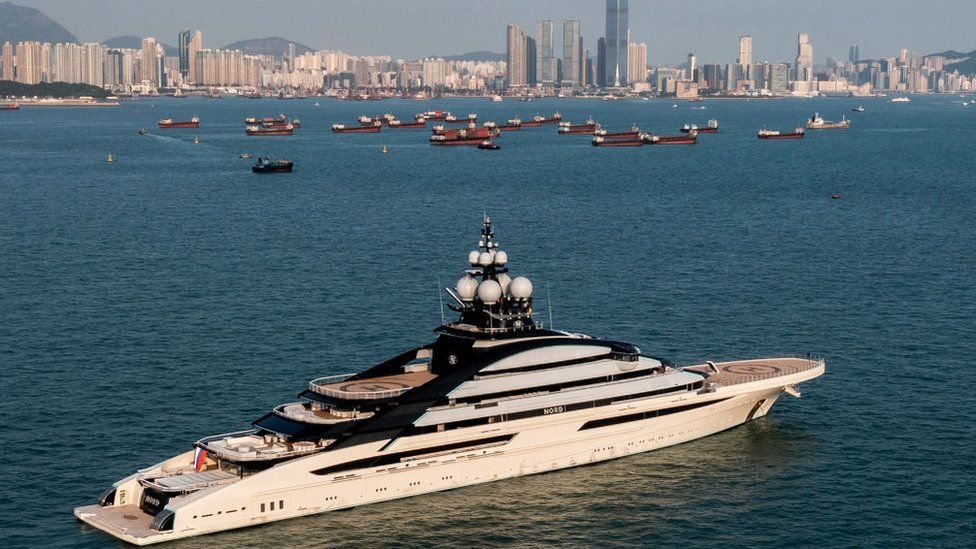
The Nord superyacht, which is linked to the sanctioned Russian oligarch Alexey Mordashov, was allowed to dock in Cape Town.
The sanctioned Russian cargo ship, Lady R, was also allowed to unload supplies at a South African naval base. The government said it contained a delayed order for ammunition.
South Africa points out it has held four joint exercises with the US since 2011, as well as drills with France and Germany.
"All countries conduct military exercises with friends worldwide," said Foreign Minister Naledi Pandor, during a visit to her country by her Russian counterpart Sergey Lavrov in January.
She said that trying to stop South Africa from conducting joint military exercises with the countries of its choice amounted to "an abuse of international practice".
Why is South Africa taking part?
South Africa is also taking part because its armed forces are underfunded and overstretched, according to Elizabeth Sidiropoulos, head of the South African Institute of International Affairs.
The navy's priorities are to protect fisheries in its home waters and combat piracy in the Indian Ocean.
"It needs to team up with other nations to have the capacity to deal with things off its coast such as piracy," she says.
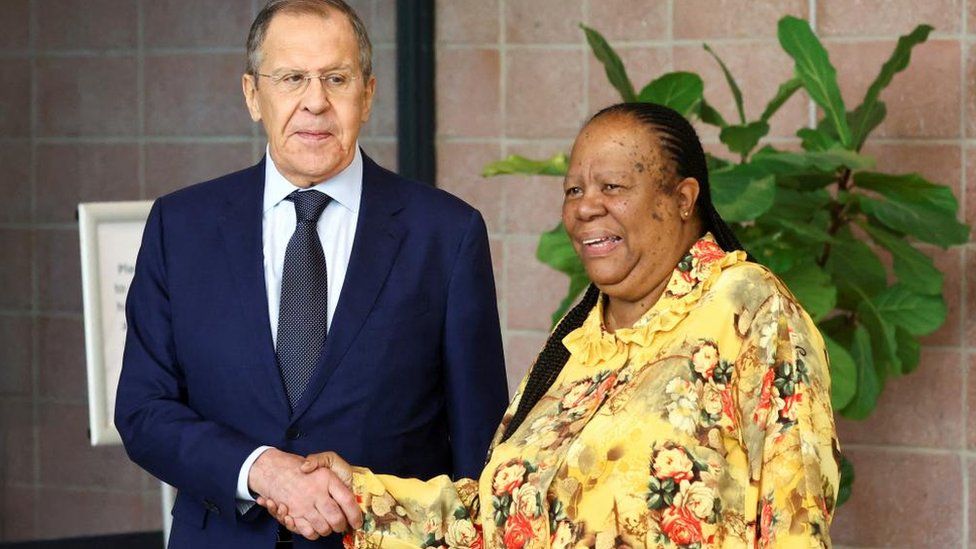
South Africa's governing African National Congress (ANC) also has long-standing ties with Russia.
These date back to the years of white-minority rule before 1994, says Dr Alex Vines from the Chatham House think-tank in London.
"The older leaders in the ANC still have an emotional attachment to Moscow, because it constantly supported their struggle," he says. "That makes it very difficult for South Africa to turn its back on Russia over Ukraine."
Russia, China and South Africa also have modern-day ties because they are all members of the Brics alliance.
The group - which also includes Brazil and India - represents some of the world's leading emerging economies.
What do Russia and China want?
Ms Sidiropoulos says Russia has more to gain than anyone from this year's exercise.
"It shows that Russia can still project its power far away, and that it still has allies around the world.
"It lets them say that it's not the world that's against Russia. Only the West is against Russia."
China is keen to keep shipping lanes open for commercial vessels travelling from its ports to African destinations, says Dr Vines.
It also wants to establish its naval power in the Indian Ocean, off the African coast.
"It's about getting its navy out into international waters.
"China already uses Djibouti on the East African coast as a naval base to combat piracy, and perhaps it is hoping to get more bases."
Latest Stories
-
Video: Immunity should be exercised without creating classism – Inusah Fuseini on cocaine bust
3 minutes -
Ghana Air Force passes out 293 recruits after six months of intensive training
11 minutes -
EOCO vrs Baffour Awuah: EOCO should have secured warrant before arrest attempt at court – Inusah Fuseini
15 minutes -
Triple fibre cuts disrupt telecom services across Northern, Oti regions – Sam George
18 minutes -
Politicisation could undermine parliamentary probe into cocaine seizures – Dr Osae-Kwapong
25 minutes -
EOCO chases MP: Can Section 41 cure lacuna in EOCO Act? – Inusah Fuseini asks
28 minutes -
GNFS, GWL inspect fire hydrants in Ministries enclave; 23 found faulty
33 minutes -
Gov’t directs release of 50,000 bags of grain to ECOWAS
35 minutes -
Ghana, Germany deepen cooperation on railways, labour mobility
40 minutes -
Huge crowds greet Pope in Paris for open-air Mass
51 minutes -
‘I never said I’ll declare a state of emergency’ – President Mahama on galamsey
2 hours -
Bobby Banson condemns EOCO’s attempted arrest of Nana Agyei Baffour Awuah
2 hours -
When Kumasi begins to look like somebody is in charge
2 hours -
Parliamentary probe into cocaine seizure would be a waste of time – Inusah Fuseini
2 hours -
Cocaine seizure: Focus on Ghana’s reputation, not partisan blame – Osae-Kwapong
2 hours