

Audio By Carbonatix
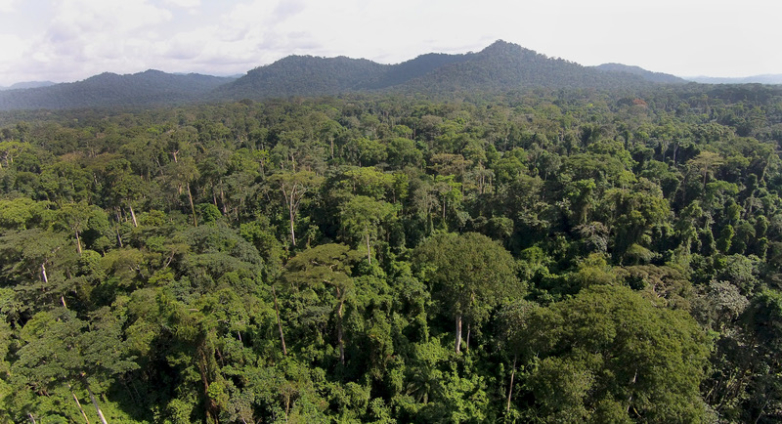
The Congo Basin is the largest forest in Africa and a significantly important carbon storage in the world.
With more than 10,000 plant species in and around the forest, the Basin is referred to as the “green lungs of Africa” – the ecological respiratory organ for the planet.
The rainforest of the Congo basin spans over six countries – Cameroon, Central African Republic, Democratic Republic of the Congo, Equatorial Guinea, Gabon and Republic of the Congo – providing food, freshwater, medicine, security and an essential lifeline for local populations and serves as a critical habitat for endangered species.
But most critically, preserving the rich ecosystem of the Congo Basin is essential in the global efforts to tackle the effects of climate change and biodiversity loss.
The soils and plants of the Congo Basin rainforest store incredible amounts of carbon, preventing it from being emitted into the atmosphere and fueling climate change.
Carbon sinks are natural areas such as oceans and forests, which absorb carbon dioxide (Co2) from the atmosphere, helping to curb global warming.
The Congo Basin, with its dense tropical peatlands, is estimated to pull around 4% of global Co2 emissions out of the atmosphere each year.
Threat of land grabbing and industrial agriculture
Central Africa's rainforest stood at 178 million hectares in 2005.
The African region has lost 65 per cent of its productive land over the last 70 years, whereas the population has grown at least sixfold over the same period.
The Congo Basin is increasingly coming under threat due to deforestation, environmental degradation, growing populations, and the impact of climate change.
Several international fossil fuel and industrial-scale agriculture developers, mostly in rubber and oil palm plantations and, fueling wide-scale deforestation.
The move for land grabbing to exploit Africa’s resources for export has put the Congo Basin under threat. Illegal timber cut in the Basin is exported to the EU, US and China.
Unsustainable and illegal logging in the Congo Basin forest is leading to deforestation, destruction of wildlife habitat, diminished resilience to climate change.
Forest loss in the Congo Basin increased by 5% in 2021. The Democratic Republic of Congo alone lost nearly 500,000 hectares of primary forest in 2021.
The increased loss of biodiversity and threatened species will undermine efforts to protect biodiversity, and of the need to take urgent action to preserve ecosystem services vital to human well-being, including crop pollination, water purification, food security, clean air, flood protection and carbon sequestration.
Of the hundreds of mammal species discovered in the Congo Basin so far — including forest elephants, gorillas, chimpanzees, and okapis — 39 are found nowhere else on earth. Of its estimated 10,000 plant species, 3,300 are also unique to the region.
Conserving the Basin as climate action
The United Nations Environment Assembly recognizes that the Congo Basin peatlands contain a high proportion of organic carbon, making them one of the world's largest carbon sinks, contributing to the mitigation of global climate change.
This is in “considering the benefits and values of Congo Basin peatlands, which sequester more than 31 billion tonnes of carbon and provide vital ecosystem functions and services that reduce the magnitude and mitigate the impact of floods and droughts, preserve biodiversity and provide food and water supplies,” emphasized the African Ministerial Conference on the Environment (AMCEN).
At the recent AMCEN meeting in Addis Ababa, the African Group of Negotiators was urged to continue working with the COP 28 parties and the presidency to reach further decisions that recognize the special needs and circumstances of Africa and “to intensify regional and international collaboration to promote a multi-stakeholder approach to the conservation and sustainable management of peatlands in the Congo Basin, in line with Brazzaville 2018 declaration; adopted at the third meeting of Global Peatlands Initiative partners”.
The leaders also welcomed the initiative of the Republic of Congo to organize the Summit "Amazon - Borneo - Mekong and Southeast Asia - Congo, Summit of the Three Basins of Ecosystems of Biodiversity and Tropical Forests (S3B EBFT)".
This is in order to constitute, through the union of the three basins, a global alliance, biodiversity ecosystems and tropical forests, an Alliance/Coalition with a South-South governance, structuring the three global ecosystems that represent 80% of tropical forests around the world, bringing together 2/3 of terrestrial biodiversity and ensuring the vital role of global regulator of carbon balance and life on earth.
The three basins are expected to capture 80% of the existing and future financial mobilization announced at COP 27 for climate and COP 15 for biodiversity.
Latest Stories
-
Zambians warned not to eat dead wildlife after anthrax kills dozens of animals
21 seconds -
AG urges GBA to remain the conscience of Ghanaian society
13 minutes -
24-Hour Economy: Minority questions demolition of schools, markets and other public assets
15 minutes -
China criticises idea it is in ‘malicious competition’ over AI
17 minutes -
Russia hits Ukrainian train shortly after Boris Johnson and top European officials leave station
17 minutes -
Sista Afia reveals fears about becoming a single mother
21 minutes -
Gov’t 24-Hour Economy markets programme is an afterthought – Minority
22 minutes -
Minority wants traders, residents heard before 24-Hour Market projects
22 minutes -
Minority demands review of 24-Hour Market programme over ‘poor planning’
24 minutes -
GIPS calls for strategic procurement to drive inclusive industrial growth
26 minutes -
Ato Forson leads NDC 2028 flagbearer poll with 32% support – Global InfoAnalytics
29 minutes -
Daily Insight for CEOs: The CEO’s role in building leadership capability
34 minutes -
AG to introduce Legal Practitioners Standard Board Bill in Parliament
43 minutes -
AG proposes Bar Welfare Fund to provide social protection for lawyers
48 minutes -
No conditions attached: Rethinking Ghana’s duty of care for citizens in crisis abroad
49 minutes